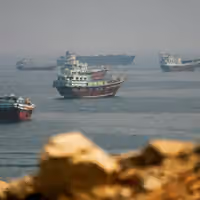
Tehran will assert stronger role in Strait of Hormuz after war, adviser says


An adviser to Iran’s leadership said the country should use the war to reshape its position in the Strait of Hormuz, according to state media on Thursday.
Mohammad Mokhber said the situation offers “one of the most important opportunities” to redefine Iran’s role in the strategic waterway.
“After the imposed war, by defining a new regime for the Strait of Hormuz, Iran will move from being under sanctions to a powerful position in the region and the world,” he said.
He added that Western powers had previously “restricted” Iran but said the outcome of the war could shift that balance.





A projectile that landed near Iran’s Bushehr nuclear power plant likely came from the north rather than the Persian Gulf, David Albright, a former UN nuclear inspector and founder of the Institute for Science and International Security, said on Thursday, citing satellite imagery.
High-resolution images taken on March 18 show an impact around 350 meters from the reactor, with a debris pattern suggesting an incoming projectile from the north, he said.
“This adds Iran to the suspect list, along with Israel and the United States, although an Iranian projectile would certainly have been inadvertent,” Albright said in a post on X.
He echoed calls by International Atomic Energy Agency chief Rafael Grossi to avoid strikes near nuclear facilities and urged that communication channels with Russia remain open to reduce risks.
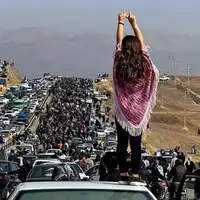
Exiled Queen Farah Pahlavi said on Thursday that this year’s Nowruz coincides with a “great awakening” to reclaim freedom and national dignity in Iran, following the state killings during recent unrest.
“This year’s Nowruz coincides with a great awakening to reclaim freedom and national pride… after the largest street killings by a regressive regime that took thousands of young Iranians from their families,” she said in a message on X.
Pahlavi expressed sympathy for families of those killed, saying she shares “the grief of the survivors” and wished them patience and peace.
She said she hopes Iranians can focus on rebuilding the country and restoring its standing, adding she wishes to see “a free and proud Iran” soon.
Explosions, air activity and security measures were reported in several parts of Iran from late Wednesday into early Thursday, according to eyewitness accounts sent to Iran International.
The southwestern city of Ahvaz, the main city in Khuzestan province, saw fighter jet activity at 5:53 a.m. followed by an explosion around 6:30 a.m. in the Golestan area.
In northern Iran, a strong blast was heard at 5:16 a.m. in Sari, the capital of Mazandaran province. The port city of Bandar Anzali was also hit by what was described as two drone attacks followed by heavy bombardment targeting naval units of the IRGC and the army. Reports said fuel storage sites were damaged and several warships were destroyed.
In central Iran, a police station in Shahin Shahr, near Isfahan, was reported hit on Wednesday evening. Separately, in the southern port city of Bandar Abbas, Basij forces were reported to have set up nighttime checkpoints in an area at the city’s entrance, with armed patrols causing traffic and fear.
Iran’s ambassador to the United Nations said in separate letters to the UN secretary-general and the Security Council president that Qatar, Kuwait and the United Arab Emirates had allowed their territory to be used for attacks against Iran, state media reported on Thursday.
Amir Saeid Iravani said in the letters that any military bases or facilities used to launch or support armed attacks on Iran could be considered legitimate military targets under its right to self-defense. He added that Iran reserved the right to take necessary measures to prevent further casualties and damage.
Iravani also wrote that the UAE’s alleged role in allowing US attacks from its territory had given rise to international responsibility and required reparations, including compensation for all material and moral damage inflicted on Iran.
Iranian Foreign Minister Abbas Araghchi accused French President Emmanuel Macron of failing to condemn US-Israeli strikes on Iran while voicing concern only after Tehran retaliated.
“His current ‘concern’ didn’t follow Israel’s attack on our gas facilities. It follows our retaliation. Sad!” the Iranian foreign minister wrote.
Macron said earlier that he spoke with Qatar’s Emir Sheikh Tamim bin Hamad Al Thani and US President Donald Trump after strikes hit gas production facilities in Iran and Qatar and called for an immediate halt to attacks on civilian infrastructure.
“It is in our common interest to implement, without delay, a moratorium on strikes targeting civilian infrastructure, particularly energy and water supply facilities,” the French president wrote on X.