A drone strike hit the US embassy in Baghdad early Wednesday, with an explosion reported in the area, according to security sources. The attack comes a day after multiple rocket and drone strikes targeted the embassy and a nearby US diplomatic facility.
Security sources said at least three explosive drones targeted a US diplomatic site near Baghdad International Airport, triggering C-RAM air defense systems.
There were no immediate reports of casualties or damage.
US Secretary of State Marco Rubio spoke with UAE Deputy Prime Minister and Minister of Foreign Affairs Sheikh Abdullah bin Zayed Al Nahyan on Tuesday.
Rubio expressed condolences for those killed in Iran’s indiscriminate attacks on the UAE and reaffirmed America’s commitment to the Emirates’ security, State Department readout said.
The IRGC targeted Iran national team striker Sardar Azmoun after he posted images with UAE leaders Mohammed bin Rashid Al Maktoum and Mohammed bin Zayed Al Nahyan, warning of prosecution and potential asset seizure.
Azmoun shared a photo of himself with the UAE rulers on Instagram, writing: “Meeting one of the most successful minds in the world was a pleasure and an honor.”
The IRGC Telegram post framed the visit as collaboration with Iran’s enemies and called for legal action against the player, saying Azmoon remained silent on US and Israeli attacks in the region.
Benjamin Netanyahu said on Tuesday Israeli forces struck targets across Iran and killed two senior officials, telling Iranians to celebrate Nowruz while warning Israel is “watching from above.”
"Our aircraft are hitting the terror operatives on the grounds, in the crossroads, in the city squares. This is meant to enable the brave people of Iran to celebrate the Festival of Fire. So celebrate and Happy Nowruz. We're watching from above," Netanyahu said.
Donald Trump said on Tuesday the United States is “knocking them for a loop” and added Iran now understands it cannot obtain a nuclear weapon, praising the strength of the US military and commending service members for their role in ongoing operations.
“We’re knocking them for a loop. They cannot have a nuclear weapon, and they now understand that very strongly. We have a great country and the most powerful military in the world. I rebuilt it in my first term, and I didn’t expect to have to use it so much in my second. The men and women of our military have my highest respect and admiration," Trump said at the White House.
Nowruz is approaching with far less of its usual energy across Iran this year, as many families abandon long-standing New Year preparations while war, economic strain and an atmosphere of uncertainty dampen the festive mood.
Several Iranians told Iran International that familiar rituals that normally fill homes with activity in the weeks before the holiday have stalled.
“This year we did nothing,” Leila, a 38-year-old resident of Tehran, told Iran International. “We didn’t wash carpets and we didn’t do the house cleaning. Every year I would start from early February, but this year we are just looking at the sky, waiting for the fall of this regime.”
Nowruz, the Persian New Year marking the arrival of spring, has been celebrated for more than 3,000 years across Iran and parts of Central Asia and the Middle East.
The holiday usually falls on March 20 or 21 and begins nearly two weeks of family visits, meals and gatherings.
An Iranian person washes a carpet during traditional spring cleaning, known as khaneh-Tekani, ahead of the Nowruz new year celebrations.
‘Shaking the house’
In most years, the weeks before Nowruz transform daily life across Iran. Families traditionally begin with Khaneh Tekaani, a deep spring cleaning whose name literally means “shaking the house.” Carpets are washed, cupboards reorganized and homes refreshed to symbolically welcome the new year.
Another essential ritual is planting Sabzeh — dishes of sprouting wheat, lentils or barley that represent renewal and rebirth and are later placed on the Haft-Seen table, the centerpiece of the celebration alongside candles, colored eggs, a mirror and often a red goldfish.
But this year, some residents say even modest traditions feel out of reach.
“Planting Sabzeh is something we Iranians do every year, but this year with all the news about war we completely forgot about it. God damn the Islamic Republic for ruining everything,” Kamran, a 42-year-old office worker in Hamedan, told Iran International.
An Iranian man installs curtains at home as part of preparations ahead of the Nowruz new year celebrations.
‘No money, no mood’
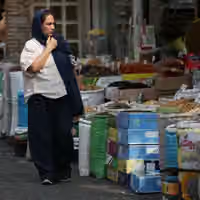
Markets that normally bustle in the run-up to Nowruz — with families buying sweets for visiting relatives, decorative items for Haft-Seen tables and new clothes for children — have also been quieter this year, residents say.
Some cite the worsening economic situation as a key reason holiday traditions have faded.
“Every year despite inflation we bought at least a few things,” said Golnaz, a 35-year-old shop owner in Karaj. “But this year we had neither the money nor the mood. We are waiting for that final moment.”
Golnaz described how rising prices have weighed heavily on households and small businesses.
“Even if we wanted to prepare and had the energy, prices are so high we simply cannot afford it. Everything has become several times more expensive. I run a small cosmetics shop and this month I have not even earned the rent for the store,” she said.
Her husband, who drives for a ride-hailing service, is working less frequently amid fears of bombings and falling demand as more people stay home.
People look at goldfish displayed for sale at a street market ahead of Nowruz celebrations in Tehran.
‘No ordinary time’
On social media, many Iranians say the emotional tone of the season has shifted sharply compared with previous years.
“If things were normal, I should be excited for next week and finishing my preparations. The scent of night-blooming flowers would be filling the house and the holiday sweets would already be in the refrigerator,” one user wrote.
Another reflected on the contrast with childhood memories: “What burns me is that it is the New Year season. People should now have the mood of buying for the holiday and welcoming the new year in Iran. I remember how excited I was as a child. But those feelings slowly died inside me.”
For generations, the approach of Nowruz has filled Iranian homes with cleaning, cooking and preparations symbolizing renewal. This year, residents say those rituals — once a nationwide signal of spring’s arrival — have been overshadowed by war, rising prices and uncertainty about what the new year will bring.
A traditional Haft-Seen table is arranged at a home ahead of Nowruz, the Persian New Year.