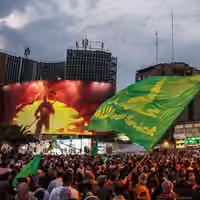
Israel says Larijani, Basij chief killed in major blow to Iran leadership
Iran's former Secretary of the Supreme National Security Council Ali Larijani
Israeli forces killed senior Iranian official Ali Larijani and IRGC-Basij commander Gholamreza Soleimani in overnight airstrikes inside Iran, Israel’s defense minister and military said on Tuesday, as Tehran has yet to confirm the deaths.
Defense Minister Israel Katz said Larijani had been killed in the strikes, while the Israeli military confirmed it targeted him in Tehran. The military separately said a strike killed Soleimani, head of the Basij paramilitary force, along with other senior officials.
Katz used stark language in comments released by his office after a security assessment.
“Larijani and the Basij commander were eliminated overnight and joined the head of the annihilation program, Khamenei, and all the eliminated members of the axis of evil, in the depths of hell,” Katz said.
The Israeli military said Soleimani was struck at a tent camp recently established by the Basij after earlier Israeli attacks damaged several headquarters used by the paramilitary organization.
According to the military, the strike also killed the deputy commander of the Basij and several other senior officials.
The Basij, which operates under the Islamic Revolutionary Guards Corps, has long been associated with the enforcement of ideological policies and the suppression of dissent inside Iran.
The reported killings mark one of the most significant decapitation strikes against Iran’s leadership structure since the outbreak of the current conflict.
Larijani: Insider and wartime power broker
Ali Ardashir Larijani, born on June 3, 1945 in Najaf, Iraq, rose to become one of the most influential figures in the Islamic Republic over four decades.
He came from a clerical family originally from Mazandaran province in northern Iran. His father, Hashem Larijani, was a cleric, and several of his brothers also held senior posts within the Iranian state.
Iran's former Secretary of the Supreme National Security Council Ali Larijani
His political career began in the early years after the 1979 Islamic Revolution, when he joined the Islamic Revolutionary Guards Corps and later moved into government posts.
Larijani served as deputy labor minister and later as deputy minister of information and communications technology before he was appointed in 1994 as the head of the state broadcasting organization, Islamic Republic of Iran Broadcasting (IRIB).
He led the state media network for a decade, a role that gave him a position in shaping the government’s propaganda during a politically turbulent period.
In 2005 he was appointed secretary of the Supreme National Security Council, placing him at the center of Iran’s security policy and nuclear negotiations. In that role he served as Iran’s chief nuclear negotiator in talks with European powers.
Larijani later entered parliamentary politics and became speaker of the Iranian parliament in 2008, a position he held until 2020.
He ran for president in 2005 but finished sixth, and later attempted to run again in 2021 and 2024. Both candidacies were blocked by the Guardian Council, which vets candidates for high office.
In August 2025, he returned to the center of national security policy when he was appointed once again as secretary of the Supreme National Security Council.
Following the death of Supreme Leader Ali Khamenei during the 2026 US-Israeli strikes, some analysts and media reports described Larijani as acting as Iran’s wartime leader, relying on long-standing ties to security institutions and clerical networks.
Iran's former Secretary of the Supreme National Security Council Ali Larijani
The United States imposed sanctions on Larijani in January 2026 over his role in the violent suppression of protests inside Iran.
Iranian on social media blame him as the mastermind behind the massacre of around 36,500 protesters during January uprising. Israeli officials said their overnight strike targeted him in Tehran.
Soleimani: Basij commander
Gholamreza Soleimani, born in 1963 in Farsan in Iran’s Chaharmahal and Bakhtiari province, built his career inside the Islamic Revolutionary Guards Corps and the Basij militia.
Despite sharing the surname, he was not related to Qasem Soleimani, the commander of the Guard’s Quds Force who was killed in a US drone strike in Iraq in January 2020.
Iran's former Basij Cheif Gholamreza Soleimani
Soleimani joined the Basij as a volunteer during the Iran-Iraq War in the 1980s and later became a member of the Revolutionary Guards.
He steadily rose through the ranks and eventually became commander of the Basij Organization in 2019.
The Basij, a paramilitary network with branches across Iran, operates under the authority of the Revolutionary Guards and has played a key role in enforcing ideological policies and mobilizing supporters of the Islamic Republic.
The force has also been widely accused by human rights groups of participating in violent crackdowns on protests.
Soleimani was sanctioned by the European Union in 2021 for his role in the repression of those protests.
The United States Treasury placed him on its Specially Designated Nationals list later the same year.
Additional sanctions were imposed by the United Kingdom and Canada in connection with human rights abuses.
Iran's former Basij Cheif Gholamreza Soleimani
The strikes occurred as Israel and the United States continued a broad aerial campaign against Iranian military and nuclear infrastructure.
Meanwhile, Israeli air defenses detected a new ballistic missile launch from Iran toward northern Israel on Tuesday.