Trump says US not focused on taking Iranian uranium ‘for now’
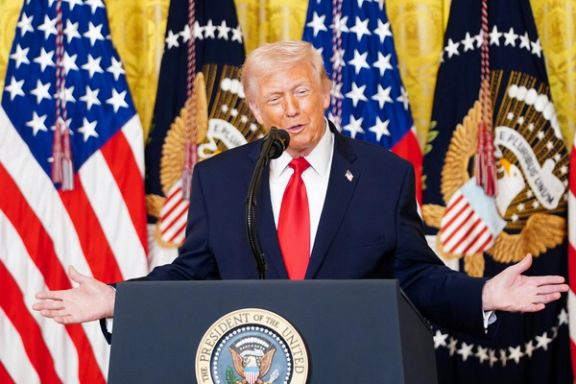
US President Donald Trump said Washington is not currently focused on an operation to take Iran’s uranium but suggested it could become an option later.
“Not focused on it, but at some point we might be,” Trump said in an interview with Fox News Radio’s The Brian Kilmeade Show.
All six crew members aboard a US KC-135 refueling aircraft that went down in western Iraq have been confirmed dead, US Central Command said on Friday.
The aircraft was lost on March 12 while flying over friendly airspace during Operation Epic Fury, CENTCOM said in a statement.
Officials said the circumstances of the incident remain under investigation but that the crash was not caused by hostile or friendly fire.
The identities of the service members will be released after their families have been notified, the statement said.
As Mojtaba Khamenei’s first public message was delivered Thursday following days of absence, Iranian newspapers and semi-independent websites moved to reinforce his image as a wartime leader.
The statement, read aloud by a state television anchor over a still photograph of the new leader, called for continued military resistance and said the Strait of Hormuz should remain a tool of pressure.
“The demand of the masses of the people is the continuation of effective and regret-inducing defense,” the message said. Khamenei has remained largely absent from public view amid persistent questions about his health and whereabouts and unconfirmed reports he was hospitalized with injuries.
In their Wednesday, March 11 editions, newspapers and websites had already begun shifting their focus from the mechanics of succession to projecting authority during an active conflict. The pivot came despite the information blackout inside Iran and Mojtaba’s continued silence at the time.
In the first two days after Ali Khamenei’s death on February 28, coverage largely emphasized Mojtaba’s religious credentials and lineage. By midweek, however, newspapers and websites had turned toward portraying him primarily as a wartime commander.
Continuity and defiance
Kayhan, closely linked to the former leader’s office, referred to him as “the general of the revolution,” highlighting his long-standing but largely hidden ties to the IRGC.
Conservative outlets and several mainstream websites dropped the respectful title ‘Agha’ (sir/master) traditionally used for the son of an ayatollah. Some instead adopted ‘Imam’ or ‘Ayatollah’, reflecting his rapid elevation to the highest clerical and political rank.
Front pages were dominated by pledges of allegiance from military commanders, clerics, bureaucrats and cultural figures.
The Tehran Times reinforced the continuity narrative with its headline, “Trump is gone, Khamenei remains,” responding to Donald Trump’s earlier remark that the new leader “would not last long.”
Moderate and reformist outlets such as Etemad offered cautious backing, framing the hereditary succession as a stabilizing step that prevented a dangerous power vacuum during wartime.
Mentions of dissent or possible unrest were absent, with coverage unfolding inside a tightly controlled information environment.
Manufactured unity
Hardline outlets such as Kayhan and Tasnim framed the succession as a strategic defeat for the United States and Israel, arguing that Ali Khamenei’s killing was meant to trigger systemic collapse and that Mojtaba’s swift appointment demonstrated the system’s resilience.
Some columnists also sought to recast Mojtaba as a capable executive, describing him as a “silent reformer” suited to confront corruption inside the state.
Official websites and IRGC-affiliated Telegram channels amplified the message with pledges of loyalty from generals, clerics and even former political rivals such as Ali Larijani.
Wartime iconography—including posters merging the faces of Khomeini, Ali Khamenei and Mojtaba—reinforced a narrative of continuity and unity.
State media repeatedly warned that public skepticism at this stage could amount to collaboration with the “Zionist enemy,” underscoring the narrow space for dissent as the new leadership consolidates power.
A senior United Arab Emirates diplomat said Iran must halt attacks on neighboring countries before any mediation efforts can begin, expressing confidence the conflict would eventually end through diplomacy.
“It is difficult to talk about mediation when under attack,” UAE Minister of State Lana Nusseibeh said in an interview on Friday. “Mediation can only happen when the guns go silent.”
Nusseibeh said she believed US President Donald Trump would ultimately lead efforts toward a diplomatic end to the war with Iran.
“Ultimately, it will be a diplomatic solution, but there needs to be that tipping point moment, and I think President Trump will lead us all to that moment in his time,” she said.
She also said Iran’s attacks on Persian Gulf states, including the UAE, had been “so shocking and so egregious,” noting they came despite recent diplomatic contacts with Tehran before the conflict erupted.
Iran’s President Masoud Pezeshkian said government policies and international engagements will be fully coordinated with the country’s supreme leader, stressing that the administration would follow the leader’s guidance in all major decisions.
“As the elected representative of the Iranian people and president, I consider it my duty to fully follow the leadership’s guidance,” Pezeshkian said in a message released on Friday.
“No policy in the administration of the country or in international relations will be proposed or pursued by the government without coordination with the leadership,” he added, saying such obedience forms “a foundation of national unity” and will remain a guiding principle of his administration.
Russia’s top nuclear official said on Friday that no changes in radiation levels had been detected following strikes on Iran’s nuclear facilities during the conflict with the United States and Israel.
Alexei Likhachev, head of Russia’s state nuclear corporation Rosatom, said monitoring had not recorded any radiation changes, according to the state news agency RIA.
It was not immediately clear which strikes he was referring to. Iran said last week that its Natanz nuclear facility had been hit during US and Israeli military operations but reported no radioactive leakage.