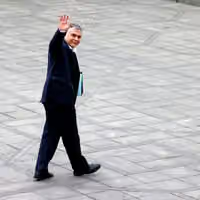
Israel’s Knesset speaker says only ‘unconditional surrender' was offered to Iran


Amir Ohana mocked his Iranian counterpart Mohammad Bagher Ghalibaf on Tuesday, saying the only proposal offered to Iran was "unconditional surrender."
Ohana wrote the comment on X in response to a post by Ghalibaf in which the Iranian parliament speaker said Tehran was not seeking a ceasefire and that the aggressor must be struck.
"Only one thing was offered to you: unconditional surrender," Ohana wrote.




Iran’s Revolutionary Guards threatened to choke off Middle East oil flows on Tuesday if US and Israeli attacks continue, but crude prices fell after President Donald Trump suggested the war with Iran may soon wind down.
A Guards spokesman, responding to Trump, said Washington was lying about conditions in the region and warned that Iran would not allow “one liter of oil” to be exported by hostile states and their partners.
The threat came after Trump warned Tehran against disrupting tanker traffic through the Strait of Hormuz, the world’s most critical oil shipping chokepoint, and said the conflict was moving ahead of schedule.
Trump said the United States would strike Iran “much harder” if it tried to stop oil shipments through Hormuz. He also predicted the war could end before the four-week timeline he had previously outlined.
His remarks helped calm markets after a wild trading session in which Brent surged to as high as $118-$119 a barrel – the highest level since 2022 – before retreating sharply as investors bet Washington may try to contain the economic fallout.
The sharp swings show how the war has thrust the Strait of Hormuz to the center of global energy markets.
Global economic ripple effects
The narrow waterway off Iran’s coast normally carries about a fifth of the world’s oil and liquefied natural gas supplies, but tanker traffic has been severely disrupted for more than a week, forcing Persian Gulf producers to cut output and raising fears of a major supply shock.
Saudi Arabia has reduced production by between 2 million and 2.5 million barrels per day, according to a Bloomberg report, while Iraq has cut output by about 2.9 million barrels per day. The United Arab Emirates has lowered production by up to 800,000 barrels per day and Kuwait by about 500,000 barrels per day.
Saudi Aramco warned on Tuesday that continued disruption to shipping through Hormuz could have “catastrophic consequences” for global oil markets.
The strait is also crucial for natural gas exports. Qatar alone ships roughly 20% of the world’s liquefied natural gas through the corridor, meaning any prolonged closure could affect energy markets far beyond oil.
Rising fuel costs are already feeding fears of renewed inflation worldwide, with analysts warning that sustained oil prices above $100 per barrel could push US gasoline prices toward $4 per gallon and raise costs for air travel, manufacturing and food.
The White House is weighing several options to contain the economic fallout, including releasing strategic oil reserves, easing sanctions on Russian crude and coordinating with allies to stabilize global supply.
The Group of Seven has said it stands ready to take steps to support energy markets, including possible stockpile releases if disruptions continue.
Israel's military said it completed another wave of overnight strikes in Tehran, targeting an underground complex used for weapons research and development.
The military said the site included a tunnel where the Revolutionary Guards carried out tests linked to the development and production of ballistic missiles.
The complex was located inside the Imam Hussein military university used by the Revolutionary Guards for operational activities, the Israeli military said.
Hakan Fidan told his Iranian counterpart Abbas Araghchi on Tuesday that the violation of Turkey's airspace by Iranian ballistic missiles was unacceptable, a Turkish Foreign Ministry source told Reuters.
Araghchi told Fidan that Tehran had carried out a broad investigation into the missiles, the source said.
Fidan also urged all sides to avoid steps that could put civilians at risk and said Ankara would take measures against missiles targeting Turkey.
The Kremlin said on Tuesday that proposals by Russian President Vladimir Putin to mediate and reduce tensions in the Iran conflict remain on the table.
Kremlin spokesperson Dmitry Peskov said Moscow was ready to provide any assistance it could to help ease tensions in the Middle East.
Peskov declined to give details on the ideas Putin raised during a call with US President Donald Trump.
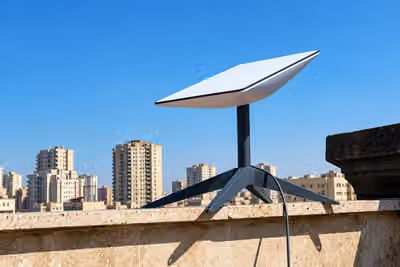
Iran’s government said on Tuesday that it is providing special internet access to select users capable of promoting its messaging online, even as the country remains under what monitoring groups call one of the most severe nationwide internet shutdowns ever recorded.
Much of that privileged access is believed to operate through so-called “white SIM cards” – mobile lines exempt from Iran’s filtering system that allow direct access to blocked platforms such as X, Telegram and Instagram.