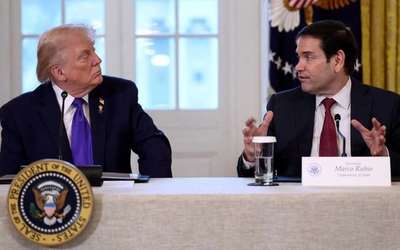
Representative Mariannette Miller-Meeks (R-IA) on Monday advised Iran's leaders to consider a deal with the US, citing military activity in the Strait of Hormuz and President Trump's support for the Iranian people.
"If I were the Mullahs, I would think twice about going forward into conflict," she said.
Protest in Tehran in January 9th, 2026, File photo
From the night of January 9, a family home in western Tehran became an improvised refuge for wounded protesters, operating for 19 consecutive nights as security forces carried out a bloody crackdown that left tens of thousands dead in the streets.
The three-member household - a dentist’s daughter and her elderly parents - treated injured demonstrators with minimal equipment until the last of them was able to leave.
For those struck by live ammunition, they took the added risk of bringing a trusted doctor into their home to remove bullets and continue care.
In the final hours of January 9, wounded protesters began arriving one by one. Some had been hit by pellet or live rounds in the streets; others said they feared arrest if they sought hospital treatment.
Maryam, the daughter, who spoke to Iran International under a pseudonym, said she initially removed superficial pellets herself. But as injuries proved more severe and the number of wounded grew, it became clear that several had been shot with live ammunition and could not safely be transferred to hospital.
“We knew if they went back outside, they might not survive,” she told Iran International.
For nearly three weeks, the house functioned as a makeshift clinic. The wounded slept there, were bandaged and monitored, and underwent procedures on mattresses laid side by side.
Maryam said she saw snipers positioned on rooftops firing live rounds at unarmed protesters. She said plainclothes agents, Basij militia members and other forces affiliated with the Islamic Revolutionary Guard Corps were also shooting at close range.
Shot again in hospitals
A young doctor who assisted at the house said colleagues in several cities told him some wounded protesters were allegedly shot again in hospitals or during transfer.
“It wasn’t one or two cases,” he said. “Reports were coming from every city. People were being sprayed with bullets. Some who reached the hospital with gunshot wounds were later found dead with bullets to the head. It is clear that crimes were committed.”
As the condition of several live-fire victims worsened, those inside debated whether to risk hospital transfer — a step many believed could lead to detention or worse.
They ultimately agreed to bring the doctor to the house, where he remained for several days administering pain relief and extracting bullets with limited supplies.
Will to survive
One protester shot in the leg said he believed he would not survive. Two nights later, the bullet was removed. Before him, others had undergone similar procedures for wounds to their legs, stomachs and hands.
Some left as soon as they were able, fearing identification. Others relocated to different cities rather than return home.
Those sheltering there described nights marked by fear, grief and solidarity. They sang Kurdish, Luri and Azerbaijani songs and mourned those killed. When images of victims from Tehran and other cities appeared on television, they wept together.
The father, Khosrow, said internet and phone disruptions initially left them cut off. Only after satellite reception improved and they were able to watch Iran International did they realize the violence extended beyond their neighborhood.
The house has since returned to daily life. But the family says the memory of those 19 nights — when their home became a refuge for people who could neither remain in the streets nor safely seek hospital care — will not fade.
They insist they did only what they could under the circumstances and say they wish they had been able to save more lives.
US President Donald Trump on Monday categorically rejected media reports about his top general Dan Caine's opposition to any attacks on the Islamic Republic and also allegations about his administration's potential plans for limited military strikes against Iran.
“Numerous stories from the Fake News Media have been circulating stating that General Daniel Caine … is against us going to War with Iran … and is 100% incorrect,” Trump said, dismissing the reports.
“General Caine, like all of us, would like not to see War but, if a decision is made on going against Iran at a Military level, it is his opinion that it will be something easily won,” he added in a post on his Truth Social.
Trump also rejected reporting about internal debate over narrower military options.
“He has not spoken of not doing Iran, or even the fake limited strikes that I have been reading about … he only knows one thing, how to WIN and, if he is told to do so, he will be leading the pack,” Trump said.
He said he would prefer a diplomatic outcome but warned of consequences if talks fail.
“I am the one that makes the decision, I would rather have a Deal than not but, if we don’t make a Deal, it will be a very bad day for that Country and, very sadly, its people,” he said.
The Wall Street Journal reported that Joint Chiefs of Staff Chairman Gen. Dan Caine had raised concerns within the Pentagon and National Security Council about the risks of a prolonged Iran campaign, including US and allied casualties, strained air defenses and overextended forces.
The Washington Post similarly reported that Caine warned Trump and senior officials about munitions shortfalls, operational complexity and limited allied backing, citing people familiar with internal discussions.
Axios reported that Caine had also cautioned that military action could risk dragging the United States into a prolonged conflict, adding that Trump has been leaning toward a strike but agreed to give envoys Steve Witkoff and Jared Kushner more time to pursue negotiations.
Separately, The New York Times reported on Sunday that Trump has been considering launching a limited strike on Iran in the near term to pressure Tehran in nuclear talks, with the possibility of a far broader campaign later if Iran does not concede.
Chairman of the US Joint Chiefs Dan Caine has been advising President Donald Trump and top officials that a military campaign against Iran could carry significant risks, particularly the possibility of becoming entangled in a prolonged conflict, Axios reported citing two sources.
Trump has been leaning towards launching a strike on Iran for several days but agreed to give his chief negotiators Steve Witkoff and Jared Kushner a bit more time for negotiations with Tehran, Axios said citing an informed source.
Trump insisted on more negotiations by Witkoff and Kushner because he wants to make sure all avenues are "exhausted," the report said citing another source.
A 34-year-old mobile phone repair technician has been charged with “enmity against God” (moharebeh), a charge that carries the death penalty under Iranian law, after being arrested during January protests by IRGC’s intelligence arm in Tehran, people familiar with the matter told Iran International.
Mohammadreza Majidi Asl was detained on Friday, January 9, near Jomhoori Street in the capital, the people said, adding that the arrest was carried out violently.
Sources said he was beaten during the arrest and later subjected to pressure and torture in detention to extract a confession.
They said the interrogation process and case-building moved at an unusually fast pace and that he was denied access to a lawyer.
His case has since been reviewed in a short proceeding at Tehran’s Revolutionary Court, sources said.
Majidi Asl has had only limited contact with his family since his arrest, they added, saying that in his last phone call he briefly referred to difficult conditions without providing details.
The Islamic Republic's flag is torn and burned by protesters during campus rallies on February 23, 2026
The burning of the Islamic Republic’s national flag at three Iranian universities on Monday marks a new high in the widening rift between the state and the people.
The protest movement in Iran is no longer selectively targeting certain symbols of the Islamic Republic, as it did a decade ago. It is now challenging everything the Islamic Republic represents, including the national flag itself.
One of the earliest visible signs of this state–society rupture emerged in 2009, when students set fire to a picture of Ayatollah Ruhollah Khomeini, the founder of the 1979 revolution. At the time, the act carried such a strong taboo that opposition leaders suggested it may have been carried out by elements linked to the security apparatus, to justify a harsher crackdown.
Around the same period, protesters began chanting, “No to Gaza, no to Lebanon — my life for Iran,” signaling a shift from the Islamic Republic’s transnational ideology to a national identity.
The Islamic Republic used such displays of anger in state television propaganda to discredit protesters. Yet each time, segments of the public repeated those same acts, turning them into a new front of defiance against the state.
The display of anger soon expanded to other figures — including Supreme Leader Ali Khamenei and senior military figures such as Qassem Soleimani, who had embodied Iran’s extraterritorial revolutionary doctrine. Their posters were torn down and burned.
Public anger even targeted the Iranian national football team during the 2022 World Cup in Qatar, which many Iranians viewed not as a sporting body but as a representative of the Islamic Republic.
For many Iranians, the team’s international presence risked strengthening the state’s domestic legitimacy and global image at a time when large segments of society felt alienated from it.
The depth of the rupture became particularly visible in June 2025, when many Iranians celebrated the killing of senior Iranian military commanders by Israel. Military figures who had been presented as national heroes four decades earlier during the war with Iraq were no longer seen as representing the nation.
Burning the flag
Students at several universities across Iran held protest gatherings for the third consecutive day on Monday, chanting slogans against Khamenei and in support of opposition figure exiled Prince Reza Pahlavi.
During their gatherings, they trampled on the flag of the Islamic Republic and threw it toward members of the security forces. At Amir Kabir University, the University of Tehran, and Alzahra University, students set fire to the flag of the Islamic Republic.
The Islamic Republic tried in 1979 to combine national and Islamic elements in the national flag. It took the colors from the pre-revolutionary flag and added the phrase “Allahu Akbar” in the middle. This is the part that many Iranians no longer sympathize with.
Iranian law does not explicitly criminalize insulting the national flag, but it can be prosecuted since the flag bears the word “Allah,” and insulting Islamic sanctities can carry severe penalties.
Islamic Republic vs. Iran
The Islamic Republic, from the very beginning, showed little regard for many Iranian traditions and symbols. Khomeini and his allies attempted to replace Nowruz new year celebration with Islamic religious holidays, although they failed.
While the White House displays a Nowruz table with traditional symbols, Khamenei delivers his New Year speeches without a Nowruz table, with only a photo of Khomeini in the background.
For many years after the revolution, the national flag did not occupy a central place in the Islamic Republic’s public symbolism.
That changed during the presidency of Mahmoud Ahmadinejad, when the display of flags expanded dramatically. Streets were lined with newly produced, brightly colored flags, and government buildings were draped in national symbols.
This was not merely aesthetic. It coincided with the intensification of the nuclear dispute and a deliberate effort to frame Iran’s nuclear program as a matter of national sovereignty rather than regime ideology.
After the 12-day war with Israel in June, the Islamic Republic made an attempt to revive some of the national symbols and motifs. At one point, after emerging from his war bunker, Khamenei asked a religious singer to perform a song about Iran. But many Iranians saw that as too little, too late.
The resentment between segments of society and the state — and anything associated with it — has intensified to such a degree that long-standing religious funeral traditions have begun to fade. The customary recitation of the Quran at funeral ceremonies has been largely replaced by music, and mourners have even danced at the funerals of victims killed during the January protests.
In certain instances, people have worn white instead of black, returning not to pre-revolutionary but pre-Islamic traditions.