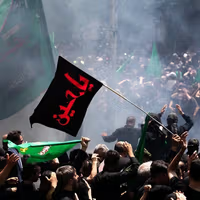
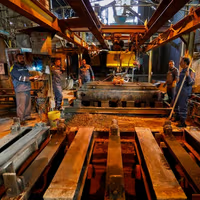
Hundreds of workers have been detained during the nationwide protests in the Shirino area of Kangan, an industrial area in Bushehr province in southern Iran, and are being held in facilities linked to Iran’s Revolutionary Guards, according to a post on X by human rights defender and university professor Hossein Raeesi.
Raeesi said the workers were transferred to warehouses belonging to Omran Sahel, a construction firm affiliated with the Guards’ engineering conglomerate tied to Khatam al-Anbiya Construction Headquarters.
“The lives of all these workers are in danger,” he wrote, adding that they were being held in inhumane conditions without access to basic facilities.
Raeesi added that at least five workers died in the early days of detention as a result of torture.


An Iranian man from the southern port city of Bushehr released a video in English appealing to US President Donald Trump and Western governments to halt any deal with Iran’s ruling establishment before taking his own life.
In the roughly 10-minute video, the man, identified by Iranian media and activists as Pouria Hamidi, said he wanted to draw attention to what he described as a deadly crackdown on protests in Iran and urged Washington not to pursue negotiations with Tehran.
“If you’re watching this, then I’m not around anymore,” he said at the start of the video, adding that he was speaking to raise awareness about a massacre carried out by Iranian authorities during recent unrest.
“More than 40,000 people died, killed, massacred. More than Russia and Ukraine war and more than Israel and Palestine.”
Addressing US leaders directly, Hamidi urged them to abandon diplomacy with Tehran, saying any agreement would “betray all those people who died.”
“So please,” he said. “I beg you, do whatever you can to stop this deal.”
The video, recorded in English, also included appeals for foreign intervention, criticism of Iran’s religious establishment and expressions of support for exiled Prince Reza Pahlavi.
“America attacking the Iran is the only hope we have right now,” he said, adding, “We can't fight this regime alone. Our people need foreign intervention.”
Hamidi described his message as an attempt to give meaning to his life and said he hoped Iranians would support one another.
At the end of the recording, he switched to Persian, saying: “We people of Iran are lonely people and have nobody, so please support each other. Long live Iran.”
Israel remains on high alert as it weighs both the risk of a new military campaign and what it sees as a worse outcome: an agreement with Iran that leaves the ruling system intact, unlocks frozen funds and fails to dismantle Iran’s nuclear and missile capabilities, Israel Hayom reported on Sunday.
“Officially, Israel is currently on the sidelines. Still, it is impossible to miss the high level of alert, not only in anticipation of a possible imminent military campaign. The main concern at present is actually the alternative scenario: an agreement with Iran that leaves the ayatollah regime in place, releases frozen funds, allows a missile program and does not fully eliminate its nuclear project,” read the article.
During that period, Israeli officials are expected to step up diplomatic outreach, intelligence activity and operational planning to persuade US President Donald Trump that there is a “historic window of opportunity” to curb Iran’s threat.
“It is likely that during this time Israel will continue its diplomatic, operational and intelligence blitz in an effort to persuade Trump not to miss what it sees as a historic window of opportunity,” it said.
Those efforts were also expected to shape Netanyahu’s planned meeting with Trump in Washington later this week, the report said.

India’s coast guard said it has seized three oil tankers in the Arabian Sea as part of what it described as a coordinated operation against an international oil-smuggling network, while tanker-tracking analysts and Iranian media said the vessels were linked to Iran.
In a statement posted on social media, the Indian Coast Guard said it intercepted three vessels about 100 nautical miles west of Mumbai on Friday after what it called “tech-enabled surveillance and data-pattern analysis.”
“The syndicate exploited mid-sea transfers in international waters to move cheap oil from conflict-ridden regions to motor tankers, evading duties owed to coastal states,” the coast guard said.
It added that sustained inspections, electronic data checks and crew questioning had revealed the network’s methods and links to what it described as a “global handler network,” and said the vessels were being escorted to Mumbai for further legal action.
The coast guard statement did not mention Iran, the ownership of the vessels, or any sanctions violations.
However, tanker tracking firm TankerTrackers said it had identified the three vessels as AL JAFZIA, ASPHALT STAR and STELLAR RUBY, adding that the ships were under US sanctions. TankerTrackers said STELLAR RUBY was operating under the Iranian flag.
Iranian media separately reported that the three seized tankers were linked to Iran and were detained for alleged oil smuggling, saying the vessels had been sanctioned by the United States in 2025.
The Indian Coast Guard said the vessels were known for frequently changing their identities and said the operation proved India’s role as “a net provider of maritime security and guardian of the rules-based international order.”
Washington has accused Iran of using a so-called shadow fleet of tankers to evade US oil sanctions.
Neither Indian authorities nor Iranian officials have publicly commented on the reports linking the seized vessels to Iran.

An eyewitness has described what he called an organized and deadly crackdown on protesters in the city of Najafabad in Iran’s Isfahan province, saying security forces opened fire on crowds from both a police station and a mosque.
In an audio message sent to Iran International on Sunday, the witness said large numbers of people took part in protests on January 8 and 9, and that authorities responded with what he described as a “massacre.”
He said plainclothes agents infiltrated the crowd on the evening of January 8 and steered protesters toward the governor’s office and a police station, where forces positioned inside the station opened fire.
Despite the bloodshed, he said protesters returned to the streets the following evening. He described the city on January 9 as resembling a “war zone,” saying security forces were deployed with heavy weapons and fired at demonstrators from Safa Mosque on Shariati Street.
He added that authorities later withheld victims’ bodies, forcing families to break into morgues to search for their relatives, and said Najafabad was effectively placed under conditions resembling martial law after the crackdown.
Israeli defense officials have told their US counterparts in recent weeks that Iran’s ballistic missile program poses an existential threat to Israel and that the country is prepared to act unilaterally if necessary, Jerusalem Post cited security sources as saying.
“We told the Americans we will strike alone if Iran crosses the red line we set on ballistic missiles,” one source said, adding that Israel believes Iran has not yet reached that threshold but that Israeli officials are closely tracking developments inside Iran.
The sources said Israel has conveyed plans to dismantle Iran’s missile capabilities and parts of its production infrastructure through a series of high-level exchanges with US officials.
One defense official said the current moment offered a “historic opportunity” to inflict a major setback on Iran’s missile infrastructure and blunt threats to Israel and neighboring countries.
Several officials said they were concerned US President Donald Trump could opt for a limited strike approach — akin to recent US operations against the Houthis in Yemen — that they fear would leave Iran’s most critical capabilities intact.
“The worry is he might hit a handful of targets, declare victory, and leave Israel to deal with the consequences, like with the Houthis,” a military official said, adding that partial action would not remove the underlying threat.