Iran parliament to discuss US-Iran negotiations in closed-door session
Iran’s parliament is set to discuss negotiations between the Islamic Republic and the United States in a closed-door session on Monday.
Iran’s parliament is set to discuss negotiations between the Islamic Republic and the United States in a closed-door session on Monday.





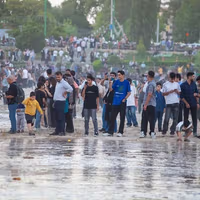

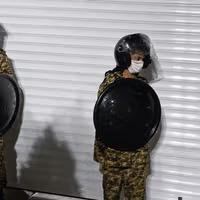
An eyewitness has described what he called an organized and deadly crackdown on protesters in the city of Najafabad in Iran’s Isfahan province, saying security forces opened fire on crowds from both a police station and a mosque.
In an audio message sent to Iran International on Sunday, the witness said large numbers of people took part in protests on January 8 and 9, and that authorities responded with what he described as a “massacre.”
He said plainclothes agents infiltrated the crowd on the evening of January 8 and steered protesters toward the governor’s office and a police station, where forces positioned inside the station opened fire.
Despite the bloodshed, he said protesters returned to the streets the following evening. He described the city on January 9 as resembling a “war zone,” saying security forces were deployed with heavy weapons and fired at demonstrators from Safa Mosque on Shariati Street.
He added that authorities later withheld victims’ bodies, forcing families to break into morgues to search for their relatives, and said Najafabad was effectively placed under conditions resembling martial law after the crackdown.
Israeli defense officials have told their US counterparts in recent weeks that Iran’s ballistic missile program poses an existential threat to Israel and that the country is prepared to act unilaterally if necessary, Jerusalem Post cited security sources as saying.
“We told the Americans we will strike alone if Iran crosses the red line we set on ballistic missiles,” one source said, adding that Israel believes Iran has not yet reached that threshold but that Israeli officials are closely tracking developments inside Iran.
The sources said Israel has conveyed plans to dismantle Iran’s missile capabilities and parts of its production infrastructure through a series of high-level exchanges with US officials.
One defense official said the current moment offered a “historic opportunity” to inflict a major setback on Iran’s missile infrastructure and blunt threats to Israel and neighboring countries.
Several officials said they were concerned US President Donald Trump could opt for a limited strike approach — akin to recent US operations against the Houthis in Yemen — that they fear would leave Iran’s most critical capabilities intact.
“The worry is he might hit a handful of targets, declare victory, and leave Israel to deal with the consequences, like with the Houthis,” a military official said, adding that partial action would not remove the underlying threat.
Psiphon's director of DC operations said that hundreds of thousands of Iranians living abroad are sharing their internet connections to help people inside Iran access the open internet.
Speaking to Iran International on the sidelines of a rally in Washington, Ali Tehrani said the effort relies on a tool known as the Conduit application.
“400,000 Iranians outside the country are sharing their internet by installing the Conduit app, so people inside Iran can access free internet,” he said.
Iran’s foreign minister said on Sunday that Tehran’s right to enrich uranium on its own soil must be recognized for nuclear talks with the United States to succeed, two days after the two sides held indirect discussions in Muscat aimed at testing whether diplomacy can be revived.
Foreign Minister Abbas Araghchi told reporters at a foreign policy conference in Tehran that Friday’s Muscat talks were limited to the nuclear file and that Iran would not negotiate on missiles or regional issues.
“Zero enrichment can never be accepted by us,” Araghchi said, adding that talks should focus on arrangements that allow enrichment in Iran.
“We need to focus on discussions that accept enrichment inside Iran while building trust that enrichment is and will remain for peaceful purposes.”
Araghchi said results of the Muscat round were being reviewed and that both sides were waiting for decisions in their capitals on whether to proceed, with any next round expected to remain indirect and potentially be held outside Oman.
“The results of the talks are under review,” Araghchi said. “The overall approach of both countries is to continue the talks, and we are waiting for decision-making in the capitals.”
He added that Iran would not negotiate its missile program or regional policies, pushing back against US calls to widen the agenda.
“The missile issue and regional issues have not been on the agenda and are not on the agenda,” Araghchi said.
Tehran’s top diplomat described the first Muscat meeting as a test of seriousness, adding that talks would continue only if Iran concluded the United States was acting in good faith.
“The first session was a trial of how much we can trust the other side.”
He also said Iran had increased consultations with regional states compared with past nuclear diplomacy, and that Tehran had kept Russia and China informed of the process.
Speaking at the same event, Kamal Kharazi, head of Iran’s Strategic Council on Foreign Relations and a former foreign minister, said Tehran’s foreign policy should prioritize ties with neighboring countries while maintaining what he called resistance to coercive pressure from adversaries.
Ali Akbar Salehi, a former foreign minister and senior nuclear official, argued that Iran faced a broader governance challenge in translating its revolutionary ideals with practical policy tools, adding that strengthening the domestic economy and modern capabilities would make Iran’s foreign policy more sustainable.
Saeed Khatibzadeh, head of the Foreign Ministry’s political and international studies center, said the conference aimed to bridge academia, industry and the foreign policy establishment.
Araghchi framed enrichment as tied to sovereignty, saying no outside power could dictate what Iran may possess, and argued that diplomacy could work only if Iran’s rights were respected.
The Muscat talks came amid high regional tensions and an expanded US military posture in the region.
Iran’s President Masoud Pezeshkian said on Sunday that the talks were a “step forward,” adding that Tehran wanted its rights under the Nuclear Non-Proliferation Treaty to be respected.
An Iranian lawmaker accused prominent reformist and opposition figures of promoting submission to the United States, using harsh religious language during a speech in parliament on Sunday.
Mohammad Seraj, a Tehran lawmaker, described the United States as “the embodiment of Satan” and said calls for engagement with Washington amounted to abandoning Iran’s independence and Islamic principles.
Seraj said those advocating what he called a “comprehensive agreement” with the United States were “friends of Satan,” naming former presidents Hassan Rouhani and Mohammad Khatami, as well as reformist opposition figures Mir-Hossein Mousavi and Mehdi Karroubi.