Iran issues death sentence for soccer player arrested during protests

Iran’s judiciary has issued a death sentence for Mohammad Hossein Hosseini, a 26-year-old footballer and political prisoner from Mashhad.
Sources told Iran International that he was subjected to severe torture.
Iran International had previously learned that the former player for Sepahan was transferred from Vakilabad Prison to another, undisclosed location.






Grammy-winning singer Shervin Hajipour has released a new song titled “I'm Iran,” dedicating it to those massacred by the Islamic Republic during the January 2026 crackdown on protesters.
"Take it all again, my land, my very home, but even my lifeless body will still speak up, because I'm Iran," reads the song's lyrics.
Shervin’s previous protest song, Baraye, became an anthem of Iran’s 2022 Woman, Life, Freedom movement and earned him a Grammy Award for Best Song for Social Change.
As Iranian and US negotiators met in Oman on Friday to discuss the framework for renewed talks, Friday prayer leaders across Iran used their sermons to dismiss the process, expressing near-uniform pessimism about the prospects for diplomacy.
The messaging was unlikely to be accidental, as Friday prayer sermons are drafted by a central headquarters overseen directly by the office of Ali Khamenei and distributed nationwide to imams, often a day in advance.
In Mashhad, Ahmad Alamolhoda, Khamenei’s representative in the city, told worshippers that negotiations conducted “with weapons and warplanes hanging over the table” were part of “America’s political game,” dismissing the process as futile.
In Rasht, Rasoul Falahati said Iranian negotiators would not retreat “a single step.” In Karaj, Hossein Hamedani warned that “trusting the enemy is a strategic mistake,” while in Isfahan, Ahmad Mahmoudi said Iran’s adversaries were frustrated because “their hands have been cut off from Iran’s resources.”
None of the sermons struck an optimistic note.
Military officials reinforced the message, with army spokesman Mohammad Akraminia asserting that Iran had “easy access to US bases” in the region. If war broke out, he warned, “its scope will engulf the entire geography of the region.”
The same line was echoed by senior lawmaker Fada Hossein Maleki, who described the talks as part of Washington’s pressure campaign.
“We are not optimistic about these negotiations, given the previous history of talks and the recent US military deployment to the region,” he told the news website Didban Iran on Friday.
“When they bring their military to our region, they are placing a gun to Iran’s head and calling it negotiation,” he added, stressing that many members of parliament shared his pessimism.
A sharply different view came from Iran’s moderate camp.
Fayyaz Zahed, a former adviser to President Masoud Pezeshkian who resigned over what he described as mismanagement in the presidential office, predicted that Tehran would ultimately be forced to make sweeping concessions.
Speaking to Khabar Online hours before the Muscat talks began, Zahed said Iran would have to hand over its stockpile of enriched uranium and freeze enrichment for an extended period. “Anything else would make entering negotiations pointless,” he said.
Zahed, however, holds no official role in the negotiations, and his remarks stood in contrast to the line coming from clerical, military, and conservative political institutions that dominate decision-making in Tehran.
Maleki’s defiant tone underscored that divide, echoing the skepticism voiced from Iran’s pulpits and military platforms earlier in the week.
“Iran is not like Venezuela, which announces its readiness to negotiate the moment the US fleet approaches its shores,” Maleki said—suggesting that even as diplomats engaged across the table in Oman, the political establishment at home was preparing the public for talks that fail, or for confrontation that follows.
The US Treasury on Friday imposed fresh Iran-related sanctions targeting two individuals, 15 entities, and 14 vessels accused of involvement in activities linked to Iran’s sanctioned energy and shipping networks.
A statement by the Office of Foreign Assets Control (OFAC) said the designations were made under Executive Order 13846 and trigger asset freezes and a ban on dealings with US persons.
Those sanctioned span several countries, including Turkey, the United Arab Emirates, China, India, and the Marshall Islands, and include shipping managers, trading firms, and oil, gas, and chemical tankers accused of facilitating Iran’s oil exports.
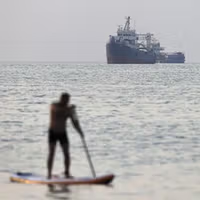
Tehran’s frequently invoked threat of closing the Strait of Hormuz may be far easier to signal than to carry out, not least because it would harm allied China more than the hostile West.
For now, the threat is muted as Iran and the United States have returned to the negotiating table. But the shadow of war has not lifted.
Hardline and influential voices in both capitals continue to push a confrontational line, and the presence of the US aircraft carrier Abraham Lincoln near Iranian waters is a reminder of how quickly tensions could escalate.
Earlier this week, units from the Islamic Revolutionary Guard Corps approached and boarded a commercial vessel flying a US flag in the strait, while a US F-35 fighter jet shot down an Iranian drone that had approached the carrier strike group.
On the same day, amid a diplomatic scramble across the region to keep talks alive, hardline lawmakers in Tehran publicly revived calls to close the strait.
Yet the economic constraints on any serious disruption are severe.
The China factor
According to data from commodities intelligence provider Kpler seen by Iran International, nearly 95 percent of Iran’s crude oil exports in 2025 were loaded at Kharg Island and shipped through the Strait of Hormuz, primarily to China.
Estimates from the US Energy Information Administration show that roughly 20 million barrels per day of crude oil and petroleum products—about one-fifth of global consumption—pass through the strait each day.
Only about 6 percent of that volume is destined for Europe and the United States. Asian buyers dominate, absorbing 84 percent of oil and petroleum products transiting Hormuz, as well as more than 80 percent of liquefied natural gas shipments.
China alone imports around 5 million barrels of oil per day via the route. Any sustained disruption would therefore strike directly at Beijing’s energy security.
That vulnerability has grown in recent months as Venezuelan oil exports to China have effectively halted following stepped-up US enforcement. Venezuela exported about 850,000 barrels per day in January—volumes sufficient to replace most of the oil consumed in Europe and the United States that transits Hormuz.
Reuters reported that the United States last month reclaimed its position as the largest individual destination for Venezuelan crude, receiving about 284,000 barrels per day.
China, by contrast, has stepped back. PetroChina recently halted purchases of Venezuelan crude, signaling that Beijing no longer expects access to discounted supplies once available under sanctions-era arrangements.
A narrowing margin
With sanctions also complicating imports from Russia and Iran, China’s reliance on Persian Gulf oil—and on uninterrupted traffic through Hormuz—is set to deepen further.
From a Western perspective, these shifts have quietly altered the risk calculus. While any disruption in Hormuz would still push global oil prices higher, Europe and the United States are now better positioned than in the past to absorb short-term shocks. China is not.
For Iran, the costs would be higher still. Roughly 80 percent of its foreign trade, oil and non-oil alike, moves through ports along the Persian Gulf. Closing Hormuz would not only jeopardize China’s energy supplies but effectively paralyze Iran’s own external commerce.
There is also a broader cushion in the system. The International Energy Agency estimates that global spare production capacity will remain near 4 million barrels per day through 2026, helping to limit the impact of any temporary disruption.
All of this helps explain why Iran’s recurring threats to close the Strait of Hormuz—raised repeatedly over more than two decades—have never been carried out.
Iran's Foreign Minister Abbas Araghchi said Iran made clear in talks with the United States that discussions were limited strictly to the nuclear issue and could only continue in the absence of threats or pressure.
Speaking to IRNA, Araghchi said Iran told the US that “the subject of our talks is solely nuclear” and that Tehran would not engage Washington on any other matters. He added that Iran stressed negotiations must take place “in a calm environment, without tension and without threats.”
“The prerequisite for any dialogue is refraining from threats and pressure,” Araghchi said, adding that this point was raised “explicitly” and must be respected for talks to move forward.