Iranian Foreign Minister Abbas Araghchi met Omani Foreign Minister Sayyid Badr Albusaidi in Muscat on Friday, Iran’s foreign ministry said.
The meeting took place in the Omani capital ahead of planned talks between Iran and the United States in Oman.

Iran’s foreign ministry released images showing the Islamic Republic’s negotiating team heading to talks with the United States in Muscat.
Under the announced schedule, the talks were due to start at 9:30 a.m. Tehran time, but began with a slight delay. Before negotiations, Foreign Minister Abbas Araghchi met with Oman’s foreign minister, Badr al-Busaidi.
State media reported the talks were expected to begin between 10 and 11 a.m. Tehran time.
Ahead of the negotiations, Araghchi wrote on X that Iran was entering the talks “with open eyes and a steady memory of the past year.”

State-backed celebrations of Shiite Imam Mahdi’s birthday this week have angered many Iranians mourning tens of thousands killed in recent protests, highlighting a widening divide over grief, faith and public displays of joy.
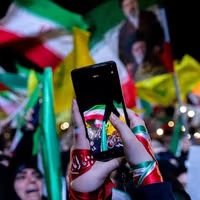
Government authorities and supporters marked the birthday of the 12th and final Shiite Imam, Mahdi, with widespread street decorations, fireworks at religious sites and city squares, and tents distributing tea, sweets and food to passersby.
State media extensively covered the festivities, while pro-government social media users portrayed public participation as evidence of continued support for the authorities and the country's return to normalcy.
In the days leading up to the public holiday, state-organized celebrations are held not only in religious venues but also across government offices and schools. During this period, authorities, municipalities and private citizens decorate streets with lights and offer sweets and drinks to pedestrians.
This year’s main ceremony took place at the Jamkaran Mosque near the holy city of Qom, where large crowds gathered for fireworks and light displays. Since the 1979 Islamic Revolution, the once-obscure mosque has expanded dramatically into a major pilgrimage and tourist complex.
Widespread opposition to the celebrations
Opposition to the celebrations has come from many who say festivities are inappropriate while millions grieve.
The official death toll from the February 8–9 protests, announced by the government — more than 3,000 people — nearly matches the total number of deaths recorded during the previous monarchy between 1963 and 1979.
An X user identified as Homayoun wrote: “When the state breeds death, theatrical joy is merely the mask of shamelessness. Celebrating over fresh wounds is neither faith nor hope; it is only the habit of witnessing the suffering of others.”
Religious and political figures boycott the festivities
At least two prominent clerics — Grand Ayatollah Asadollah Bayat-Zanjani, a senior religious authority and former reformist politician, and Grand Ayatollah Mostafa Mohaqeq-Damad, an Islamic scholar known for criticizing the state’s harsh response to protesters — announced they would refrain from holding birthday celebrations in solidarity with mourners.
Bayat-Zanjani’s son, Mohsen Bayat-Zanjani, a well-known philanthropist, said on X that his father’s office would cancel its annual event. The Institute for Religious Enlightenment, overseen by Mohaqeq Damad, issued a statement saying he would not host a celebration this year.
Neither cleric has publicly condemned the killings, prompting sharp criticism from some X users, though others praised the move. Hadi Mehrani, a former Iran-Iraq war veteran and ex-political prisoner who now openly supports the overthrow of the Islamic Republic, commended them for “standing with the people and honoring the dead.”
Beyond these two figures, no other senior clerics have been reported to oppose the festivities, and neither cleric explicitly blamed the government for the deaths.
Azar Mansouri, head of the Reform Front, wrote on X: “In the midst of this exhausting collective mourning and the deep wound inflicted on the nation’s soul, what celebration?” Pro-government commenters responded that celebrating the Imam’s birth is obligatory regardless of circumstances.
Historical precedence
Boycotting religious celebrations during periods of mourning has historical precedent in Iran. In July 1978, after dozens of demonstrators were killed in Tehran’s Jaleh Square, Ayatollah Ruhollah Khomeini declared public mourning and urged people to avoid festivities for Mahdi’s birthday, emphasizing unity in the political struggle.
In 1962, Grand Ayatollah Mohammad Reza Golpayegani similarly called for canceling the celebration in protest against the Shah’s “White Revolution” reforms.
Protesters respond with slogans
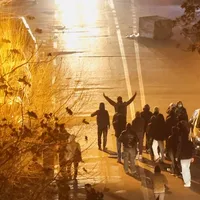
Citizen journalists have circulated reports of residents chanting slogans from windows during the festivities.
One X user said members of the Basij militia set up a booth in the Chitgar district of western Tehran playing religious music and Quran recitations, prompting apartment residents to shout slogans in opposition. A video posted by the user captured voices chanting “Death to the Islamic Republic” and “Death to the Basij.”
Outside Iran, a group of supporters of exiled prince Reza Pahlavi gathered Tuesday outside the Islamic Centre of Manchester, disrupting a planned Mahdi birthday celebration with chants and protests.


As Iran and the US convene in Oman for bilateral talks, reports suggest Muslim-majority states are pushing for a framework that would include a non-aggression pact, curbs on Iran’s nuclear program and its arms support for allied militants, and reassurances on its missiles.
Saudi Arabia, Qatar, Egypt, Oman, the United Arab Emirates and Pakistan worked on the framework proposal ahead of the Friday talks, The Times of Israel reported, citing two Middle Eastern diplomats.
The proposal includes a non-aggression pact under which Washington and Tehran would agree not to target one another, the report said, adding that the pact would also cover allies and Iran-backed armed groups in the region.
The framework drafted by the six countries would also address Iran’s nuclear program, ballistic missiles and Iran-backed armed groups, according to the report.
One of the diplomats cited in the report acknowledged that binding Israel to such an agreement would be difficult.
Proposed Iran commitments
Separately, Al Jazeera reported that mediators from Qatar, Turkey and Egypt have presented Iran and the United States with a framework of key principles to be discussed in Friday’s talks, citing two sources familiar with the negotiations.
Under that proposal, Iran would commit to zero uranium enrichment for three years, after which it would limit enrichment to below 1.5 percent, the report said.
Iran’s stockpile of highly enriched uranium — including about 440 kilograms enriched to 60 percent — would be transferred to a third country under the framework, according to the report.
The Al Jazeera report said the proposal also includes a ban on Iran's initiation of ballistic missile attacks and a commitment by Iran not to transfer weapons or technologies to its allied armed groups in the region.
Iran and the United States have not yet reacted to these reports.
Iran’s foreign ministry said on Thursday the negotiations would focus solely on the nuclear issue, underscoring Tehran’s position that other matters — including missiles and regional activities — are off the table.
A day earlier, US Secretary of State Marco Rubio said Washington expects talks with Iran to address a range of issues beyond the nuclear file.
“I think in order for talks to actually lead to something meaningful, they will have to include certain things, and that includes the range of their ballistic missiles. That includes their sponsorship of terrorist organizations across the region. That includes the nuclear program, and that includes the treatment of their own people,” Rubio said, referring to items on the US agenda for Friday’s talks with Tehran.

A group of 197 Iranian athletes and sports figures in an open letter on Thursday urged the US Congress to recognize exiled Crown Prince Reza Pahlavi as the legitimate representative of the Iranian people and as leader of a unified democratic opposition.
“In our view, his leadership represents a unifying force for many Iranians inside the country and throughout the diaspora, and may contribute to guiding a peaceful, orderly, and non-violent transition … toward a democratic and secular system based on the rule of law,” the letter said.
Addressed to members of Congress, the signatories also called for a reassessment of engagement policies toward Tehran to ensure international actions do not unintentionally contribute to repression inside Iran.
Iran’s foreign minister Abbas Araghchi arrived in Muscat on Thursday ahead of talks with the United States, on a flight that was deliberately listed as departing from “Tabas” rather than Tehran in what the state media called a symbolic move.
Tabas is the site of the failed 1980 US hostage rescue mission, when a sandstorm and equipment failures forced Washington to abort Operation Eagle Claw, killing eight American servicemen.