Negotiations between Iran and the United States set for Friday will begin indirectly and shift to direct talks after Tehran receives a US guarantee to adhere to whatever is agreed, Hezbollah-affiliated Al Mayadeen said, citing an unnamed source in Tehran.
The source added that Iran wants to resume negotiations from where they left off before the 12-day war in June.
The report said the talks will be exclusively focused on the nuclear issue and that Tehran has requested that a large number of countries not attend.

Human rights advocates in Canada are urging the country’s national police to gather evidence on Canadians linked to Iran’s repression apparatus after thousands of protesters were killed in January.
The call is directed at the Royal Canadian Mounted Police (RCMP) and centers on what is known as a “structural investigation,” an evidence-gathering process that could help lay the groundwork for future prosecutions of individuals linked to crimes against humanity.
“We know that there are a number of IRGC officials in Canada, and also a very large Iranian diaspora with substantial evidence they can provide to the RCMP,” said Brandon Silver, an international human rights lawyer and founding director of policy and projects at the Raoul Wallenberg Centre for Human Rights.
“The RCMP can initiate what’s called a structural investigation into crimes against humanity,”
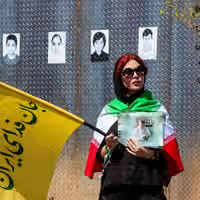
The push comes amid mounting demands for accountability after Iran International’s Editorial Board confirmed that more than 36,500 Iranians were killed by security forces during the January 8–9 crackdown, the deadliest two-day protest massacre in history.
Advocates say Canada must ensure perpetrators cannot find refuge abroad — and that Iranian Canadians have a direct avenue to report evidence.
Nazanin Afshin-Jam, a member of the Iranian Justice Collective, said structural investigations would give Iranian Canadians a concrete pathway to come forward and begin the accountability process.
Calls from Parliament Hill
The renewed push followed a day of meetings and testimony in Ottawa, where Afshin-Jam appeared before the House of Commons Subcommittee on International Human Rights.
“Yesterday I was invited to testify before the subcommittee on international human rights to give an update on the human rights situation in Iran and to also provide some recommendations,” she said.
Afshin-Jam said the aim was to press Canada to move beyond statements of condemnation toward tangible action.
Pressure on the IRGC
Silver also urged Ottawa to expand sanctions against senior officials directing the repression.
“Sanction the architects of this repression, starting with the Ayatollah,” he said.
He argued that Canada should coordinate closely with allies as international pressure mounts on the Islamic Revolutionary Guard Corps.
Afshin-Jam said Canada has already taken significant steps in the past — including listing the IRGC and closing its embassy in Tehran — and should again lead among Western democracies.
Advocates said they were encouraged by signs of cross-party engagement in Parliament but stressed that the next step must be follow-through: evidence collection, sanctions enforcement, and coordinated international action.

The US ambassador to NATO said Washington’s pressure on Iran is focused on preventing Tehran from acquiring nuclear weapons and stopping the killing of protesters, adding that President Donald Trump has clear red lines.
“It is all about Iran not having nuclear weapons,” Matthew Whitaker told Fox News. “And at the same time, also not killing protesters.”
Whitaker said reports indicated “thousands, if not tens of thousands of people” had died during last month’s protests in Iran.
“President Trump, I think, has a clear handle on this, has red lines, and we'll see what negotiators can come up with,” he added.
Iran combined diplomatic maneuvering with military provocations this week as talks with the United States approached, in what the Wall Street Journal described as “a last-minute curveball aimed at leaving everyone else off balance.”
"Iran’s tactics present a challenge for Trump’s style of diplomacy, in which he prefers quick deals negotiated via a small number of trusted lieutenants," the report said.
According to the WSJ, Tehran abandoned a planned meeting in Turkey involving US and regional officials and instead pushed for narrower talks in Oman limited to its nuclear program and restricted to bilateral discussions with Washington. The shift came the same day Iran flew a drone toward a US aircraft carrier and sent gunboats to confront a US-flagged oil tanker.
Despite the flare-ups, US officials said diplomacy remained on the table. White House press secretary Karoline Leavitt told reporters that talks with Iran were still scheduled.
US and regional officials told the WSJ that Special Envoy Steve Witkoff and Trump’s son-in-law Jared Kushner had been slated to attend the meeting with Iranian officials, though plans were not final. Regional officials said there was agreement in principle to meet in Oman on Friday, but that discussions over the scope of the talks and participation by other countries were ongoing.
The WSJ reported that Iranian officials have threatened to pull out of negotiations, while some US officials said Trump has considered walking away from the talks because of Iran’s military actions.
The paper said the episode underscored how Iran is seeking to apply pressure ahead of negotiations, as Washington pushes for broader talks covering missiles and regional activities while Tehran insists discussions focus solely on its nuclear program.

Iran and the United States are set to hold talks in Oman on Friday, using the same format as earlier rounds mediated by Muscat, Iran's ISNA news agency reported on Wednesday.
According to the report, “the negotiations are expected to mirror previous Iran–US nuclear discussions hosted by Oman, with Abbas Araghchi leading the Iranian delegation. Steve Witkoff is confirmed to attend as Washington’s chief negotiator, while the possible participation of Jared Kushner has also been raised.”
ISNA added that the talks will focus primarily on Iran’s nuclear file, with Tehran pressing for sanctions relief as a key demand.

Iran’s decision to fly a surveillance drone toward a US aircraft carrier and later confront a US-flagged tanker was likely meant to test US naval reactions and signal its ability to threaten American forces, the Institute for the Study of War said.
In the first incident on Tuesday, an Iranian Shahed-129 surveillance drone approached the USS Abraham Lincoln carrier strike group in the Arabian Sea before being intercepted and shot down by a US Navy F-35C fighter jet. Several hours later, Iranian fast attack craft, supported by a surveillance drone, attempted to stop a US-flagged tanker in the Persian Gulf, prompting a response from a US destroyer.
ISW said the incidents fit the pattern of what it described as a “probing action,” which “seeks to test the strength, disposition, and reactions of an opposing force,” while also serving a broader signaling purpose.
“It is unclear how close the Shahed-129 came to the Lincoln, though the way that the Lincoln group responded to the drone’s approach can give Iran useful intelligence on how the US Navy will engage Iranian drones operating in its vicinity,” the think tank said.
ISW added that the pairing of the drone incident with the attempted interception of a US-linked tanker suggested a deliberate effort to showcase Iran’s capacity to challenge US naval activity. “These two incidents may be the beginning of an Iranian maritime escalation that seeks to deter a US strike by demonstrating Iran’s capability to challenge US naval activity,” it said.
The Shahed-129 is an intelligence, surveillance and reconnaissance (ISR) and strike drone, distinct from the Shahed-136 one-way attack drones used by Russia in Ukraine. ISW said Iran has used the Shahed-129 extensively across the Middle East to collect intelligence and conduct attacks against US and Israeli targets.