Iran will not negotiate over its nuclear activities or missile capabilities, a senior lawmaker said on Monday, while saying Tehran remains open to talks under clear conditions.
Alaeddin Boroujerdi, a member of parliament’s national security and foreign policy commission, said peaceful nuclear knowledge, along with missile and drone capabilities, were not negotiable.
“Peaceful nuclear knowledge, like missile and drone capabilities, are red lines of the Islamic Republic and are not open to negotiation,” he said.
Boroujerdi said Iran had always been serious about negotiations but stressed that the country’s policy was not one of war, adding that Tehran was ready for talks based on what he called clear and logical terms.
Tehran’s foreign ministry spokesman also addressed mounting tensions with Washington, saying Iran had learned from what he described as repeated US “bad faith” over the past decade and stressing that “threats are not compatible with diplomacy.”
At the same time, he said Iran remained committed to diplomacy to safeguard its national interests and regional stability, and that Tehran was reviewing the “structure” of any potential negotiations as regional states pass messages between the sides.
Details of various diplomatic processes to manage tensions with the US are being examined, he added.
Baghaei said lifting sanctions remained a core priority for Iran, arguing that the nuclear issue had long been used as a pretext to pressure Tehran, and that any confidence-building would have to be matched by the removal of what he called “unjust” sanctions.
Baghaei also dismissed speculation over military drills, saying there had been no change in Iran’s regular exercises, including annual joint naval drills with Russia and China, and accused some media of trying to inflame public anxiety.
Iran’s Foreign Minister Abbas Araghchi held separate phone calls with his counterparts in Egypt, Saudi Arabia and Turkey to discuss regional and international developments, Iranian media reported, as Tehran faces rising US threats.
IRGC outlet Tasnim said Araghchi has stepped up outreach to regional capitals in recent weeks, focusing in particular on Washington’s warnings toward Iran. He also traveled to Turkey last week for talks with President Tayyip Erdogan and Foreign Minister Hakan Fidan.
The diplomatic push comes as Qatar’s prime minister and foreign minister made a brief visit to Tehran on Saturday to meet Araghchi and Iran’s top security official Ali Larijani.
Axios reported late Sunday that Turkey, Egypt and Qatar are working to arrange a meeting this week in Ankara between US envoy Steve Witkoff and Iranian officials – a claim not confirmed by Tehran.”
Iran’s judiciary chief Gholamhossein Mohseni Ejei said on Monday that recent unrest amounted to a “major sedition” orchestrated by enemies and vowed firm action against those accused of violence, as tensions and security concerns continue to grip the country.
“America should know that if it starts a war, this time it will be a regional war,” he said, echoing similar remarks made by the Supreme Leader a day earlier.
Ejei also acknowledged mounting domestic pressures, saying officials must address people’s grievances and economic difficulties to prevent further instability.
“We must solve the people’s problems and reduce them day by day as much as possible,” he said, warning that failure to tackle even basic issues could leave the country vulnerable in larger conflicts.
He added that Iran remained prepared to confront future threats, including possible military action, terrorism and renewed unrest.
Iran’s armed forces chief Major General Abdolrahim Mousavi rejected suggestions that Iran could be weakened by a naval blockade, saying the country was geographically and strategically “impossible to encircle.”
He said during a late-night visit to a military unit on Sunday that Iran is fully prepared to retaliate against Israel and warned that any miscalculation could trigger a broader regional conflict.
Mousavi said Iran had revised its military doctrine after the 12-day war shifting from a defensive posture to an offensive one based on rapid and sustained operations.
He added that Iran’s response to any attack would be “swift and decisive” and not shaped by US calculations.
Mousavi also warned that in the event of escalation, “no American will be safe,” saying the fire of a regional conflict would engulf the United States and its allies. He said Iran was focused solely on victory and was fully prepared “to confront and deliver a retaliatory blow.”
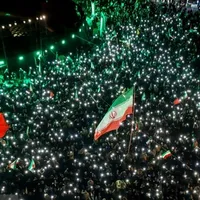
Iranian expatriates around the world held massive rallies and demonstrations over the weekend to support protesters in Iran and call on the international community to take firm action against the Islamic Republic following the recent brutal crackdown.
On Sunday, 100,000 people attended one of the biggest rallies worldwide in the city of Toronto, Canada, according to the local police.
Huge crowds of people also took to the streets of London, Washington DC, Vienna, Paris, Brussels, Cologne in Germany, Sofia in Bulgaria, Adelaide in Australia, and Nicosia in Cyprus.
Earlier Saturday, similar demonstrations took place in London, Berlin, Paris, Hamburg, Stockholm, Düsseldorf, Manchester, Newcastle, and several other cities.
Protesters carried Lion and Sun flags and displayed images of those killed during the national uprising. They chanted slogans against the Islamic Republic and urged governments worldwide to provide practical support to the people of Iran.