Recent statements by Iranian officials and their apparent acceptance by some foreign leaders have created a misleading sense of reassurance about the state’s response to the latest protests.
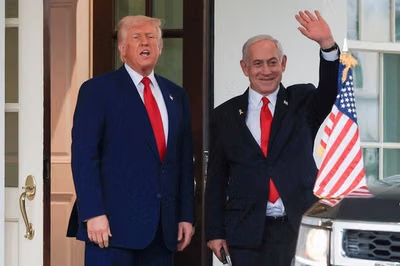
Foreign Minister Abbas Araghchi told Fox News on Wednesday that Tehran had “no plan to execute protesters.” President Donald Trump told reporters he had it “on good authority” that the killing of protesters had stopped.
White House Press Secretary Karoline Leavitt told reporters on Thursday that Tehran had halted 800 executions slated for the previous day following warnings by Trump.
Taken at face value, such statements by Iranian officialdom appear to mark official restraint. A closer look at the Islamic Republic’s record suggests otherwise.
Tehran has rarely—perhaps never—executed individuals under the formal charge of participating in an illegal gathering. Under Iran’s Islamic Penal Code, that offense does not carry the death penalty and is typically punishable by imprisonment.
In that narrow, technical sense, officials can plausibly claim that the state does not execute people for protesting. The distinction, however, lies in how protesters are subsequently defined.
Across successive protest movements, Iranian authorities have routinely reframed demonstrations by dividing participants into shifting categories: first “peaceful protesters” and “rioters,” and more recently “vandals,” “saboteurs” and “terrorists.”
These labels are not merely rhetorical. Each carries specific legal consequences.
“Security forces and the judiciary will show no tolerance whatsoever toward saboteurs," Iran's Supreme National Security Council said in a statement on Jan. 9.
The stark warning came a day after Supreme Leader Ali Khamenei said Tehran would accept legitimate economic protests but stop "rioters."
Once a detainee is removed from the category of protester, prosecutors gain access to a separate set of charges—including moharebeh (warring against God), efsad-fel-arz (corruption on earth), terrorism, armed action or collaboration with hostile states—all of which can carry the death penalty.
The underlying conduct may remain the same, but its legal classification changes.
In this way, the state’s claim that it does not execute protesters is technically consistent with its practice. Executions occur only after protest-related activity has been reclassified as a more serious offense.
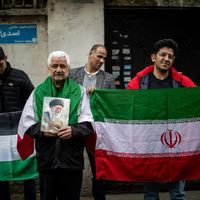
This approach is also reflected in the government’s longstanding assertion that it “recognizes the right to protest” while opposing only “chaos” or “violence.” In practice, independent demonstrations have not been permitted for decades.
Pro-government rallies, often organized by state institutions, proceed without restriction, while applications for lawful protests by independent political groups, civil organizations and even officially registered parties are routinely denied, regardless of legal compliance.
The result is a system in which the boundary between lawful protest and criminal conduct is not defined in advance, but determined after the fact. Legal terminology becomes flexible, allowing prosecutors to retrofit charges once arrests have been made.
This history helps explain why assurances based on terminology alone offer little protection.
In the absence of an independent judiciary, transparent trials or due process safeguards, commitments not to execute “protesters” leave ample room for coercive confessions, security-driven indictments and capital charges under different names.
The danger, then, is not that the Islamic Republic will execute people for protesting. It is that those who protest may still face execution once they have been renamed.