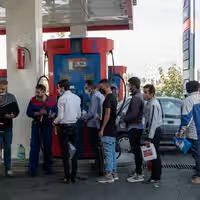
US Senate Republican Mitch McConnell voiced support for Iranians fighting against government repression, saying its "evil gamble" of domestic repression and foreign aggression is collapsing.
"For decades, the Iranian regime's obsession with exporting terror, spilling American blood, and chasing nuclear weapons was contingent on its ability to repress the dreams and aspirations of the Iranian people,” Kentucky Senator posted on X on Friday.
“Repression at home, aggression abroad. That evil gamble appears to be collapsing, and not a moment too soon. My prayers are with the brave people of Iran as they fight for their future," McConnell said.

Internet experts are warning that Iran’s sweeping nationwide internet blackout is being used to shield lethal crackdowns on protesters, cutting off evidence of state violence as unrest continues across the country.
“This is the worst internet shutdown in Iran’s history,” said Ali Tehrani, director of Washington operations for Psiphon, an open-source anti-censorship tool widely used in Iran. “Even Starlink uploads have been affected.”
Tehrani said supporting internet freedom in Iran must become a serious and active priority for the U.S. government, particularly as Iranian authorities increasingly rely on digital blackouts during periods of unrest.
Cybersecurity expert Amin Sabeti told Iran International that the blackout, which began Thursday evening local time, has severed access to the global internet across much of the country and disrupted domestic online services that remained partially available during previous crackdowns.
“This is the most extreme internet shutdown we’ve ever had,” Sabeti said, adding that its scope signals a significant escalation in Tehran’s use of digital repression amid nationwide unrest.
‘Iranians will die’
Iranian authorities have imposed the communications blackout to prevent protesters from coordinating and to stop evidence of state violence from reaching the outside world.
Tehrani said the current shutdown is even more severe than the near-total blackout during the November 2019 uprising, widely known as Bloody Aban, named after the month in the Persian calendar when the protests occurred.
“It’s not just for The Washington Post that democracy dies in the darkness—it’s Iranians that die in the dark,” said Behnam Ben Taleblu, a senior fellow at the Foundation for Defense of Democracies.
Taleblu said communications shutdowns are a core component of Iran’s repression strategy, designed to sever the link between protesters and the international community while security forces operate with reduced scrutiny.
Dozens killed
Despite the blackout, Iran International said it has received and reviewed a disturbing video showing several people lying motionless on the ground following large protests held Thursday night in Fardis, about 25 miles west of Tehran.
The outlet said the shutdown has obstructed efforts to determine the full scale of casualties shown in the footage.
The Center for Human Rights in Iran said on Friday that it has grave and urgent concerns that Iranian security forces may be carrying out lethal repression under the cover of the internet shutdown.
The group said it has received credible first-hand reports of hospitals overwhelmed with injured protesters in several cities and has documented the use of live ammunition by security forces.
It warned that reports of mass killings from the night of January 8 could not be independently verified due to the communications blackout.
US Congressman Suhas Subramanyam on Friday expressed solidarity with Iranians protesting against human rights abuses and economic turmoil, supporting their calls for a free, secular future.
"For years, the people of Iran have been faced with human rights abuses and economic turmoil, leading to protests demanding change. As the current protests in Iran continue, I stand with the people of Iran and their aspirations for a more free, secular future," the Democratic member of the House from Virginia posted on X.

The European Union on Friday called on all parties in Iran to exercise maximum restraint amid ongoing protests and condemned any excessive use of force against demonstrators.
“We urge Iranian authorities to adhere to Iran's international obligations and fully uphold the rights to freedom of expression, association and peaceful assembly,” High Representative Kaja Kallas said in the statement issued on behalf of the EU.
“We also call for ensuring the right of access to information, including by restoring access to the internet for all,” the statement added.
The statement highlights support for the Iranian people's “legitimate demands for democracy and human rights.”

X changed its Iran flag emoji to the historical lion and sun symbol, users reported on social media on Friday.
The previous emoji reflected the flag of the Islamic Republic, which features a red emblem introduced after the 1979 revolution.
The lion and sun motif was used on Iran’s flag for centuries before being removed following the revolution and is now widely associated with Iran’s pre-revolutionary era.
The new flag, associated with Iran's monarchy, is now appearing on the official X accounts of Islamic Republic officials and state media including the IRGC-affiliated Tasnim News.

The official Iran flag appearing on the country's Foreign Ministry's X account has changed into the pre-revolution version, after an update by X.

"Iran's in big trouble," US President Donald Trump told reporters on Friday. "It looks to me that the people are taking over certain cities that nobody thought were really possible just a few weeks ago."
"We're watching the situation very carefully. I've made the statement very strongly that if they start killing people like they have in the past, we will get involved. We'll be hitting them very hard where it hurts."
"That doesn't mean boots on the ground, but it means hitting them very, very hard where it hurts. So we don't want that to happen. There have been cases like this where President Obama totally backed down."
"But this is something pretty incredible that's happening in Iran. It's an amazing thing to watch. They've done a bad job. They've treated their people very badly, and now they're being paid back. So let's see what happens," he added.
"You'd better not start shooting because we'd start shooting too," Trump said.