EU foreign policy chief condemns Iran crackdown on protesters
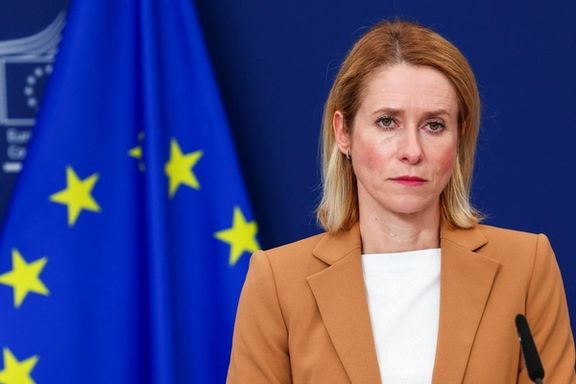

EU foreign policy chief Kaja Kallas said on Friday that Iran’s leadership was showing its “true colours” by ignoring protesters’ demands and using what she called excessive force.
“The Iranian people are fighting for their future. By ignoring their rightful demands, the regime shows its true colours,” Kallas wrote on X.
She said images from Tehran showed “a disproportionate and heavy-handed response by the security forces,” adding: “Any violence against peaceful demonstrators is unacceptable.”
Kallas also criticized the internet shutdown. “Shutting down the internet while violently suppressing protests exposes a regime afraid of its own people,” she said.


X changed its Iran flag emoji to the historical lion and sun symbol, users reported on social media on Friday.
The previous emoji reflected the flag of the Islamic Republic, which features a red emblem introduced after the 1979 revolution.
The lion and sun motif was used on Iran’s flag for centuries before being removed following the revolution and is now widely associated with Iran’s pre-revolutionary era.
The new flag, associated with Iran's monarchy, is now appearing on the official X accounts of Islamic Republic officials and state media including the IRGC-affiliated Tasnim News.

Iranian Foreign Minister Abbas Araghchi on Friday accused the United States and Israel of being involved in the protests in Iran, denied reports that his family had fled the country and said foreign military intervention was unlikely.
“The US and Israel have announced that they are involved in these demonstrations,” Araghchi said in Beirut, pointing to a social media post by former US Secretary of State Mike Pompeo in which he wrote: “Happy New Year to every Iranian in the streets. Also to every Mossad agent walking beside them.”
Araghchi rejected rumors that his family had left Iran. “My family has not gone anywhere. They are in Tehran,” he said.
He said foreign military intervention during the protests was unlikely. “The possibility of military intervention in Iran at the same time as these protests is unlikely,” he said.
Araghchi also said Oman’s foreign minister was due to visit Tehran on Saturday, but added: “We do not know whether he is carrying a message.”

Iran’s top Sunni cleric Molavi Abdolhamid said on Friday that many Iranians were struggling to afford food and backed the nationwide protests.
“A large number of people in Iran are in need of bread,” he said. “Many people barely eat one meal a day.”
He accused officials of looting national resources. “They have plundered many of the country’s national resources,” he said.
Abdolhamid said protests in recent years had come at a high cost. “In past years, people have protested many times and have given their lives,” he said.
Warning of worsening conditions, he added: “We have reached a point where cemeteries could be created because of hunger.”
He said people from all backgrounds had joined the protests. “Last night, everyone saw that Iranians from all walks of life came out,” he said, adding that people had risen up “for their dignity and honour.”
The United States is closely monitoring protests in Iran for signs they could threaten the stability of the ruling system, US officials told Axios.
Early this week, US intelligence assessed that the protests lacked enough momentum to challenge the regime, but that view is now being reassessed, according to the report.
“The protests are serious, and we will continue to monitor them,” a senior US official was quoted as saying.
The protests have grown and spread over the past 12 nights, with Thursday’s rallies described as the largest so far. They have been driven mainly by economic pressure, which has worsened amid renewed US sanctions and damage from the 12-day war in June, Axios said.

European Parliament member Hannah Neumann said on Friday that Iran was using internet shutdowns to conceal violence against protesters and weaken resistance.
“The Internet shutdown in Iran is not a technical issue. The regime uses it to hide brutality and break the resistance of protesters,” Neumann wrote on X.
“More violence, more arrests, more people disappearing,” she added. “Families [are] left not knowing if loved ones are alive, injured or imprisoned.”
Neumann said the blackouts were a deliberate strategy to “cut people off from help and protection,” “make the regime’s deadly violence invisible,” “silence those under attack” and “prevent the world from seeing the size of the protests.”
“Internet blackouts are a weapon by the #IranianRegime,” she wrote. “Silence is not neutrality. It enables repression. Europe must speak up now!”