US President Donald Trump told the New York Times in an interview that his presidency could have been doomed if a daring US attack to capture Venezuelan President Nicolas Maduro had failed.
Citing a failed bid by Democratic President Jimmy Carter to rescue US hostages in Iran on April 24, 1980, Trump said failure in Venezuela could have meant a “Jimmy Carter disaster. That destroyed his entire administration.”
That mission, aimed at freeing 52 American hostages seized at the US embassy in Tehran, failed when a US helicopter crashed into an aircraft, killing 8 soldiers.
“I don’t know that he would have won the election,” Trump said. “but he certainly had no chance after that disaster.”
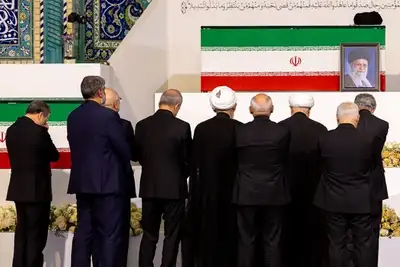

As protests continue across Iran, separate reports and remarks have raised questions about potential contingency planning by Iran’s leadership, including allegations of Russian cargo flights to move assets and claims that officials are seeking overseas visas for their families.
In London, British lawmaker Tom Tugendhat told parliament there were reports of Russian cargo aircraft landing in Tehran and of large quantities of gold leaving the country. He asked whether the reports suggested that Iran’s leadership was preparing for a possible collapse.

British lawmaker Tom Tugendhat told parliament on Thursday that there were reports of Russian cargo aircraft landing in Tehran and quantities of gold leaving the country.
“We’re also seeing Russian cargo aircraft coming and landing in Tehran, presumably carrying weapons and ammunition, and we’re hearing reports of large amounts of gold leaving Iran,” Tugendhat said. It was unclear what reports he was referencing.
Anti-government protests have gripped Iran since Dec. 28 in one of the biggest challenges yet to the near 50-year rule of the Islamic Republic.
US-based rights group HRANA reported that 34 protestors and 2 members of the security forces have been killed.
Tugendhat asked the government to comment on the information that he said could indicate preparations “for life after the fall.”
Responding to the remarks, UK Minister for the Middle East and North Africa Hamish Falconer said he was “not in a position to give a detailed update” on the assertions.
Britain, Hamish added, believed freedom of assembly and the right to protest were “inalienable rights of the Iranian people” and should be respected by the Iranian authorities.
Tugendhat had earlier suggested senior figures in Iran’s government may already be reaching out to foreign intelligence services and trading secrets in search of protection if the government falls.
“How many senior regime officials are reaching out to foreign intelligence officials and trading secrets for security when the regime collapses?” Tugendhat posted on X on Friday.
“The leadership will be suspicious that many are looking for safe landing but paranoia won't help many of the leaders are doing it too,” he added.

A photo circulated on social media shows a large contingent of Iranian security forces gathered inside a school campus in the central city of Arak, with dozens of motorcycles and several vehicles parked in the courtyard.
The image shows uniformed personnel grouped near the motorcycles as others move around the grounds.
The campus belongs to Imam Ali high school, which was previously used to stage forces and equipment during earlier waves of unrest, including nationwide protests that erupted after the death of Mahsa Amini in police custody in 2022.
A group of Iranian filmmakers condemned the crackdown on protests and said dissent was a basic civil right, according to a joint statement released on Thursday.
“We condemn the suppression of people’s protests under any pretext. Protest is the natural and civil right of every human being,” the filmmakers said.
They said firing on unarmed protesters was unjustifiable. “Shooting at people who have come into the streets with empty hands is a crime against the right to life and has no justification,” the statement said.
The filmmakers said organized corruption, the looting of public wealth and fear-based ideology had pushed people into poverty and despair, while national resources were lost in regional conflicts.
“We will portray these days and these wounds, defend freedom of expression with all our strength, condemn the suppression and killing of protesters, and stand with the people of Iran,” they said.
The statement was signed by prominent figures including directors Jafar Panahi and Asghar Farhadi, along with actors and filmmakers from across Iran’s cinema community.

Iran is witnessing the broadest strike and protest movement in the Islamic Republic’s history, Nobel Peace Prize laureate Shirin Ebadi said on Thursday, saying the protests showed Iranians would no longer accept despotism.
“A free and democratic Iran will be built through unity and solidarity and in cooperation among all people,” she wrote on Instagram. “The people of Iran are building a different Iran together, an Iran in which we will see less suffering and more joy.”
Ebadi said the solidarity seen across society was a lesson for future political movements that Iranians would no longer submit to autocracy.