• العربية
  • فارسی
Brand
  • Iran Insight
  • Politics
  • Economy
  • Analysis
  • Special Report
  • Opinion
  • Podcast
  • Live TV
  • Iran Insight
  • Politics
  • Economy
  • Analysis
  • Special Report
  • Opinion
  • Podcast
  • Live TV
  • Theme
  • Language
    • العربية
    • فارسی
  • Iran Insight
  • Politics
  • Economy
  • Analysis
  • Special Report
  • Opinion
  • Podcast
  • Live TV
All rights reserved for Volant Media UK Limited
volant media logo

Ex-IRGC commander says Iran needs paradigm shift, sees no sign of change

Dec 31, 2025, 07:11 GMT+0Updated: 11:51 GMT+0
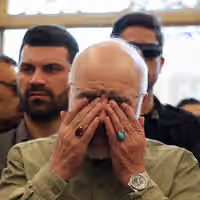
Hossein Alaei, a former commander of the Islamic Revolutionary Guard Corps navy

Iran risks sliding deeper into economic and security crises without a fundamental change in its governing approach, a former Revolutionary Guards commander said, adding that he sees no sign the leadership is prepared to make such a shift.

“I have seen no indication that the ruling system wants to change its paradigm,” Alaei said in a video interview with the news site Entekhab, published on Monday. “The current situation shows that previous policies and strategies have not worked.”

Alaei said sanctions had left Iran unable to export freely or access the global banking system, while the domestic economy remained dominated by the state, despite what he described as historical evidence that state-led economic models do not succeed.

“We cannot export normally and we have no access to the world’s banking system,” he said. “At the same time, the economy is still run by the state, even though human experience shows such models fail.”

He said Iran could still pursue a change in direction but argued that parts of the ruling establishment viewed any paradigm shift as a retreat from core values. Others, he added, believed revising failed strategies was itself a way of safeguarding the country’s fundamental principles.

Alaei also warned that the United States and Israel were moving toward what he described as a “Plan B,” centered on intensifying sanctions to worsen economic conditions, trigger unrest and potentially justify military intervention – unless Iran addressed domestic economic mismanagement and recalibrated its foreign policy.

He said a diplomatic opening could still be possible if the United States were to lift all sanctions, even under current political conditions.


Most Viewed

With the war quieting, Iran's hijab crackdown gathers pace again
1

With the war quieting, Iran's hijab crackdown gathers pace again

2
ANALYSIS

Turkey’s gas pivot leaves Iran with fewer cards to play

3
INSIGHT

Ghalibaf's hunger warning sparks hardline backlash over showing weakness

4

Iran leaders sound economic alarms under Trump’s Economic D-Day

5

Trans woman prisoner says she was raped in Iran Intelligence Ministry detention

Banner
Banner
Banner

Spotlight

  • Ghalibaf's hunger warning sparks hardline backlash over showing weakness
    INSIGHT

    Ghalibaf's hunger warning sparks hardline backlash over showing weakness

  • Iran crude loadings plunge to one-seventh of pre-war level as blockade bites
    ANALYSIS

    Iran crude loadings plunge to one-seventh of pre-war level as blockade bites

  • Turkey’s gas pivot leaves Iran with fewer cards to play
    ANALYSIS

    Turkey’s gas pivot leaves Iran with fewer cards to play

  • Can Iran's fragile economy survive Trump's 'Economic D-Day'?
    ANALYSIS

    Can Iran's fragile economy survive Trump's 'Economic D-Day'?

  • The unlikely return of European diplomacy in the Iran-US conflict
    ANALYSIS

    The unlikely return of European diplomacy in the Iran-US conflict

  • For Iranian journalists, exile can last a lifetime
    OPINION

    For Iranian journalists, exile can last a lifetime