Isfahan bazaar shops shut on third day of protests
Shopkeepers at Isfahan’s Naghsh-e Jahan Square closed their stores on Tuesday, joining strikes on the third day of protests linked to Iran’s economic crisis, according to reports received by Iran International.
Reports from the city said merchants at the historic square, one of Iran’s main commercial and tourist hubs, kept their shops shut throughout the day.
The closures follow similar strike action by traders in Tehran and other cities.
Naghsh-e Jahan Square is a central gathering point in Isfahan.
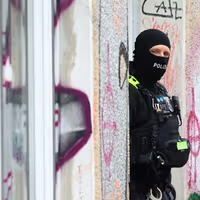
Iranian security forces were deployed in Tehran’s Aryashahr neighborhood on Tuesday, creating a tense security atmosphere as protests continued in the capital, according to reports received by Iran International.
Reports from residents said police and security personnel were stationed across parts of the western Tehran district, with officers visible on main streets and at key intersections.
Citizens described a noticeable increase in patrols and checkpoints, saying the deployment appeared aimed at preventing gatherings or demonstrations.
The Wall Street Journal reported late Monday that protests triggered by Iran’s falling currency were spreading beyond Tehran, adding pressure on the Islamic Republic as economic frustration deepens and security forces move to contain unrest.
The Journal said verified social media footage showing demonstrations near Tehran’s bazaar, including chants of “azadi” and scenes of riot police firing tear gas.
It said protests and strike activity expanded across Tehran and to other parts of the country, including Qeshm Island, where crowds chanted “death to the dictator,” and Hamadan, where some protesters shouted pro-monarchy slogans.
The report also cited remarks by President Masoud Pezeshkian on social media calling on the Interior Ministry to hear people’s demands.
Iranian authorities ordered a province-wide shutdown in Tehran for Wednesday, citing cold weather and energy constraints, as protests over economic hardship entered a third day.
The Tehran Provincial Energy Consumption Management Taskforce said all government offices, schools, universities, banks, municipalities and commercial centers would be closed on Wednesday.
Officials said the decision was based on meteorological forecasts warning of low temperatures in the coming days and was aimed at ensuring stable energy supply.
The announcement comes as Tehran has seen protests and strikes linked to economic instability, although authorities did not connect the shutdown to the demonstrations.
Iranian security forces were deployed in parts of Mashhad on Tuesday, creating a heavy security atmosphere as protests continued in the northeastern city, according to videos and eyewitness reports.
Footage and accounts received by Iran International showed police and other government forces stationed at several locations, including Azadi Square, one of Mashhad’s central intersections.
Residents said large numbers of uniformed and plainclothes personnel were visible on main streets, with security units positioned at key junctions and public squares.
Witnesses described the atmosphere as tense, saying the deployments coincided with fears of renewed demonstrations following protests in Tehran and other cities over economic conditions.
Abolfazl Ghadiani, a jailed Iranian political dissident, called from Evin Prison on Tuesday for protests and strikes to expand, saying demands for the fall of the Islamic Republic must turn into a nationwide public outcry.
In a statement issued from prison, Ghadiani backed strikes and protests over the past two days and urged the continuation of peaceful demonstrations.
“Opportunities have been lost one after another,” he wrote, adding that “with every passing minute and hour, the chance for a peaceful, nonviolent and low-cost transition becomes narrower.”
He warned of a growing risk of foreign intervention, saying Iran’s political future could be shaped by outside powers, “especially the United States in cooperation with Israel,” rather than by Iranians themselves.
Ghadiani said avenues for reform had long been closed. “The mirage of gradual reform from within has become obvious,” he wrote.
He called for a referendum on changing the system and the formation of a constituent assembly to draft a new constitution, adding that such a transition “will certainly not be possible under Ali Khamenei’s grip on power.”