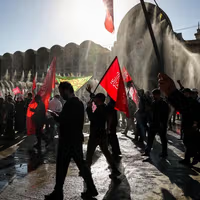
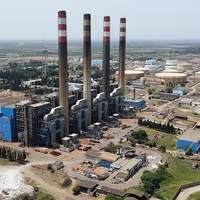
Iranian authorities ordered a province-wide shutdown in Tehran for Wednesday, citing cold weather and energy constraints, as protests over economic hardship entered a third day.
The Tehran Provincial Energy Consumption Management Taskforce said all government offices, schools, universities, banks, municipalities and commercial centers would be closed on Wednesday.
Officials said the decision was based on meteorological forecasts warning of low temperatures in the coming days and was aimed at ensuring stable energy supply.
The announcement comes as Tehran has seen protests and strikes linked to economic instability, although authorities did not connect the shutdown to the demonstrations.
Iranian security forces were deployed in parts of Mashhad on Tuesday, creating a heavy security atmosphere as protests continued in the northeastern city, according to videos and eyewitness reports.
Footage and accounts received by Iran International showed police and other government forces stationed at several locations, including Azadi Square, one of Mashhad’s central intersections.
Residents said large numbers of uniformed and plainclothes personnel were visible on main streets, with security units positioned at key junctions and public squares.
Witnesses described the atmosphere as tense, saying the deployments coincided with fears of renewed demonstrations following protests in Tehran and other cities over economic conditions.
Abolfazl Ghadiani, a jailed Iranian political dissident, called from Evin Prison on Tuesday for protests and strikes to expand, saying demands for the fall of the Islamic Republic must turn into a nationwide public outcry.
In a statement issued from prison, Ghadiani backed strikes and protests over the past two days and urged the continuation of peaceful demonstrations.
“Opportunities have been lost one after another,” he wrote, adding that “with every passing minute and hour, the chance for a peaceful, nonviolent and low-cost transition becomes narrower.”
He warned of a growing risk of foreign intervention, saying Iran’s political future could be shaped by outside powers, “especially the United States in cooperation with Israel,” rather than by Iranians themselves.
Ghadiani said avenues for reform had long been closed. “The mirage of gradual reform from within has become obvious,” he wrote.
He called for a referendum on changing the system and the formation of a constituent assembly to draft a new constitution, adding that such a transition “will certainly not be possible under Ali Khamenei’s grip on power.”

Gohar Eshghi, a prominent Iranian justice-seeking mother, urged people on Tuesday to join protests and strikes, warning against efforts by those loyal to Supreme Leader Ali Khamenei to silence calls for accountability.
In a post on her social media pages, Eshghi wrote: “Do not let the voice of seeking justice be silenced by Khamenei’s criminals.”
“No mother in this land has a wish higher than the safety and freedom of her children,” she added.
Addressing Iran’s security forces, she called on them to side with protesters. “Khamenei has bought a mouse hole for himself and wants to send you to be killed,” Eshghi wrote.

Who is Gohar Eshghi
Eshghi is known in Iran as a “justice-seeking mother,” a term used for relatives of people killed or detained in crackdowns who publicly demand accountability. Their statements often resonate during protest waves, when families challenge official narratives and urge security forces not to confront demonstrators.
Iran’s parliamentary speaker Mohammad Bagher Ghalibaf said on Tuesday that Iranians would prevent protests over economic hardship from being diverted into unrest, while calling on officials to respond to public anger over living costs as demonstrations continued for a third day.
Speaking in an open session of parliament, Ghalibaf said people’s grievances over livelihoods required “full responsibility” from officials and dialogue with representatives of professional guilds.
He accused unnamed opponents of seeking to turn demands into violence. “Ill-wishers want to drag people’s demands into disorder and unrest,” Ghalibaf said, adding that “the people of Iran know the enemy and its malicious goals.”
He said measures should focus on boosting purchasing power, reforming economic decision-making and ensuring coordinated action across the government.
Ghalibaf also praised what he called timely involvement by President Masoud Pezeshkian, and said urgent steps were needed to protect household incomes and strengthen the central bank’s authority in economic policy.
What officials mean by 'unrest'
Iranian officials routinely draw a distinction between what they call “legitimate protests” over economic or social issues and “unrest” or “riots,” a term they often use to describe demonstrations they link to foreign-backed groups or organized networks. The framing is frequently used during periods of nationwide protests to justify security measures.
The US State Department on Monday posted a video of students at the University of Tehran chanting at night while surrounded by intelligence motorcycles, saying the students are shouting for freedom.
“Students at the University of Tehran are showing extraordinary courage, and even while security forces have besieged their dormitories, they are shouting for freedom and dignity,” the State Department’s Persian account on X said.
“Their slogans echo the determination of a generation that will not be silent, a generation that is the future of Iran,” the post added.
In the video, one speaker can be heard saying: “We all tell each other and promise each other that we expect nothing from any of the students who spoke. Take care of yourselves, know that there is such a risk, stay calm, and stand firm for freedom and for the ideals of the university."
“Do not be afraid, do not be afraid, we are all together. Students may die, but they will not accept humiliation,” the students’ chant.