The State Department on Monday published a video showing scenes of protests in Tehran, voicing support for the Iranian people and calling on the Islamic Republic to refrain from a violent crackdown.
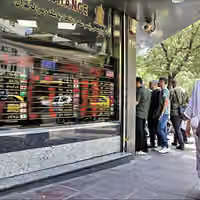
“As Iran’s currency falls to its lowest level ever against the US dollar, hundreds of people gathered in Tehran’s Grand Bazaar to protest the worsening economic situation. Despite violence and a heavy security presence, brave Iranians continue to raise their voices and stage significant demonstrations,” the State Department’s Persian account on X said.
“The Islamic Republic must respect the fundamental rights of the Iranian people and respond to their legitimate demands instead of silencing them. The United States supports the Iranian people in their efforts to make their voices heard,” it added.
Iran's President Masoud Pezeshkian, in his first official reaction to nationwide protests over economic woes, said on Monday he had ordered his interior minister to engage in dialogue with the representatives of protesters.
“I have tasked the interior minister with listening to the legitimate demands of protesters through dialogue with their representatives, so that the government can act with full capacity to resolve problems and respond responsibly," he said.
"People’s livelihoods are my daily concern. We have placed fundamental measures to reform the monetary and banking system and to protect people’s purchasing power on the agenda."


A senior aide to Iran’s supreme leader warned on Monday that any new aggression would draw a harsher response, following comments by US President Donald Trump about possible further attacks on Iran.
“Iran’s missile and defensive capabilities are neither containable nor in need of permission. Any act of aggression will be met with a harsh, immediate response beyond the imagination of its planners,” Ali Shamkhani, a top adviser to Supreme Leader Ali Khamenei, posted on X.
His comments came after Trump said on Monday he would support possible Israeli strikes on Iran if the Islamic Republic develops its ballistic missile or nuclear programs, warning Tehran against rebuilding military capabilities destroyed in a brief June war.
“I’m hearing that Iran is trying to recover — if that happens, we’ll have to hit them hard,” Trump said. Asked whether he would support Israeli strikes on Iran if it further develops its ballistic missile and nuclear programs, he replied: “If they continue with missiles, yes, quickly. If they continue with nuclear, immediately.”
Shamkhani, a member of Iran's Supreme Defense Council, warned that “in Iran’s defense doctrine, some responses are determined before a threat even reaches the execution stage."
The United States held five rounds of negotiations with Iran over its nuclear program earlier this year, for which Trump set a 60-day deadline. When no agreement was reached by the 61st day on June 13, Israel launched a surprise military offensive, followed by US strikes on June 22 targeting key nuclear facilities in Isfahan, Natanz and Fordow.
The attacks killed several Iranian officials and nuclear scientists as well as hundreds of military personnel and civilians, while Iranian counterattacks killed 32 Israeli civilians and an off-duty soldier.
Iran denies seeking nuclear weapons and says its nuclear program is for peaceful purposes, and Khamenei has said dealing with Trump is beneath the dignity of the Islamic Republic, while Iranian officials have rejected US demands to end uranium enrichment and curb missile capabilities.
Former Israeli Prime Minister Naftali Bennett posted a video message on X on Monday addressed to protesters in Iran, saying they deserve a better future and that the free world stands with them.
“The Iranian people have a glorious past, and they can have an even more glorious future. That future depends on every one of you."
"So to all the brave men and women now rising up across your country, all the nations of the free world stand with you in your just struggle. Change is possible; there will be a better Middle East,” Bennett said.

Strikes and protests in Iran spread nationwide on Monday, turning violent in several cities as nighttime crowds chanted against the ruling state and bazaar merchants vowed to continue their shutdowns and demonstrations into Tuesday.
What began as anger over the surging price of the US dollar and the collapse of the rial has widened into a broader wave of unrest, moving beyond market corridors and into streets, squares and university campuses across multiple provinces.
In Tehran, major sections of the bazaar were shuttered, including major commercial centers in the Grand Bazaar as well as the Alaeddin mall.
Crowds poured into streets in several parts of central Tehran, where security forces deployed tear gas and clashes were reported.
One widely shared video shows a protester sitting on the ground in front of security forces. Many viewers compared the scene to the “Tank Man” moment during China’s 1989 Tiananmen Square protests, a symbol of solitary defiance in the face of state power. The protester was quickly beaten and removed.
The unrest deepened outside the capital. Protests and nighttime rallies were reported from Qeshm Island in the south to Zanjan and Hamadan in the north, and from Malard and Pardis near Tehran to Kerman in the southeast.
In Hamadan, security forces reportedly shot directly at demonstrators, and in Malard, tear gas was fired at protesters.
While the slogans were mainly focused on economic issues on the first day, the second day's chants underscored a transition from economic frustration to more explicit political dissent.
Chants in several cities targeted Iran's political authority, with crowds shouting slogans such as 'death to the dictator" and "Seyyed Ali (Khamenei) will be toppled this year".
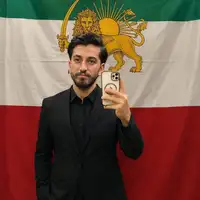
Pro-monarchy slogans like "This is the final battle, Pahlavi will return," and "Reza Shah may God bless your soul" were also heard in various parts of Tehran and other cities during Monday protests, videos obtained by Iran International show.
Exiled Prince Reza Pahlavi in a message on Instagram called on Iranian people to join protesters in the streets and put an end to the rule of Tehran's theocracy which toppled his father's monarchy in 1979.
Root causes of protests
At the core of the crisis is the dollar’s surge to roughly 144,000 tomans over the weekend before easing slightly to 136,000 tomans on Monday.
Shopkeepers say the volatility has made it impossible to price goods, secure supply or plan for basic business survival.
Amid the turmoil, the governor of Iran’s central bank resigned and President Masoud Pezeshkian appointed Abdolnaser Hemmati as the new chief in an effort widely seen as aimed at calming markets and protests.
However, there was no immediate sign the move influenced protesters, and momentum continued to build.
Tehran shopkeepers have vowed to extend their strikes into Tuesday, marking a third consecutive day of action.
Students at Shahid Beheshti University and Amirkabir University, prestigious academic centers in Tehran, also announced plans for a protest gathering Tuesday morning.
With protests spreading nationwide, turning more confrontational and carrying into the night, the coming days will test whether this wave remains anchored in economic collapse or develops into a broader challenge to authority.
Iranian exiled prince, Reza Pahlavi, in a message on Instagram on Monday called on Iranian people to join protesters in the streets and put an end to the rule of Tehran's theocracy which toppled his father's monarchy in 1979.
“Greetings to my compatriots in the bazaar and to those who have taken the streets of Tehran into your own hands. As long as this regime is in power, the country’s economic situation will only worsen. The time has come, now more than ever, to keep up your solidarity,” Pahlavi said.
“I ask all sectors of society to join their compatriots who have taken to the streets and to call for an end to this regime. In particular, I have a message for the security and police forces: Take your destiny into your own hands. This regime is collapsing. Don’t stand against the people, join the people,” he added.
“Victory is ours because our cause is just and because we are united.”