• العربية
  • فارسی
Brand
  • Iran Insight
  • Politics
  • Economy
  • Analysis
  • Special Report
  • Opinion
  • Podcast
  • Live TV
  • Iran Insight
  • Politics
  • Economy
  • Analysis
  • Special Report
  • Opinion
  • Podcast
  • Live TV
  • Theme
  • Language
    • العربية
    • فارسی
  • Iran Insight
  • Politics
  • Economy
  • Analysis
  • Special Report
  • Opinion
  • Podcast
  • Live TV
All rights reserved for Volant Media UK Limited
volant media logo

Russia seeks to keep Iran at odds with the world, ex-FM Zarif says

Oct 17, 2025, 07:59 GMT+1Updated: 12:04 GMT+1
Russia Foreign Minister Sergei Lavrov (right) and Iran's former foreign minister Mohammad Javad Zarif

Russia has long sought to prevent Iran from having normal relations with the world, former foreign minister Mohammad Javad Zarif said, days after the Russian foreign minister faulted him for accepting a sanctions clause in a 2015 nuclear deal.
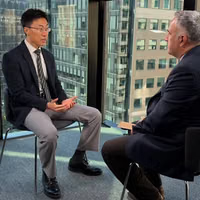
Speaking at a conference in Tehran, Zarif said Russia has two “red lines” in its policy toward Iran — that the country should never enjoy normal relations with the world and should also not enter direct confrontation. “That is why Russia supported the Geneva interim agreement. It kept the wound open but prevented conflict,” he said, according to the official IRNA news agency.

Lavrov said earlier this week that the snapback provision — which allows the rapid return of UN sanctions if Iran breaches the agreement — was “largely Zarif’s creation” and a “legal trap” for Tehran.

Zarif said the snapback clause was added during the final stage of nuclear talks as a substitute for a far worse proposal from Russia and France. “Mr Lavrov and the French had suggested a very bad plan on the status of previous UN Security Council resolutions, and we worked hard to replace it,” he said, according to the official IRNA news agency.

He said the final mechanism, later included in the 2015 nuclear deal and endorsed by UN Security Council Resolution 2231, was designed to prevent any single country from using its veto to block or extend sanctions.

Hardliners in Iran have long criticized Zarif for accepting the JCPOA’s snapback mechanism, viewing it as a concession that enabled the reimposition of UN sanctions.

Last month, France, Germany and the United Kingdom triggered the snapback mechanism, restoring UN sanctions on Iran over its nuclear activities after they accused Tehran of blocking inspections and rejecting diplomacy. The move came despite opposition from Russia and China.

Long mistrust

In a leaked 2022 interview, Zarif said Russia had tried to prevent the 2015 deal from being finalized, adding that “Russia made every possible effort in the final week to stop the agreement from being concluded.”

Zarif also accused Moscow this week of disclosing sensitive information about Iran’s military and diplomatic activities, including General Qassem Soleimani’s visit to Moscow and details of Iranian drone supplies to Russia for the war in Ukraine. “They were the ones who made those public,” he said.

Lavrov has said Russia has always supported the nuclear deal and the UN Security Council resolution that endorsed it. He said the final decision on the JCPOA “was made directly by Zarif and Kerry” and that other participants, including Russia, were observers.

The United States withdrew from the deal in 2018 during first President Donald Trump’s administration. In response, Iran gradually reduced its compliance and in 2019 began enriching uranium at higher levels.

Most Viewed

Alamolhoda seeking presidency of Iran’s Assembly of Experts - report
1

Alamolhoda seeking presidency of Iran’s Assembly of Experts - report

2
INSIGHT

What is Pickaxe Mountain, and why does Trump keep saying he will bomb it?

3
EXCLUSIVE

Satellite images show Iran’s key ports falling quiet under US blockade

4
ANALYSIS

Debate grows over whether Iran is burning its strongest card in Hormuz

5
INSIGHT

Iran's appliance industry is collapsing, and so is the market it was built for

Banner
Banner

Spotlight

  • Satellite images show Iran’s key ports falling quiet under US blockade
    EXCLUSIVE

    Satellite images show Iran’s key ports falling quiet under US blockade

  • Iran's appliance industry is collapsing, and so is the market it was built for
    INSIGHT

    Iran's appliance industry is collapsing, and so is the market it was built for

  • In Hormuz, Iran only needs to keep ships guessing
    PODCAST

    In Hormuz, Iran only needs to keep ships guessing

  • If Britain backs US plan, Iran's London bank shuts down on October 22
    ANALYSIS

    If Britain backs US plan, Iran's London bank shuts down on October 22

  • 'If I'm not happy, they'll execute me': Iran's new grammar of dissent
    ANALYSIS

    'If I'm not happy, they'll execute me': Iran's new grammar of dissent

  • Debate grows over whether Iran is burning its strongest card in Hormuz
    ANALYSIS

    Debate grows over whether Iran is burning its strongest card in Hormuz

Banner