• العربية
  • فارسی
Brand
  • Iran Insight
  • Politics
  • Economy
  • Analysis
  • Special Report
  • Opinion
  • Podcast
  • Iran Insight
  • Politics
  • Economy
  • Analysis
  • Special Report
  • Opinion
  • Podcast
  • Theme
  • Language
    • العربية
    • فارسی
  • Iran Insight
  • Politics
  • Economy
  • Analysis
  • Special Report
  • Opinion
  • Podcast
All rights reserved for Volant Media UK Limited
volant media logo
EXCLUSIVE

Iranian media warned against positive coverage of Trump peace signals

Oct 13, 2025, 21:59 GMT+1Updated: 00:13 GMT+0

Iran’s top security body warned domestic media against positive coverage of US President Donald Trump’s talk of peace with Iran, calling it part of an enemy psychological war, according to a confidential directive seen by Iran International.
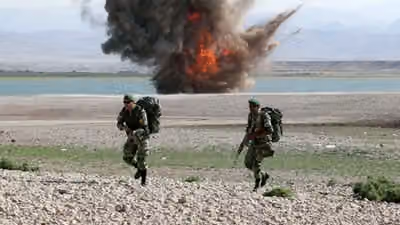

President Trump told the Israeli Knesset on Monday that Tehran was tired of war and Washington was ready for peace after US attacks on Iranian nuclear sites in June.

Hours later, Iran’s Supreme National Security Council (SNSC) sent a directive to domestic media instructing them to exercise caution in covering his remarks.

"Trump’s remarks in the parliament of the Zionist regime, along with certain claims such as pursuing peace, making a deal with Iran and attempting to influence the media environment, make it necessary for colleagues to exercise vigilance regarding the enemy’s psychological warfare."

"Any optimistic view or excitement over a possible shift in the US approach could send wrong signals abroad, harm the economy, and undermine national unity," the SNSC said, according to the directive a copy of which was obtained by Iran International.

It also urged media outlets to provide analytical coverage of Trump's remarks and not simply repeat or amplify his statements.

In a later speech in Egypt's Sharm el-Sheikh, Trump said Iran could not survive sanctions and that it would likely return to negotiations.

"I think Iran will come along. They've been battered and bruised and, you know, they're out there. They need some help. There are big sanctions, as you know, tremendous sanctions," he told reporters alongside Egypt's President Abdul Fattah al-Sisi.

"I'd love to take the sanctions off when they're ready to talk. But they can't really survive with those sanctions," he added ahead of the Middle East Peace Summit which gathered the leaders of 20 countries following a US-brokered ceasefire in Gaza.

Iran was also invited by Cairo to the summit, but declined the invitation citing the presence of Trump who ordered strikes on Iran in June and has imposed the harshest sanctions against the country.

"While favoring diplomatic engagement, neither President Pezeshkian nor I can engage with counterparts who have attacked the Iranian People and continue to threaten and sanction us," Foreign Minister Abbas Araghchi said on Sunday.

Most Viewed

Ideology may be fading in Iran, but not in Kashmir's ‘Mini Iran'
1
INSIGHT

Ideology may be fading in Iran, but not in Kashmir's ‘Mini Iran'

2
INSIGHT

Hardliners push Hormuz ‘red line’ as US blockade tests Iran’s leverage

3
VOICES FROM IRAN

Hope and anger in Iran as fragile ceasefire persists

4

Iran International says it won’t be silenced after London arson attack

5

US sanctions oil network tied to Iranian tycoon Shamkhani

Banner
Banner

Spotlight

  • Hardliners push Hormuz ‘red line’ as US blockade tests Iran’s leverage
    INSIGHT

    Hardliners push Hormuz ‘red line’ as US blockade tests Iran’s leverage

  • Ideology may be fading in Iran, but not in Kashmir's ‘Mini Iran'
    INSIGHT

    Ideology may be fading in Iran, but not in Kashmir's ‘Mini Iran'

  • War damage amounts to $3,000 per Iranian, with blockade set to add to losses
    INSIGHT

    War damage amounts to $3,000 per Iranian, with blockade set to add to losses

  • Why the $100 billion Hormuz toll revenue is a myth
    ANALYSIS

    Why the $100 billion Hormuz toll revenue is a myth

  • US blockade targets Iran oil boom amid regional disruption
    ANALYSIS

    US blockade targets Iran oil boom amid regional disruption

  • Iran's digital economy battered by prolonged blackout
    INSIGHT

    Iran's digital economy battered by prolonged blackout

•
•
•

More Stories

'What foreign policy?': Iranians lament Tehran’s snub of Trump Gaza summit

Oct 13, 2025, 19:15 GMT+1
•
Tehran Insider

Tehran’s decision to skip a Gaza peace summit in Egypt has left many Iranians feeling further cut off from the world—another sign, they say, of leaders who mistake isolation for strength or dignity.

What might once have passed as defiance now feels like self-inflicted irrelevance, an empty gesture that deepens the country’s loneliness.

“(Foreign Minister Abbas) Araghchi said they won’t engage with those who threaten Iranians,” says my friend Sima, an emergency-room doctor. “Well, no one has harmed and threatened us like the Islamic Republic does.”

We’re sitting in a crowded café in central Tehran. The air is thick with the scent of coffee beans and the sound of drab Iranian ‘fusion’ music. Almost no woman wears a headscarf.

I started the conversation, admittedly forcing the topic. My friends were reluctant at first, wary of repeating the same hopeless arguments. But once you start bashing the Islamic Republic, you can’t stop.

“Who gave Araghchi the mandate to talk on our behalf?” Sima continues. “Did they ask us if we wanted them to go to Sharm el-Sheikh? Have they ever asked if we want to be friends or foes with the United States?”

‘Unnecessary isolation’

As glaring as the vanishing hijab is, the fact that no one whispers when politics come up—not because the state has relaxed its grip, but because more and more people are simply assuming their liberty.

“Posturing is all that’s left for them,” says my other friend Amir, a digital marketing manager. “What’s to gain from not being at the table? They’re more irrelevant than ever. Another generation has to suffer this unnecessary isolation.”

Across the table, Elham, a musician, nods. “Listen, I do care about Palestine—and not many around me do, honestly. But what these idiots do, and have been doing for decades, does nothing for the Palestinian cause. You don’t recognize Israel and then what? It’s just empty sloganeering.”

“I don’t think it’s posturing,” Sima interjects. “It’s calculated. Think of Iran as a business worth hundreds of billions. Real change means losing privilege. Why would they?”

‘They don’t want to be normal’

As we speak, I keep checking my social-media feed—with a VPN, of course. Photos from Sharm el-Sheikh flood in: Trump landing, surrounded by world leaders from Europe, the Arab world, and beyond.

For once, Iran wasn’t excluded. It excluded itself.

“They don’t want to act normal,” Amir says, agreeing with Sima, “because behaving normal might be the end of them.”

Elham adds, “Truth is, because elections aren’t free, we never even have the option to show what we want. Only those who toe Khamenei’s line get through. So we can’t even vote for someone who says: stop this madness and be a normal country.”

Her tone isn’t angry—just flat, like someone long past expecting change.

‘Nothing to lose’

Amir smiles bitterly, making it hard to gauge if he's serious or joking.

“Once Khamenei’s gone, things could change," he says. "Khamenei is nearly ninety. He’s got nothing to lose—unlike us. He wants to be remembered as the one who stayed the course. He doesn’t care that his course leads us to ruin.”

This isn’t a typical conversation in Tehran. Most people talk about rent, prices or finding medicine. But scratch the surface, and the anger spills out.

Everyone I know, in one way or another, links their daily struggles to what they see as a deluded, self-defeating foreign policy—one that isolates Iran while pretending to defend its dignity.

As Sima put it, calling this foreign policy “violates the word itself.”

Israeli PM calls US attacks on Iran and Soleimani killing 'historic moments'

Oct 13, 2025, 12:55 GMT+1

Israeli Prime Minister Benjamin Netanyahu called Donald Trump’s June attacks on Iran’s nuclear facilities as a “historical moment” in a speech delivered before the US President addressed the Jewish state’s parliament.

Likening the bombing of Fordow to the 2020 killing of Quds Force chief, Qassem Soleimani, killed in an airstrike in Iraq, Netanyahu said to Trump: “You have changed the balance of power.”

Trump’s address came as Iran-backed Hamas in Gaza released all the remaining 20 living hostages held since October 7, 2023, when the militant group, designated a terrorist organization by countries such as the US, captured over 250 and killed over 1,200 mostly civilians.

The living hostages were back in Israel by lunchtime on Monday, while 28 other dead one were still due for release and the first of 1,950 Palestinian prisoners on terror charges were released from Israeli jails.

Since October 7, Netanyahu said, Iran and its allies around the region have all been weakened. The deaths of leaders including Hamas leader Yahya Sinwar and Hezbollah leader Hassan Nasrallah had shown the damage done to Iran’s ‘axis of resistance’ - a group of allies united under the Palestinian cause and aiming for the destruction of Israel - which attacked the Jewish state from seven fronts in the wake of October 7.

“Our enemies now know the strength of Israel,” he said. Israel achieved “amazing victories over Hamas and the entire Iranian terror axis,” he added, saying that after the bloody 12-day war in June which saw death and destruction to both Iran and Israel, Iran’s nuclear and ballistic missile program has been “rolled back.”

Speaker of the Knesset, Amir Ohana spoke of the 'bravery' of Trump, saying the bombing of Iran’s three nuclear facilities, Fordow, Isfahan and Natanz, in Operation Midnight Hammer, was a huge act of bravery after Israel launched Operation Rising Lion on June 13 when it launched air attacks which killed swathes of Iran's military leadership and top nuclear experts.

Ohana called Trump a “colossus who will be enshrined in the pantheon of history,” declaring that the Jewish people will remember him “thousands of years from now.”

US ready for peace with Iran, Trump says in speech to Israeli parliament

Oct 13, 2025, 12:34 GMT+1

Speaking before the Israeli Knesset on Monday, President Donald Trump said that Iran is tired of war and Washington is ready for peace after US attacks on Iranian nuclear sites in June.

"Iran, we are ready when you are and it will be the best decision Iran has ever made, and it’s gonna happen," he said in an address welcoming the first phase of a US-mediated Gaza peace plan.

"Because of us, the enemies of all civilization are in retreat, thanks to the bravery and skill of the Israeli defense forces and Operation Rising Lion," he said, referring to Israel's surprise air strikes on Iran on June 13 which triggered the 12-day war.

Praising Israeli Prime Minister Benjamin Netanyahu in his first foreign address to a parliament during his second term, he said: "Great job and my people loved working with you. Many of Iran’s top terrorists including nuclear scientists and commanders have been extinguished from this earth."

During Operation Midnight Hammer, he said, which saw the US join the war and strike Iran's three main nuclear facilities, Natanz, Fordow and Isfahan, "the US military flew seven of those beautiful B2 bombers, (we just ordered 28 more of them, a little updated version) and almost 100 other planes went with them, including fighter jets".

As 20 living hostages were released from Gaza after two years in Iran-backed Hamas captivity, Trump said that since he came to office, the US had finished eight wars in eight months, including the Iran war.

"We dropped 14 bombs on Iran’s nuclear facilities, which has been confirmed to have obliterated those facilities and together we helped stop the world’s number one state sponsor of terrorism from making nuclear weapons. If we didn’t do that, there would be a dark cloud over this [Gaza] deal. This was our last shot,” he said.

"If there were large scale nuclear weapons in the hands of iran we wouldn’t be here today. We took a big cloud off the Middle East and off Israel,” he said, referring to the other nations in the region who have for decades feared Iran’s nuclear capabilities. "They took a big hit."

As Trump now looks to expand the 2020 Abraham Accords, which saw Arab nations such as the United Arab Emirates normalize relations with Israel, he spoke of peace with Iran.

"It would be great if we made a peace deal with them, wouldn’t it be nice, I think they want to, I think they’re tired," he said.

"When someone told me they had started their nuclear program again, I said, they’re not starting anything, they want to survive, the last thing they want is to start digging holes again in mountains that just got blown up. But first we have to get Russia done."

Speaking of Iran's military allies in the region, he said that "the enemies of all civilization are in retreat".

"In Lebanon, the dagger of Hezbollah long aimed at Israel’s throat has been totally shattered and my administration is supporting the new president of Lebanon and permanently disarm Iran’s Hezbollah brigades," he said.

Since October 7, when Iran-backed Hamas invaded Israel, killing 1,200 mostly civilians and taking more than 250 hostage, Iran and its allies across the region joined Hamas in attacking Israel from countries including Syria, Iraq and Lebanon.

"By force of arms you’ve won," Trump told Israel's parliament after the longest Gaza war since Hamas took control of the strip in 2007 came to an end.

Iran says skipping Sharm el-Sheikh summit will not limit regional influence

Oct 13, 2025, 09:54 GMT+1

The Islamic Republic decided not to attend the Sharm el-Sheikh peace summit after carefully reviewing the potential benefits and risks, Iran’s Foreign Ministry said Monday but insisted the move would not diminish Tehran’s influence in regional or international developments.

The government had received an invitation from Egyptian President Abdel Fattah el-Sisi addressed to President Masoud Pezeshkian, Foreign Ministry spokesperson Esmaeil Baghaei told reporters on Monday. The decision not to attend, he said, was made “after thorough discussions inside and outside the ministry,” with all “positive and negative aspects evaluated before a final choice that serves national interests” was announced.

Responding to suggestions that Iran’s absence could weaken its regional role, Baghaei said, “Iran’s influence and role in regional and international developments go far beyond physical participation in any single event.” Tehran’s presence “cannot be confined to attending or not attending one international meeting,” he added.

“Iran remains one of the most active countries in opposing Israel’s actions in Gaza,” Baghaei added, saying Iran “will continue its work actively and is confident of its impact wherever necessary.”

Iran assessing Trump peace initiative

Asked about the US-led peace proposal and the summit chaired by President Donald Trump, Baghaei said Iran is “closely evaluating the developments” surrounding the plan. “The Islamic Republic is in a position to turn any threat into an opportunity and to chart a course for securing its national interests from within challenges,” he said.

Tehran has long studied every aspect of the Gaza conflict and continues to oppose the ongoing violence, he noted.

“Fortunately, Iran is in a position to counter any sanctions and to identify and use every opportunity arising from challenges in the interest of the nation.”

Other diplomatic matters

Baghaei also confirmed that Iran’s ambassadors to Germany, France, and the United Kingdom — who had been recalled for consultations — have returned to their posts.

Asked about Trump’s recent remarks that US strikes on Iran’s nuclear facilities helped pave the way for the Gaza peace deal, Baghaei said such remarks “should be asked of them [the Americans],” adding that “Iran has always firmly defended its interests and continues to use all its capacities to confront foreign adventurism.”

US strike stopped Iran from getting nuclear bomb before Gaza deal, Trump says

Oct 13, 2025, 08:01 GMT+1

The United States’ destruction of Iran’s nuclear facility prevented Tehran from obtaining a nuclear weapon just months before the Gaza peace deal, US President Donald Trump said Sunday, calling it key to achieving the current ceasefire framework.

“Had we not taken out Iran’s nuclear facility… it would have a really dark cloud over" the Gaza peace deal, "because in two months they would have had a nuclear weapon,” Trump told reporters aboard Air Force One on his way to the Middle East.

He recalled that Israeli Prime Minister Benjamin Netanyahu had pleaded with former President Barack Obama and then–Vice President Joe Biden not to move forward with their Iran policy.

“Remember when Netanyahu came and he begged that Obama and Biden not do what they were doing with Iran? Begged him and they wouldn’t even listen to him. Everything they did was the opposite of what you should have done. Biden and Obama backed Iran,” Trump told reporters.

Iran’s president Masoud Pezeshkian has declined Egypt’s invitation to attend the Sharm el-Sheikh peace summit on Monday, where more than twenty world leaders are expected to discuss Gaza’s post-war future.

Foreign Minister Abbas Araghchi also announced he would not attend, citing continuing US sanctions and what he called “threats against the Iranian people.”

The summit, co-chaired by Trump and Egyptian President Abdel Fattah el-Sisi, includes leaders or top diplomats from Germany, France, the UK, Italy, Spain, Qatar, Turkey, Saudi Arabia, the UAE, Jordan, Pakistan, and Indonesia.

“Iran wants to work on peace now,” Trump said earlier this month. “They’ve informed us they are totally in favor of this deal. We appreciate that, and we’ll work with Iran.”