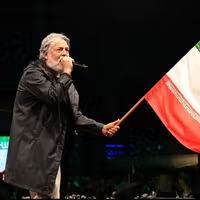
Negotiations over the Islamic Republic’s nuclear program are meaningless while foreign powers remain focused solely on extracting concessions, wrote Iran’s hardline daily Kayhan on Monday.
“Until one side only seeks to take concessions and impose surrender on the other, talk of diplomacy is meaningless and a waste of time,” the paper overseen by Supreme Leader Ali Khamenei said.
“Adversaries confronting Iran are unchanged from the 1980s, during the Iran-Iraq war,” it argued, insisting that only “resistance and non-surrender remain viable.”
The window of diplomacy is valid only so long as the other side accepts such a window and its rules, which is giving and taking concessions, the paper said.
One hundred Mossad operatives were deployed inside Iran to install and operate smuggled heavy missile systems, which were used to disable missile launchers and air-defense batteries at the start of June’s 12-day war, according to a documentary by Israel’s Channel 13.
“I told him: 'We have to do it.’ And he said, ‘You’re right, it’s gotta be done,’” Prime Minister Benjamin Netanyahu recalled of informing US President Donald Trump about the planned operation, according to the documentary.
The new Channel 13 documentary describes what it calls an unprecedented mission — both in scale and technical demands.
Specially trained agents deployed inside Iran installed and operated smuggled heavy missile systems, which were then used to strike the Islamic Republic’s ballistic missile launchers and air-defense batteries, aiding Israel’s broader campaign, the report said.
Negotiations over Iran’s nuclear program began under Trump’s administration with a 60-day ultimatum. On day 61, June 13, Israel launched its surprise 12-day campaign, coinciding with the eve of the sixth round of talks with Washington.
By the ninth day of fighting, the US carried out strikes on three Iranian nuclear sites, with Trump later boasting they had “obliterated” the program.
The Israeli operation involved about 100 foreign operatives, raising major logistical and command challenges, the report said. Channel 13's interviews with senior ministers suggest broader aims beyond disabling equipment: damaging underground facilities, weakening command structures and shaping events to sway US policy.
According to the report, leaders even discussed targeting Iran’s supreme leader if the chance arose.
Defense Minister Israel Katz is quoted as saying, “If there had been an opportunity, we would have [targeted him].”
Netanyahu reportedly told defense officials: “We are going to destroy the Iranian nuclear project as best we can. We aren’t waiting for a green light from the US, and it doesn’t matter if they say no.”
Secrecy, risk and the politics of optics
Secrecy was paramount, the documentary said. Foreign Minister Gideon Sa’ar recounted discussing a friend’s daughter’s upcoming wedding even as he knew it would not go ahead due to the looming offensive. Even families of top officials were mostly kept uninformed.
Brig. Gen. Gilad Keinan, the Israeli Air Force operations chief, said confidence was high in recovering downed crews, but extracting them from Iran was less certain. He added that many Iranian jets stayed grounded for fear of being shot down by their own defenses.
Cabinet transcripts revealed concern with optics. Strategic Affairs Minister Ron Dermer suggested images of destruction would help persuade Trump.
Netanyahu agreed, urging strikes on fuel tanks and a Basij facility, vowing to deliver a “birthday greeting” to the US president in the form of a decisive blow, according to the documentary.
Channel 13 said nuclear and missile sites were damaged and nuclear materials partly destroyed in the operation.
Air attacks killed nuclear scientists along with hundreds of military personnel and civilians.
Tehran answered with over 500 ballistic missiles and 1,100 drones, inflicting heavy casualties and widespread destruction, killing 31 Israeli civilians and one off-duty soldier.
"Iran’s reign of terror threatens Israel, our allies, and the world. We must all stand together to ensure Iran does not gain access to a nuclear weapon," New Jersey Representative Josh Gottheimer said.
"I’ve long called for the UN to reinstate snapback sanctions, and I’m glad to see them follow through."
Ali Motahari, a former member of parliament, on Sunday called on President Masoud Pezeshkian to accept talks with Donald Trump, if requested, during his trip to New York for the sake of the “nation’s” interests.
In a post on X, Motahari further stressed that Trump’s cult of personality is such that he wants to take credit for everything, and this very trait could ultimately work to Iran’s advantage.
Reformist politician Gholam-Hossein Karbaschi also called on Pezeshkian to secure Supreme Leader Ali Khamenei's permission for a meeting with Trump in New York.
An investigative report by a Tehran daily documented dozens of cases of Iranian boys abused in schools, sports and transport, shedding light on a mostly underreported pattern compared to widespread accounts of girls’ abuse.
“My teacher wanted me to take off my clothes,” said Farid, a survivor who spoke to the reformist Shargh newspaper under a pseudonym.
The paper’s reporter collected detailed, often graphic recollections from men who described being touched, groped or coerced into sexual acts in settings where they expected safety.
Amir-Ali, now 32, recalled a taxi ride in which a passenger repeatedly pressed his body close and then placed a hand on his thigh. He said he felt powerless, ashamed and unable to tell friends or family.
“I didn’t speak to anyone — I thought I’d be mocked,” he told the reporter.
Majid described being molested on a crowded metro: the man next to him repeatedly adjusted his hand until the touching became unmistakable. He said he moved away without protest because embarrassment and fear made him freeze. “It was so strange and scary,” Majid added. “I just wanted to get off at the next stop.”
Far more sustained abuse appears in other accounts. Javid recounted grooming and repeated sexual exploitation by a 25-year-old assistant coach at a youth football class. He says the coach showed explicit videos, demanded sexual acts and pressured boys to comply, leaving Javid depressed and withdrawn for years.
Some victims described telling only a single friend or, in a few cases, later raising the matter in therapy — and even then withholding details.
Another survivor, Sepehr, said a close relative forced him into sexual acts from the age of ten and that he has only ever disclosed the abuse in psychotherapy. He feared family fallout and shame: “I was scared that people in the family would find out,” he told Shargh.
Shame, silence and long-term harm
The dominant theme is shame, according to psychologist Parisa Pouyan, who works on social-harm issues.
“They often feel their masculinity and sexual identity are questioned; for many, the violation is deeply humiliating,” she added. Pouyan warned that the silence compounds harm: survivors commonly suffer depression, social withdrawal and difficulties forming intimate relationships long after the assaults.
Legal advocates say institutional barriers deepen invisibility. Although Iran’s statutes do not formally distinguish male and female victims, “in practice, the numbers and the follow-through are very different,” Monica Nadi, a lawyer experienced in social-harm cases, told the paper.
She pointed to stigma, a lack of male-oriented support services and the legal difficulties of proving sexual crimes — lost physical evidence, absent witnesses and delayed reporting — as reasons why men rarely pursue judicial remedies.
Settings and system failures
Shargh’s investigation found incidents in boys’ schools, sports clubs, family homes, barracks, prisons, taxis and metro cars.
Several interviewees said suspected perpetrators were later moved between institutions rather than removed from positions of authority after being exposed for their harassment, risking further abuse.
The paper’s reporting calls for targeted steps: breaking cultural taboos, expanding counselling and support services for male survivors, training educators and staff, and improving mechanisms for reporting and evidence collection.
Survivors and experts warned that without systemic reform, many victims will continue to carry trauma in silence and cycles of abuse may persist.
File photo shows a woman in a shelter in Brazil for girls who have faced sexual violence or sexual commercial exploitation
Iran's Shi'ite establishment promotes temporary marriage as a way to prevent illicit relationships. Yet even devout families often disapprove, associating the practice with prostitution and social shame.
Under Shi'ite law, a man can have four permanent wives simultaneously and any number of temporary wives. He needs his first wife’s consent for additional permanent marriages, but not for temporary ones.
Women, by contrast, can only enter one temporary marriage at a time and, after termination, must wait at least 45 days before remarrying to establish paternity if pregnant.
“I don’t know a single woman around me who would agree to a temporary marriage, unless she is involved with a married man and wants to protect herself from being charged with adultery if discovered,” said Taraneh, an art teacher in Tehran.
“In these cases, it’s more a formality than religiosity. Just like an affair, they hide it from everyone, even their family and friends.”
Taraneh explained that stigma is deeply rooted. The longstanding association between temporary marriage and prostitution, she said, reinforces secrecy and social judgment, especially against women.
“But in some poorer rural areas I’ve visited, it is somehow more common for widowed or divorced women who are unable to financially support themselves to marry temporarily with men whose wives will not allow them to officially take second wives,” she added.
“However, even these are normally longer-term and not publicized. Everyone considers very short-term temporary marriages shameful because of the money involved."
Temporary marriage in Shi'ite Islam
Under Shi'ite Islamic law, temporary marriage, known in Persian as sigheh or mut‘ah, is a marriage contract with a set duration. The term may last from a few hours to several years, depending on the agreement.
The contract is usually verbal and consists of the man and woman (or their representatives) reciting a formula (sigheh) that specifies the agreed duration and a predetermined dowry (mahr). Witnesses are not required for it to be valid.
Since 2013, temporary marriage has been legally recognized in Iran, though registration is only required if a child is conceived.
If registered or witnessed, temporary marriage allows recognition of children and provide some legal security to women. Once the term ends, the marriage automatically dissolves without requiring divorce proceedings.
Children are legally recognized, with inheritance and custody rights, though complications often arise if the marriage is not officially registered.
Unlike permanent marriage, a woman in temporary marriage is not entitled to alimony after expiration and has no right of inheritance from her temporary husband.
Widows and divorced women may enter temporary marriage without paternal consent. Unmarried girls, however, need their father’s approval, as in permanent marriage. The minimum legal age for girls is 13, fueling concern about child marriage in poor areas.
Sunni Islam does not recognize temporary marriage.
Sex trade in disguise
Islamic jurists describe temporary marriage as a legitimate solution to sexual needs and a safeguard against prostitution.
Although prostitution is explicitly criminalized and punishable in Iran, sigheh still enjoys legal backing, and its broad interpretations have created a religious-legal loophole that paves the way for exploitation.
The sex trade often operates under the guise of temporary marriage. This is especially visible in religious cities such as Mashhad and Qom, pilgrimage hubs where millions travel each year.
Since its legal recognition, numerous social media channels have openly advertised temporary marriage, offering arrangements from “one-hour to longer terms,” for fixed fees.
Even clerics who accept the principle of sigheh criticize this trend. They argue that it normalizes polygamy or masks prostitution.
“Can you believe that some ignorant, clueless people have set up [Telegram] channels to promote polygamy and temporary marriage? They claim they are reviving the Prophet’s tradition!" wrote cleric Ehsan Ebadi on X.
"Curse on you—you have understood neither the Prophet, nor Islam, nor the philosophy behind these rulings. All you are doing is tarnishing the image of religious people."
Javan newspaper, affiliated with the Revolutionary Guard, reported on September 20 that the growth of online channels and pages under the titles of matchmaking and sigheh-finding has turned into a platform for fraud and exploitation of users.
“The rapid increase of these channels is a serious alarm bell for society.”