Russia blasts E3 sanctions bid on Iran as 'gross violation' of 2015 deal
Britain, France and Germany "grossly violated the procedure for the consideration of disputed situations we have under JCPOA in particular," Russia's Permanent Representative to the UN Security Council Vasily Nebenzya said before the body voted not to permanently lift sanctions on Iran.
"Their only goal now is to use the council as a tool for their bad faith play, as a lever to exert pressure on ... a state which is trying to defend its sovereign interests," he continued.
"Here you have a very good illustration of the fact that our European colleagues do, in essence, reject diplomacy. They prefer the language of blackmail and intimidation."
The UN Security Council convened on Friday morning to discuss a draft resolution concerning the snapback of sanctions on Iran, a process initiated after European governments declared the country in significant non-performance of the 2015 nuclear deal.
South Korea, as Council president this month, placed the text in blue earlier in September. It contains a single operative paragraph affirming that past sanctions remain terminated, meaning adoption would preserve relief measures under resolution 2231.
European ministers said in an August 28 letter that Iran’s actions left no credible alternative to triggering the mechanism. They pointed to more than 8,400 kilograms of enriched uranium—forty times the agreed limit—including several hundred kilograms enriched to 60 percent. “Iran has yet to take the reasonable and precise actions necessary to reach an extension of resolution 2231,” the German Foreign Office said Wednesday.
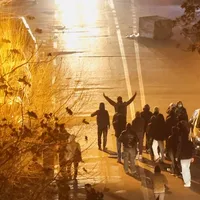
Police officers clash visitors during a hijab-related dispute in Ramsar, northern Iran.
A video circulating on social media shows security guards clashing with visitors at the Marble Palace in Ramsar, after a hijab warning escalated into physical confrontation and police intervention.
The palace is a historic Pahlavi-era building built in 1937 by Reza Shah Pahlavi as a royal summer residence.
Iranian outlets reported the incident took place about a week ago. In the footage, a man with blood on his face lies on the ground while a guard holds a pepper spray canister. Eyewitnesses said guards used pepper spray against young women, creating panic among visitors.
The visitors were from the religious city of Mashhad, according to Entekhab News, citing a local journalist. A guard confronted one of the women at the entrance, and when her headscarf slipped inside the museum, he pushed her, sparking a fight that drew in police, the report said.
Social media users noted the recording date as September 11, days before the third anniversary of the death in custody of Mahsa Amini, detained in 2022 for alleged hijab violations.
Journalist and activist Masih Alinejad reacted on Instagram, writing: “This is the same government that stages concerts at night, executes by day, and assaults women over a few strands of hair.”
Wider crackdown
The video has renewed focus on violent enforcement of compulsory hijab, with calls for accountability and protection of women in public spaces. Confrontations have been documented before, with security forces, plainclothes agents, and civilians policing women’s dress. Rights advocates warn such practices intrude on privacy and fuel social violence.
Recent weeks have seen a wave of closures targeting businesses, cafés, hotels, and bookstores over alleged defiance of hijab rules. Rights group HRANA previously reported more than 30,000 women were stopped last year for non-compliance, and at least 536 commercial units were sealed.
Despite intensified state pressure, women’s acts of defiance persist. A video obtained by Iran International on September 16 showed a woman in Karaj standing unveiled atop a garbage container and shouting, “You have turned Iran into a prison.”
A poster from a protest in support of Ahmadreza Djalali
The Foreign Policy Committee of the Flemish Parliament in Belgium has called on Iran’s ambassador to clarify the fate of Ahmadreza Djalali, the jailed Iranian-Swedish academic whose whereabouts have been unknown since June.
“After three months without any news, concern about the condition of Prof. Ahmadreza Djalali is greater than ever. The MPs therefore want to obtain more information from the Iranian ambassador,” parliament chair Freya Van den Bossche and committee chair Bogdan Vanden Berghe said in a joint statement on Thursday.
Djalali, a disaster medicine specialist affiliated with the Free University of Brussels, was detained in April 2016 during a professional visit to Iran. In 2017 he was sentenced to death on charges of espionage and complicity in the killing of two Iranian nuclear scientists, accusations he and his family have consistently denied.
Earlier this year, he suffered a heart attack while held in Tehran’s Evin prison. After the Israeli bombing of that facility, he was transferred with other detainees to the Greater Tehran Penitentiary. From there, according to accounts shared by his family, he was taken away separately. Since June 23, there has been no trace of him.
Pressure builds in Belgium
Last week, the committee and parliament speaker Van den Bossche met Djalali’s wife, Vida Mehrannia, to discuss his situation. Following that meeting, MPs unanimously agreed to summon the Iranian envoy.
Djalali’s case has drawn international concern, with European institutions and human rights organizations urging Tehran to halt his death sentence and release him on humanitarian grounds.
For Belgian lawmakers, his disappearance has heightened alarm not only about his health but also about the Iranian authorities’ treatment of dual nationals, many of whom remain imprisoned under contested charges.
A member of Iranian healthcare professional community
Almost 29 percent of registered general practitioners in Iran are not practicing medicine, according to figures cited by local media, which said the trend highlights waste in training costs and ongoing shortages of medical specialists.
More than 104,000 general practitioners are officially registered, but at least 30,000 are not active in the field, Nour News, an Iranian outlet affiliated with Supreme National Security Council, reported Thursday.
“The number alone demonstrates the loss of educational, financial and human capacity in a country that constantly faces shortages of specialists and unequal access to health services,” the outlet wrote.
It criticized authorities for repeatedly expanding medical school admissions as a response to shortages, arguing this has produced “a surplus of manpower without efficiency.”
Concerns about the lack of specialists have grown in recent years.
Interest in six key specialty fields has declined to the point that “the absence of applicants in these core disciplines will confront Iran’s healthcare system with serious challenges,” Abbasali Reis-Karami, head of Tehran University of Medical Sciences warned in July.
Training each general practitioner, according to Nour News, costs the government “tens of thousands of dollars,” yet many leave medicine altogether or turn to unrelated jobs.
No effective strategy has addressed the shortage of specialists, the outlet added, citing the most recent residency exam where only 10 percent of emergency medicine slots were filled, alongside 32 percent in anesthesiology, 22 percent in pediatrics, and 15 percent in infectious diseases.
An increasing number of Iranian doctors and nurses are leaving the profession or emigrating, mainly due to very low wages, raising concerns about a serious shortage of healthcare workers.
Iranian medical and government officials have repeatedly warned in the past few years about the inevitable deterioration of the healthcare system and its possible collapse if the same trends continue.
An International Atomic Energy Agency (IAEA) sign at the opening of the IAEA General Conference at the agency's headquarters in Vienna, Austria, September 15, 2025.
Iran pulled a resolution at the UN nuclear watchdog’s annual conference that sought to prohibit attacks on nuclear facilities.
The draft resolution—co-sponsored by China, Russia, and a group of nations including Cuba and Venezuela—condemned the June 2025 Israeli and US strikes on Iranian nuclear facilities.
“Guided by the spirit of goodwill and constructive engagement, and at the request of several member states,” Tehran had deferred action until next year, Iran’s Ambassador to the UN Reza Najafi told the General Conference on Thursday.
Iran and the other sponsors of the resolution do not wish to place member states in a position of endorsing an unrealistic decision, he said.
The issue will be raised again at the next session of the IAEA General Conference, according to the Permanent Mission of the of Iran.
The withdrawal also comes as France, Germany and the UK have invoked the snapback mechanism to reimpose UN sanctions on Iran under resolution 2231. That process is expected to conclude by September 28 unless the Security Council adopts a resolution to preserve sanctions relief.
This comes against a backdrop of escalating tensions, triggered by Israeli strikes on Iranian nuclear and military sites in June, followed by US attacks on three additional facilities.
However, Tehran says its nuclear program is peaceful.
French President Emmanuel Macron said on Thursday that the sanctions process was “a done deal,” adding that “The latest news we had from the Iranians is not serious.”