Iran armed forces chief hails Russia’s stance during 12-day war
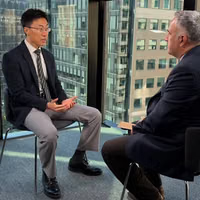
Chief of Staff of Iran’s Armed Forces Abdolrahim Mousavi (right) meeting Russian Energy Minister Sergei Tsivilev in Tehran on September 18, 2025.
Russia took firm positions during the 12-day war with Israel, Chief of Staff of Iran’s Armed Forces Abdolrahim Mousavi said in a meeting with Russian Energy Minister Sergei Tsivilev in Tehran on Wednesday.
“The enemy used negotiations as a cover for deception and betrayed diplomacy by starting the war,” Mousavi said.
He said Iran has never initiated war and sees diplomacy as the best way to resolve disputes, but argued that the armed forces had given a strong response to the United States and Israel.
Moscow supports stronger cooperation in both economic and defense fields, the Russian minister said in return.
Pezeshkian stresses partnership
Iran is prepared to expand cooperation with Moscow, President Masoud Pezeshkian said in a separate meeting with Tsivilev.
Iran's President Masoud Pezeshkian (right) meeting Russian Energy Minsiter Sergei Tsivilev (left) in Tehran on September 18, 2025.
“No barrier stands in the way of Iran-Russia cooperation, and the model of successful cooperation between independent countries like ours will prove that the era of unilateral powers has ended,” Pezeshkian said.
He called joint projects proof that sanctions have not obstructed Tehran. “Growth can be achieved without reliance on unilateral powers,” Pezeshkian added, saying that agreements in transport, energy, and power generation will move forward if ministers and expert teams accelerate implementation.
Officials from both governments remain in regular contact to ensure agreements are carried out, Tsivilev said. “No pressure or sanctions can disrupt this process.”
Iranian and Russian officials have repeatedly announced projects on trade, transport, and energy. Many have been delayed or left incomplete because of financial limits and logistical difficulties.
France has selected Iranian director Jafar Panahi’s It Was Just An Accident, winner of this year’s Cannes Palme d’Or, as its submission for the Academy Awards in the international feature category, giving the exiled filmmaker a path to Hollywood that Tehran was unlikely to offer.
The revenge drama, produced largely in France and shot in Iran without government approval, follows a group of former political prisoners confronting a man they believe tortured them decades earlier.
The decision, announced on Wednesday, was made by an 11-member committee convened by France’s culture ministry after reviewing five finalists, including Richard Linklater’s Nouvelle Vague and Rebecca Zlotowski’s A Private Life.
Panahi, long banned from working or traveling in Iran, has spent much of the past 15 years under house arrest or in prison. He was released from jail in 2023 after a hunger strike, and edited the new film in France.
US distributor Neon has acquired the film and is planning an awards campaign, while Mubi has taken international rights.
“This Iranian drama, directed by the great Jafar Panahi and produced with the decisive support of France … is proof that our country, 130 years after inventing cinema, remains the beating heart of international co-productions,” Gaëtan Bruel, head of the CNC film body, said in a statement.
The move also highlights stark contrasts with Iran’s own Oscar choice. A day earlier, Tehran selected Ali Zarnegar’s Cause of Death: Unknown, a moral drama that won praise abroad but was pulled from Iran’s state-run Fajr Festival in 2022. Independent filmmakers in Iran continue to face censorship, surveillance and travel bans.
The 98th Academy Awards will take place in Los Angeles on March 15, 2026.
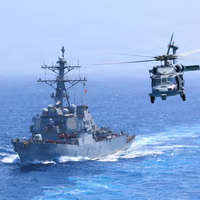
Pentagon budget documents seeking urgent new funding show that the US has fired around $500 million worth of its Terminal High Altitude Area Defense (THAAD) interceptor missiles to defend Israel, primarily during its June war with Iran.
"This reprogramming action provides funding for the replacement of defense articles from the stocks of the Department of Defense expended in support of Israel or identified and notified to Congress for provision to Israel," the document said.
The budget document dated August 1, is titled Israel Security Replacement Transfer Fund Tranche 9, and requested $498.265 million in funding for THAAD systems alone.
“Funds are required for the procurement of replacement THAAD Interceptors expended in support of Israel. This is a congressional special interest item. This is an emergency budget requirement,” the document said.
The War Zone reported that the US fired more than 150 THAAD missiles during the Iran war alone.
The publication also said details of US bombings of Iranian nuclear facilities, known as Operation Midnight Hammer, are only just coming to light now, though the full cost is still unknown.
The US announced it had deployed THAAD defences in Israel in October, more than a year after the Gaza war broke out, seeing Iran's allies in the region firing on the Jewish state from Lebanon, Yemen, Iraq and Syria.
It also came after Iran's second direct attack on Israel when hundreds of missiles and drones were fired in a massive aerial barrage.
"This reprogramming action addresses funds for the replacement of defense articles expended in support of Israel through US combat operations executed at the request of and in coordination with Israel and for the defense of Israeli territory, personnel, or assets during attacks by Iran, and subsequent or anticipated attacks by Iran and its proxies," the document said.
The documents show the extent of the cost of the US military's defense of Israel and also the cost of weapons that American forces used during their extensive bombing of Iran’s three main nuclear facilities in June, Natanz, Fordow and Isfahan.
Among the funds requested were those to "replace GBU-39s expended during Operation Midnight Hammer in support of Israel", the document detailed. "This is a congressional special interest item. This is an emergency budget requirement."
Made by US defense contractor, Lockheed Martin, THADD intercepts short, medium and intermediate-range ballistic missiles, engaging targets directly at ranges of 93 to 124 miles both inside and outside the atmosphere.
Each THAAD battery system requires around 100 soldiers, and has been used to help defend Israel from ballistic missiles from both Iran and its military ally, the Houthis, in Yemen.
US Missile Defense Agency documents say that each THAAD interceptor costs roughly $12.7 million, and now there are concerns about insufficient American stockpiles.
In addition to Iranian attacks, Israel says dozens of drones and ballistic missiles have been fired from Yemen to Israel since the outbreak of the Gaza war. The Iran-backed Houthis say their actions are in allegiance with Iran’s ally Hamas in Gaza.
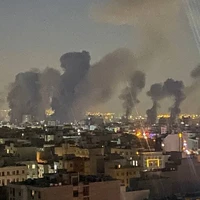
During the 12-day war in June, Iran fired over 500 ballistic missiles in response to Israel’s surprise attacks on June 13, in which dozens of military and nuclear figures were killed.
Iran-aligned media and online networks joined Russia- and China-linked actors in pushing false or inflammatory narratives after US conservative activist Charlie Kirk was shot dead earlier this month according to US officials and outside researchers.
Monitoring firm NewsGuard said on Wednesday that official outlets in China, Russia and Iran mentioned Kirk more than 6,000 times from September 10–17, frequently framing the shooting as a conspiracy and recycling unsubstantiated claims.
“The more confusion and mistrust they can inject right after a breaking news event, the harder it becomes for people to know what’s true,” McKenzie Sadeghi, NewsGuard’s editor for AI and foreign influence, said.
Utah Governor Spencer Cox said earlier this week that authorities were tracking “a tremendous amount of disinformation” and bot activity urging violence; he did not cite specific accounts.
Police have charged a 22-year-old suspect and said he acted alone. Authorities have not linked the killing to any foreign government.
Analysts and media reports say the narratives diverged: pro-Kremlin channels sought Ukraine links; Beijing-aligned accounts highlighted US polarization and gun violence; and Iran-linked outlets and influencers promoted anti-Israel conspiracy theories.
Pro-Iranian groups say Israel was behind Kirk’s death and that the suspect was set up to take the fall, according to New York Times.
“They’re picking up domestic actors and amplifying them,” said Joseph Bodnar of the Institute for Strategic Dialogue.
Cox urged Americans to ignore viral claims that appear designed to provoke fear.
The activity fits a longer pattern US officials have attributed to Tehran. Microsoft’s Threat Analysis Center reported in August 2024 that Iranian operators stood up US-facing pseudo-news sites such as “Savannah Time” and “Nio Thinker,” sometimes using generative AI, and in June 2024 attempted to compromise accounts tied to US presidential campaigns.
The Foundation for Defense of Democracies said in September 2024 it had identified at least 19 pro-Iran sites targeting minority and veteran voters. Google Cloud’s Mandiant and Meta have separately flagged Iran-linked efforts aimed at US audiences.
Washington has sanctioned Iranian and Russian entities over alleged interference. In December 2024, the US Treasury blacklisted an Islamic Revolutionary Guard Corps subsidiary known as the Cognitive Design Production Center and Russia’s Center for Geopolitical Expertise, accusing both of seeding disinformation and, in Moscow’s case, using AI-generated deepfakes.
Russia, China and Iran have all denied targeting Americans with disinformation.
Kirk, founder of Turning Point USA, had mixed public views on Iran over the years. In 2020 he warned against a broader war after the US killed Iranian commander Qassem Soleimani. In June 2025, after US strikes on Iranian nuclear sites, he publicly backed the action while praising Iranian-Americans in earlier campus remarks widely shared online.
US officials say foreign exploitation of domestic crises predates the 2024 election cycle. A 2021 declassified assessment found Iran sought to undercut Donald Trump’s prospects in 2020 while eroding trust in US institutions; security agencies warned again in 2022 and 2024 that Tehran aims primarily to inflame social divisions.
The Center for Countering Digital Hate said posts calling for retaliatory violence after Kirk’s killing were viewed 43 million times on X, though the share from foreign sources is unclear.
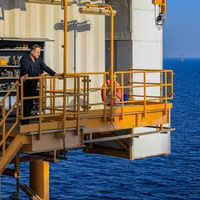
Iran hemorrhages the value of about four out of every five barrels of oil it manages to export, a former senior US Treasury official told Iran International, as sanctions forced funds to be lost in corrupt smuggling networks.
“They push this oil through corrupt networks and the worst actors in the government— people already sanctioned internationally," said Miad Maleki, former head of the US Treasury’s Office of Global Targeting within the Office of Foreign Assets Control (OFAC), "They get paid for only one out of five barrels they ship.”
The United States has maintained sanctions on the Islamic Revolution for decades but the measures were dramatically ramped up in 2018 when Donald Trump launched his so-called maximum pressure campaign.
Tehran has developed elaborate methods to evade sanctions, including a dark fleet of tankers that baffle tracking by switching off their transponders and conduct ship-to-ship transfers to mask the origin of its oil.
Maleki, a US air force veteran, argues these methods renders oil sales extremely costly. “Most of the money is wasted on shipping, discounts and commissions paid to layers of corrupt actors,” he said.
In nearly eight years at OFAC, Maleki helped design and implement the Treasury's sanctions campaigns against the Islamic Republic and its regional allies including Hezbollah and Hamas
'Malign intent'
Maleki said he never saw signs that goal of Iran’s leadership was sustainable growth for its citizenry.
“It was mostly about day-to-day survival and paying political rent to supporters,” he said. Instead, Iran’s oil revenues have been funneled to the Islamic Revolutionary Guard Corps (IRGC), its elite clandestine wing, the Quds Force and other heavily sanctioned actors.
Born in Iran and a first-hand witness to life's hardships there, Maleki said he saw sanctions as a way to ultimately help the Iranian people, since Iran’s rulers would not use oil revenue for public benefit.
“Any value taken away from this cycle is value taken away from corruption and malign intent,” he said.
During President Trump’s first term, Maleki was an architect of the new sanctions regime and helped pushed their remit beyond oil.
“Sanctions on the financial sector were the key,” Maleki said. “Targeting IRGC and Defense Ministry-owned banks tied the regime’s hands in dealing with the global financial system. It was very impactful.”
In 2019, Washington also sanctioned the office of Supreme Leader Ali Khamenei.
Maleki sees it as one of the most impactful measures against the Islamic Republic, citing the vast wealth controlled by sprawling state foundations under Khamenei’s supervision including Bonyad Mostazafan, the Execution of Imam Khomeini’s Order (Setad) and Astan Quds Razavi.
Enmeshed in critical sectors spanning the economy, many of the entities disguised their activities as philanthropy.
“They invest in metals, petrochemicals and agriculture. But you don’t see much charity work,” he said.
Maleki said the sanctions were designed so that even after Khamenei, the next supreme leader and his appointees will remain under sanctions.
“The Bonyads and foundations and all the subsidiaries are operating Iran's economy and stealing from their own people and also engaging in funding a wide range of nefarious activities, supporting terrorism, instead of using those funds to help Iran's economy," he said.
Nuclear costs and wasted billions
US and Israeli attacks on Iran’s nuclear facilities in June destroyed key parts of Iran’s nuclear program and ended tense talks between Tehran and Washington.
The United States urged Iran last week to take "immediate and concrete action" to meet its nuclear safeguards obligations.
France, Germany and Britain last month triggered the the so-called snapback mechanism of a 2015 international nuclear deal with Iran which could soon restore global sanctions unless resumed diplomacy secures a reprieve.
Maleki said it was unclear how damaging the move might be.
“The US sanctions are in place. Adding UN sanctions on top of it, I don't know how much meaningful financial restrictions that's going to bring on the regime, but politically, it's going to increase the pressure," he said. "You are going to see some shifts in governments, their approach to Iran, and how diplomatically they are engaged with Iran."
Estimates of Iran’s nuclear spending range from $500 billion to $1 trillion. Maleki said even per the low-range estimate of around half a billion dollars—equivalent to 17-20 years of oil revenue— the program produced only about 11–12% of Iran’s electricity.
A surge in electricity outages across Iran has caused severe disruption to daily life and economic activity, leaving Iranians frustrated and businesses paralyzed.
For roughly €15 billion (about $16 billion), Maleki continued, Iran could have built enough conventional power plants to avoid worsening shortages.
“Even if the goal was peaceful, the nuclear program never made economic sense."
Below is the full text of an editorial penned by Iranian Nobel Laureate Narges Mohammedi for Iran International on the occasion of the third anniversary of Mahsa "Jina" Amini's death in morality police custody:
From the very start of the killings, imprisonments, torture, murders and executions in the early days of the Islamic Republic, the pursuit of justice began in Iranian society.
In every era, under every condition and in every place, justice-seeking in Iran has taken on a form shaped by its social circumstances — but it has never been extinguished.
The images of the mothers and fathers of those killed and executed, the handwritten notes, the histories, the testimonies and memoirs of prisoners and torture survivors, and the protest actions carried out through public and private letters, petitions to judicial and security authorities, and appeals to international human rights bodies — all these have been part of the ongoing struggle over the past 46 years.
These acts — through their representation in poetry composed by renowned poets; in songs and ballads performed by celebrated singers from Marjan and Marzieh to the rap verses of young artists; in films created underground or in exile; in clandestine theater staged under fear; and in powerful stories penned by gifted and conscientious writers — have formed another part of our society’s effort to keep the pursuit of justice alive.
In truth, justice-seeking as a collective process has spread through every layer of society, accompanied by actions, reactions, creative and influential events and both individual and collective protests.
In recent years, civil activists have worked alongside prisoners, torture survivors, the wounded and the families of those killed and executed, bringing wider segments of society into this process and strengthening the justice-seeking movement.
Families and survivors of the executed, the killed, the imprisoned, the tortured, the abused, the oppressed and the wronged have all played a vital role in advancing this movement in Iran.
In the 1980s, when the solidarity of society, political and social forces and the broader public was not as widespread as in recent years, families endured indescribable suffering under government — and at times social — pressure, in order to plant the seeds of justice-seeking in society.
They made the historical tradition of justice-seeking in Iran richer and more meaningful.
With the continuation and intensification of the Islamic Republic’s oppression, every decade, every year and every day the number of justice-seekers has grown, as has the depth of their demand for justice.
Survivors of the 1980s executions and massacres, the chain murders, the 1999 student protests, the Green Movement, the protests of 2017 and 2019, and the “Woman, Life, Freedom” uprising have all been interconnected threads sustaining the pursuit of justice.
Together with civil, professional, social, political, and cultural circles, they have forged a powerful chain within society.
From the image of the Khavaran mother standing tall over an unmarked grave, to the embrace of Mahsa Jina Amini’s parents in a hospital corridor as they endured her final moments in pain and tears, countless scenes have been created that will remain eternal in the history of our nation’s quest for justice.
From the images of anti-execution activists outside prison walls who kept vigil with families through the night of darkness until the dawn of execution, to the journalists who paid the price of reporting and speaking with families through imprisonment, torture, solitary confinement and the silent suffering of exile — all attest to the hidden strength of the justice-seeking movement.
Justice-seeking is a path toward liberation through the realization of justice itself — justice trampled by a tyrannical government and stripped of the tools to achieve it. In the wasteland of injustice and oppression, justice-seeking is a lamp to light the way, a hope in the darkness of despair and an effort to resist defeat and passivity.
Our society, in its pursuit of justice and its struggle to expose oppression and discrimination so that history cannot erase them, stands among the greatest in the world.