Britain, France and Germany last week triggered the so-called snapback mechanism which is due to reinstate UN sanctions by month's end, sending Iran’s fragile economy into a tailspin.
Iran’s currency, the rial, now trades at more than one million to the dollar, having lost nearly a third of its value since Donald Trump won the US presidential election last November.
Even the country’s private sector has sounded the alarm, but fast regretted it.
The Iran Chamber of Commerce—an institution run by business elites under heavy state oversight—published a report warning that UN snapback sanctions could spark a “deep crisis,” with inflation hitting 90 percent and GDP shrinking by three percent.
The report was swiftly deleted. Tasnim News, tied to the Revolutionary Guards (IRGC), blasted it as “dangerous and inflammatory,” saying it could fuel panic and speculative inflation.
Within hours, IRGC intelligence officers raided the Chamber, interrogated staff, and pressured the board into silence. It was yet another display of the regime’s instinct: shoot the messenger.
Official bravado
Government officials have chosen defiance over honesty.
Deputy Foreign Minister for Economic Diplomacy Hamid Qanbari declared that Iran’s “economy is so big and self-sufficient that it will not break under sanctions.”
Oil Minister Mohsen Paknejad admitted snapback could tighten restrictions on oil exports but boasted that “our hands are not tied.”
The message is meant for domestic consumption, but Iranians have heard it before: decades of promises that sanctions are survivable, even beneficial. Few believe it now.
Rial’s dead cat bounce
The rial’s collapse has not been a straight line.
On March 24 it hit a historic low of nearly 1.1 million to the dollar. But in April, as Tehran and Washington engaged in Oman-mediated nuclear talks, the currency clawed back 31 percent.
Officials convinced themselves they could entice the Trump administration into a deal that would preserve Iran’s nuclear leverage, maintain funding for regional proxies, and leave intact its growing missile and drone programs.
But surprise Israeli strikes on June 12 torpedoed the talks, upended markets and erased the rial’s temporary gains, initiating the next slide.
An economy in ruins
Iran’s economic woes go beyond currency freefall. Inflation and joblessness are grinding daily life, while water shortages, blackouts and environmental crises repeatedly halt basic activity.
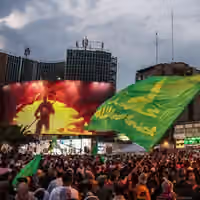
Public anger simmers but has not so far erupted.
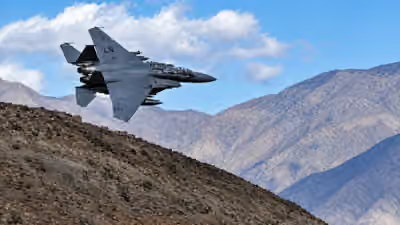
Meanwhile, Tehran’s military capacity has been gutted. Missile stockpiles are depleted, air defenses degraded, and armed allies from Gaza to Lebanon weakened by repeated blows. Once a symbol of strength, Iran’s arsenal is now a reminder of vulnerability.
And yet, the clerical establishment shows no sign of recalibrating.
Faced with looming UN sanctions, domestic crisis and international isolation, it clings to the illusion that a mix of propaganda, repression and tactical stalling can buy survival.
Talk therapy as diplomacy
For years, Tehran has treated negotiations less as a path to resolution than as a pressure valve—a way to appear engaged, delay enforcement and test the patience of counterparts.
That strategy may have worked when the global community was divided or distracted. It no longer does.
The snapback mechanism is proof: Europe has abandoned its posture of indulgence, siding with Washington in reimposing penalties.
Iran’s rulers now face the consequences of years spent refusing with one hand and pretending to accept with the other.
For ordinary Iranians, the result is an ever-shrinking future: savings vaporized, wages worthless and hope steadily eroded.
Tehran remains content to offer the world more of the same—talk therapy instead of genuine negotiation, illusion instead of strategy—while hoping for divine intervention.