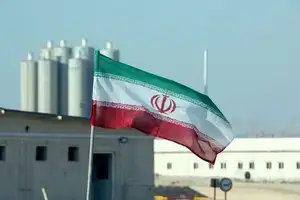
Khamenei’s man rejects reformists’ call to halt uranium enrichment
Ahmad Khatami, Tehran’s interim Friday prayer leader and a representative of the Supreme Leader
Ahmad Khatami, Tehran’s interim Friday prayer leader and a representative of the Supreme Leader, criticized the Reform Front’s recent manifesto, saying its proposal for suspending uranium enrichment mirrored US demands.
“Suspending enrichment is the American prescription in this statement,” Khatami told worshippers at Tehran’s Imam Khomeini Mosalla, according to state media.
He added: “Nuclear energy is the energy of the future, and people have repeatedly said nuclear energy is the nation’s inalienable right.”
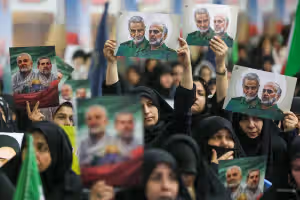
Khatami also rejected the manifesto’s suggestion of direct talks with Washington, saying: “How can we negotiate with America, which martyred General Soleimani, attacked our country, violated all international agreements, and struck our nuclear centers?”
Iran’s Reform Front has urged sweeping political and foreign policy changes, including a temporary suspension of uranium enrichment, release of political prisoners, and direct negotiations with Washington in return for sanctions relief. The reformist push has drawn fierce backlash from conservatives.
“The Iranian people will never surrender to America — hayhat minna al-dhilla,” he said, invoking a famous phrase from Shi’ite Islam Imam Hussein’s sermon on the day of Ashura, which means ‘far be it from us to accept humiliation.’ The expression, rooted in Hussein’s rejection of submission to Ibn Ziyad in 680 AD, has come to symbolize choosing death with dignity over life in disgrace.
Citing remarks by Ali Khamenei last year, Khatami said: “The Leader has already said negotiations with America are neither rational nor honorable. This statement recommends dishonor, and the Iranian nation will not accept such a humiliating recipe.”
Khatami further denounced the reformist document as divisive, calling it a “black letter that translates Netanyahu’s words into Persian.”
He argued that Iranians had voted 47 times since the 1979 revolution and dismissed claims of repression of dissent, insisting that media and social networks were active and free.
A senior Iranian diplomat warned Europe that triggering the UN’s “snapback” mechanism to restore sanctions would squander its leverage and harden Tehran’s nuclear stance.
Deputy Foreign Minister Saeed Khatibzadeh told Germany’s Frankfurter Allgemeine Zeitung on Thursday that Europe had no right to reimpose lapsed sanctions under the 2015 nuclear deal.
“Such an action would only waste Europe’s last card and further diminish its credibility as a mediator,” he said.
He warned that any future talks on Iran’s nuclear program would be “armed negotiations.” “If we return to negotiations, it will be an armed negotiation. We will all have our fingers on the trigger, because we do not trust the other side,” he said.
Khatibzadeh rejected again US demands for “zero enrichment.” “Iran will not be treated as an exception to international law. The right to enrichment is non-negotiable, although the level and details can be discussed,” he said.
Tehran insists it will resist pressure and has warned that activating snapback sanctions could push it to leave the Nuclear Non-Proliferation Treaty.
Britain, France and Germany — the so-called E3 — have warned Iran that unless it returns to nuclear talks by the end of August, they will trigger the mechanism that could reimpose all UN sanctions lifted under the 2015 nuclear deal.
Tehran has accused Washington of seeking through diplomacy what it failed to achieve with June’s military strikes, with Foreign Minister Abbas Araghchi saying this week that talks with the United States have not yet reached a “mature stage.”
Israel’s June 13 offensive and subsequent US strikes on Esfahan, Fordow and Natanz ended oversight of Iran’s facilities, though Araghchi said limited cooperation with the IAEA will continue under tighter national controls.
Iran said Friday that Araghchi would hold a telephone conference call with his French, German and British counterparts.Parallel to planned call, International Atomic Energy Agency officials are due to meet Iranian counterparts in Vienna.
A prominent Iranian conservative figure alleged that Israel seeks to orchestrate leadership change in Tehran by assassinating members of the Assembly of Experts to pave the way for former president Hassan Rouhani, Iranian media reported on Thursday.
Mohammad-Hassan Ghadiri Abyaneh, Iran’s former envoy to Australia, said: “The assassination of members of the Assembly of Experts is part of Israel’s plan, and the individual favored by the enemies to head the system is Hassan Rouhani.”
The Assembly of Experts is an 88-member clerical body empowered to appoint Iran’s Supreme Leader. Its members, elected for eight-year terms, are chosen from candidates vetted by the Guardian Council, whose members are themselves appointed directly or indirectly by the Supreme Leader.
Abyaneh added, “They want to put someone like Rouhani at the top of the system in order to fragment Iran, and the fragmentation of Iran is among Rouhani’s goals.”
He also accused reformist politician Behzad Nabavi of advising President Masoud Pezeshkian to disrupt the economy deliberately to create leverage for negotiations with the United States.
He did not present any evidence for his claims.
His comments come as Rouhani and Iran’s Reform Front have urged sweeping political and foreign policy changes, including a temporary suspension of uranium enrichment, release of political prisoners, and direct negotiations with Washington in return for sanctions relief.
Rouhani said earlier in the month, “There is no way to save the country except for all of us to become servants of the people — to recognize that sovereignty belongs to the people.”
The reformist push has drawn fierce backlash from conservatives, with some likening it to a 2003 reformist manifesto that ended in arrests and bans.
Tasnim, an outlet linked to Iran’s Guards, warned that reformists’ calls for sweeping policy changes resembled a “Gorbachev moment,” arguing such concessions to foreign narratives risk weakening national interests and repeating mistakes that led to the Soviet Union’s collapse.
European powers have warned that unless Tehran resumes nuclear talks by the end of August, they are prepared to trigger the UN’s sanctions “snapback” mechanism, which could restore Security Council penalties.
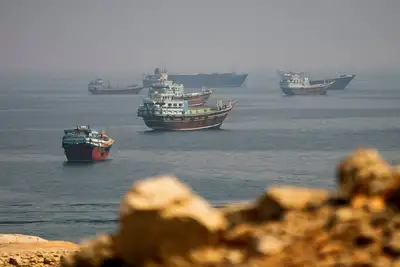
The United States imposed sanctions on 13 companies and eight vessels over suspected ties to Iran, the Treasury Department said on Thursday, in the latest effort to stop Tehran's oil exports in violation of US sanctions.
The designations target Greek national Antonios Margaritis and his network of companies, including Marant Shipping and Trading, Square Tanker Management, Comford Management and United Chartering, which Washington said had facilitated Iranian petroleum shipments for years.
“Today’s action against Margaritis and his network degrades Tehran’s ability to fund its advanced weapons programs, support terrorist groups, and threaten the safety of our troops and our allies,” Secretary of the Treasury Scott Bessent said in a statement.
"He (Antonios Margaritis) has most recently been involved in the operations of OFAC-sanctioned vessel MS ENOLA and MS ANGIA, which has carried Iranian oil," the Treasury said.
“Treasury remains determined to hold accountable all those who seek to aid the Iranian regime and threaten global security," he added.
The companies sanctioned on Thursday are based in Hong Kong, China, the United Arab Emirates and the Marshall Islands, according to the Treasury.
The Treasury accused Changbai Glory Shipping of moving more than four million barrels of Iranian oil to China on the LAFIT since March, Regal Liberty of delivering about two million barrels on the GIANT, and U Beacon Shipping of transporting over a million barrels on the ADELINE G.
It also accused Hong Kong Hangshun Shipping of shipping millions of barrels on the KONGM, and Ares Shipping of moving nearly ten million barrels on the ARES, often via ship-to-ship transfers with already sanctioned tankers.
UAE-based Ozarka Shipping was also sanctioned for managing vessels that transported Iranian petroleum products to China, while additional Hong Kong firms, including U Beacon Shipping, Hong Kong Hangshun Shipping and Ares Shipping, were sanctioned for their role in moving Iranian oil.
The Austrian Embassy in Iran has suspended all consular services citing an “insurmountable obstacle” but giving no further details or timeline for reopening.
According to the embassy’s official website, all consular services are suspended until further notice, which means that even previously submitted applications cannot be processed.
The announcement also said that existing appointments for residence and settlement services are canceled until the end of September, advising applicants to “book new appointments as soon as the situation has returned to normal.”
No further details were provided about what prompted the decision.
The Austrian foreign ministry told Iran International it was"working to re-establish the conditions which would allow us to resume consular services at the Embassy in Tehran."
However, it said "there is no concrete indication when consular services will resume."
Several embassies and consulates in Iran suspended services in June during the 12-day war with Israel.
The Czech Embassy suspended its services in June and has not yet resumed its operations, though it announced plans to gradually restart services in September.
The German Embassy, citing security concerns, relocated some consular staff to other countries in the region, but continues to provide services in Iran.
Embassies of Portugal, Switzerland, and the United Kingdom also suspended services in June but have since resumed full operations.
The closure of foreign embassies in Tehran during and after the 12-day war left between 3,000 and 4,000 Iranian passports stuck in diplomatic missions, stranding visa applicants, Iranian officials said earlier this month.
Omid Mohammad-Alikhan, a member of Iran’s Association of Travel Agencies, told state news agency IRNA that with some embassies halting tourist visa issuance, between 40,000 and 50,000 people remain in limbo.
The disruption has hit hardest those needing to travel on fixed dates, such as students who must arrive for the start of the academic year and athletes travelling to competitions or training camps.
Iran currently faces a deadline from France, Germany, and the United Kingdom to reach a deal with world powers on its disputed nuclear program by the end of August or face the return of UN sanctions through the so-called "snapback" mechanism.
Iran's foreign minister said on Wednesday that the UN sanctions could return, but that Tehran was working with Russia and China to prepare for such a scenario.
A survey conducted by a Netherlands-based institute found that the majority of Iranians would vote for either a regime change or a structural transition away from the Islamic Republic, highlighting growing demands for political change across Iran.
The Group for Analyzing and Measuring Attitudes in Iran (GAMAAN), which conducted the survey in June 2024, said it polled more than 77,000 respondents inside Iran, weighting the results to represent the literate adult population.
“A majority of the population opposes the Islamic Republic and supports changing or transforming the political system,” the report’s author Ammar Maleki said.
Only around 20 percent of respondents want the Islamic Republic to remain in power, according to the survey.
Support for the principles of the 1979 revolution and the Supreme Leader fell to 11 percent, down from 18 percent in 2022. By contrast, some 40 percent of participants said regime change was a precondition for reform, while another 24 percent favored a structural transition away from the current system.
Opposition is strongest among young, educated, and urban Iranians. More than 74 percent of university graduates rejected the Islamic Republic, compared to 66 percent among those without higher education. In rural areas, however, support for the current system reached 28 percent—nearly double the level found in cities.
When asked about forms of governance, 89 percent of Iranians said they supported democracy. Yet the survey also showed that 43 percent of respondents were open to the idea of rule under a strong leader, a view more common among rural and less-educated citizens.
Religious rule and military government, meanwhile, were decisively rejected, with two-thirds opposing clerical rule and more than 70 percent opposing military control.
Divided over future systems
The survey found no single consensus on what system should replace the current order. A secular republic was backed by 26 percent of respondents, while 21 percent supported a monarchy. Another 22 percent said they lacked enough information to decide, and 11 percent said that the form of an alternative system was not important so long as change occurred.
Support for a federal structure was concentrated in minority regions, with 15 percent nationally endorsing either a federal republic or a federal monarchy. These preferences reflected regional demands for decentralization, particularly in Kordestan, West Azarbaijan, and Sistan and Baluchestan.
Asked about political parties, 37 percent of Iranians preferred platforms prioritizing individual freedoms and human rights. Social justice and workers’ rights drew 33 percent support, while 26 percent favored nationalist parties. Only 5 percent backed groups emphasizing traditional and religious values.
Younger and more educated Iranians leaned heavily toward human rights, environmental, and economic liberalization platforms. By contrast, nationalist orientations were strongest among monarchy supporters.
Leadership support
Among Islamic Republic-affiliated figures, Supreme Leader Ali Khamenei and former president Mahmoud Ahmadinejad each polled at 9 percent. Among opposition figures, exiled prince Reza Pahlavi was the most popular with 31 percent, followed by rapper Toomaj Salehi at 6 percent and jailed Nobel laureate Narges Mohammadi at 5 percent.
Pahlavi’s support was higher among men and older, less-educated Iranians, peaking in Gilan province at 42 percent. But in Kurdish and Azeri regions, his support fell below 20 percent.
“The demand for a democratic government is widespread among Iranians, though at the same time, a notable portion of society shows an inclination toward individual authoritarianism,” Maleki said.
“No political or civil figure currently enjoys majority support in society. Each political cluster represents only a portion (between 5% to 35%) of the population, and no single opposition force is capable of representing the full diversity present within the country.”
Since June 2024, when the GAMAAN survey was conducted, major developments — including the 2024 presidential election and the 2025 twelve-day war between Iran and Israel — have taken place that may further influence Iranian public opinion.