Related Articles
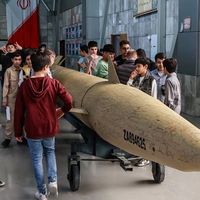
The battle begins in the revered name of Haider. Ali returns to Khaybar with his Zulfiqar," the official X account of Iran's Supreme Leader Ali Khamenei wrote on Tuesday.
"God is great," it added, including an illustration of a fortified town being attacked.
Khaybar was a fortified Jewish stronghold in Arabia that Ali ibn Abi Taleb, the first Shia Imam, is said to have conquered during a key battle in early Islamic history.
Khamenei often couches political decisions in terms of incidents in the sacred past of Shia Islam, the state creed of the theocracy he leads.

After the quietest night since Iran began its retaliatory attacks on Israel on Friday, the former head of the Iranian strategic desk in Israeli Defense Intelligence, a branch of the Israeli military, told Iran International that Tehran’s missile stocks are running low.
Danny Citrinowicz, who now heads the Iran and Shia axis program at the Institute of National Security Studies, said that at the beginning of the war, intelligence estimates showed Iran had around 2,000 missiles.
But as Israel pounds both launchers and production facilities, Iran is unable to regroup in time to retaliate to Israel’s ongoing attacks, he said.
“Iran is having a real problem to produce large salvos. They are calculating now in terms of what’s left, and they still have supplies but they know it’s going to be a lengthy war.”
After several consecutive nights of bombardment that have destroyed numerous homes and resulted in 24 deaths, Monday was a quiet night.
A missile strike hit a factory and bus station north of Tel Aviv in the only reported case of an impact.
According to Israeli military, since the start of the military campaign, fewer than 400 missiles and hundreds of unmanned aerial vehicles have been launched, causing approximately 35 impacts.
More than 647 people have been injured—with 10 seriously and 37 moderately—and nearly 19,000 damage claims have been filed, mostly for buildings. Additionally, 2,725 people have been evacuated from their homes.
Key commander killed
“With the air superiority of Israel and the assassination of the head of the missile program in the first surprise attacks, he will be hard to replace,” Citrinowicz said, referring to the death of Brigadier General Amir Ali Hajizadeh, the former commander of the IRGC Aerospace Forces.
“He headed last year’s April and October attacks on Israel and had so much knowledge and experience, and the trust of the top leadership, so while he was replaced, it would not be by someone like him with his caliber and expertise, and it’s taking a toll.”
Israel estimates 1,200 missiles left
Israeli estimates are that there are around 1,200 missiles left. “Iran can still have a war of attrition but they’ll have to calculate that. It will be very hard to launch 100-200 missiles at one time. They are under the superiority of Israel and can’t use a lot of launchers as Israel will hit them, and they are also launching in hiding,” added Citrinowicz.
“Israel has also hit the production hard. So what they started with, that’s what they have until the end of the war. Iran couldn’t have imagined such a thing would happen.”
“In the first blow, Iran’s senior leaders were at home. They didn’t see that coming and were very amateur. Iran is a one trick pony in terms of missiles. When Israel is really attacking facilities, it’s very hard for Iran to produce something dramatic and produce something to force Israel to stop the war.”
A Western intelligence official, who spoke on condition of anonymity, told Iran International that Iran's vulnerabilities are now on display.
"Iran’s capability is a paper tiger. This is why they created their network of proxies and why the regime so desperately want nuclear weapons," the official said.
"They are no match for Israel’s military firepower and defensive strength and Iran right now cannot risk dragging the US into war, so it will not attack US forces or facilities in the region," the source added.
US President Trump spoke with Israeli Prime Minister Benjamin Netanyahu by phone on Tuesday, Axios reported citing an Israeli official.
Explosions ringed out over Tel Aviv on Tuesday evening as a Reuters live feed showed Israeli interceptors confronting an Iranian missile barrage.
The Israeli military had warned just before the clash that a salvo was incoming.

The fate of Iran and the Middle East was on a knife on Tuesday as Israel continued to lash its enemy with nationwide airstrikes and US President Donald Trump indicated Washington could imminently join the fight.
President Trump on Tuesday demanded Iran’s unconditional surrender and warned US patience was wearing thin but said there were no plans to kill Iran’s leader - "yet" - as the Israel-Iran air war raged for a fifth day.
As an internet blackout gripped Iran, terrified resident fled the capital city after Trump called for a full evacuation and the Islamic Republic's armed forces' pace of missile salvos against Israel appeared to slacken.
A day after G7 heads of state including Trump mooted a resolution to end the hostilities, Trump appeared to take a dramatically harsher line on social media posts.
“We know exactly where the so-called ‘Supreme Leader’ is hiding,” he wrote on Truth Social. “We are not going to take him out (kill!), at least not for now... Our patience is wearing thin.”
Three minutes later, he blared, “UNCONDITIONAL SURRENDER!”
Explosions were reported all across Iran on Tuesday, Iran fired more missiles toward Israel. Air raid sirens sounded in Tel Aviv and southern Israel. Israel said it struck 12 missile sites and storage facilities in Tehran.
US involvement?
Trump met with his National Security Council for 90 minutes Tuesday afternoon, a White House official said, but no details were immediately forthcoming.
Meanwhile the United States is deploying more fighter jets and extending existing deployments, Reuters reported citing three officials. Defense Secretary Pete Hegseth described the posture as defensive, citing US assistance in intercepting missiles fired at Israel.
Israel said Tuesday it had killed Iran’s new wartime chief of staff Ali Shadmani, four days after his predecessor was killed in earlier strikes.
Amid mass evacuation orders and fears of wider conflict, Iranians at home and abroad are reporting major disruptions to banking and internet services, adding to the chaos as Israeli airstrikes and US warnings drive thousands to flee major cities.
Fordow next?
Iranian media said Israel had launched a “massive cyber war” against its digital infrastructure. Iran’s cybersecurity command has since banned officials from using mobile phones, Fars news reported — hours after Israel’s envoy to Washington hinted at a broader operation than the one that once paralyzed Hezbollah’s communications.
The UN nuclear watchdog said on Tuesday that an Israeli strike hit the underground enrichment halls at Natanz. But the Fordow facility—where Iran is enriching uranium close to weapons-grade—remains untouched.
Only the United States has the bunker-busting bombs capable of potentially breaching Fordow, where nuclear material is deeply buried and heavily fortified.
Israel’s national security adviser said the strikes will not end until Fordow is damaged.
Israel, not a party to the Non-Proliferation Treaty, is widely believed to be the only Middle Eastern nation with nuclear weapons, though it maintains official ambiguity on the matter.