Israel's Defense Minister Israel Katz warned Iran's Supreme Leader Ali Khamenei that "Tehran will burn" if it keeps firing missiles at Israeli civilians.
"The Iranian dictator is turning the citizens of Iran into hostages and bringing to reality the fact that they, and in particular the residents of Tehran, will pay a heavy price for the criminal harm to the citizens of Israel. If Khamenei continues to fire missiles at the Israeli home front - Tehran will burn," Katz said in a statement.
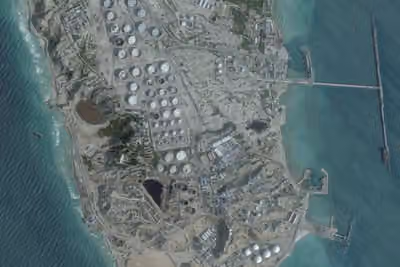

An Israeli airstrike on Saturday morning hit a site near the city of Asadabad in Iran’s western Hamadan province, killing two emergency workers and wounding five others, Iranian officials said.
Hamzeh Amraei, a senior local official, said the victims were part of an emergency response team caught in the strike.
Israel’s N12 News earlier reported the strike targeted ballistic missile launchers in the area believed to pose a threat to Israel.
The deputy political and security governor of Hamadan told Tasnim News Agency that five people were killed in the attack. He added there have been no reports of further strikes on Noje Airbase or Sobashi radar installations.
Kazem Alamdari, an Iranian sociologist and author, told Iran International that a portion of Iranian society has expressed satisfaction over the deaths of certain senior government officials, viewing them as perpetrators of state violence.
“There is a segment of society that feels a sense of relief over the killing of officials who have committed crimes,” Alamdari said.
“In contrast, others believe that the country is under foreign attack and that, in such circumstances, one must stand in defense of the homeland and its people.”
Iran has formally notified the United States, United Kingdom, and France that it plans to launch extensive attacks against Israel and warned that any country assisting in repelling these strikes will face retaliation.
According to Iranian state media, Tehran said that all regional bases of what it called "collaborating governments," including military installations in Persian Gulf countries and naval vessels in the Persian Gulf and Red Sea, would be targeted by Iranian forces if those countries intervene.

Iran’s nuclear facilities in the central city of Isfahan were targeted several times on June 13, but there has been no indication of increased off-site radiation levels, the International Atomic Energy Agency (IAEA) said on Saturday.
The UN nuclear watchdog confirmed it remains in close contact with Iranian authorities following the reported strikes and continues to monitor the situation.
The IAEA did not specify the extent of damage, but emphasized that “as of now, there is no sign of radiological release.”
Iran’s Supreme National Security Council convened on Friday evening to review and reinforce ongoing plans for responding to Israel, the council’s secretariat said.
The meeting took place shortly before Iran’s initial retaliatory strikes against Israeli targets. Officials revisited previously outlined strategies for sustained responses to hostile actions and emphasized their implementation.
Domestic preparedness and necessary security measures were also evaluated and coordinated to ensure readiness for future developments, according to a statement by the council.