Trump vows to take 'all action' to prevent Iranian nuclear weapon
Speaking in a Riyadh conventional hall crowded with top Saudi and US officials including Crown Prince Mohammed bin Salman, US President Donald Trump again vowed to deny Iran a nuclear bomb.
In the lengthy address, Trump excoriated Iran at length, accusing it of spreading militancy and war throughout the region and demanding it swiftly choose whether to accept a new nuclear deal.
"Our task is to unify against the few agents of chaos and terror that are left and that are holding hostage the dreams of millions and millions of great people," Trump said.
"The biggest and most destructive of these forces is the regime in Iran, which has caused unthinkable suffering in Syria, Lebanon, Gaza, Iraq, Yemen and beyond. There could be no sharper contrast with the path you have pursued on the Arabian Peninsula than the disaster unfolding right across in the Gulf in Iran."
Trump insisted he sought to end wars and unify enemies but that time was limited for Iran to accede to US demands on reaching a nuclear deal as talks completed a fourth round over the weekend.
"In the case of Iran, I have never believed in having permanent enemies. I am different than a lot of people think. I don't like permanent enemies ... I want to make a deal with Iran.
"But if Iran's leadership rejects this olive branch and continues to attack their neighbors, then we will have no choice but to inflict massive maximum pressure drive Iranian oil exports to zero like I did before," Trump added, stopping short of explicitly mentioning an attack on Iran as he has previously.
"(The US will) take all action required to stop the regime from ever having a nuclear weapon."
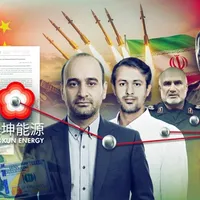
The United States on Tuesday introduced fresh sanctions against a shipping network it says has sent millions of barrels of Iranian oil to China, the State Department announced.
The network facilitated "the shipment of millions of barrels of Iranian crude oil worth billions of dollars to China on behalf of Iran’s Armed Forces General Staff (AFGS) and its front company, Sepehr Energy Jahan Nama Pars (Sepehr Energy)," the State Department's statement said.
The sanctions were imposed one day after Iran International reported that Sepehr Energy company worked on behalf of the Iranian military and spawned a network of shell companies to sell sanctioned Iranian oil to Asia and did business with a Netherlands-based firm that was aware of its government ties.
Business documents and emails obtained by Iran International revealed a layered network of shell companies used to mask the military links and channel the sanctioned oil through foreign intermediaries.
As Iran grapples with a worsening electricity crisis, the government has resolved to prioritize power supply to industries, sacrificing residential comfort and daily public services in a bid to avert economic collapse.
“There will be no such thing as production if we cut off the supply of gas in winter and electricity in summer to industries,” government spokeswoman Fatemeh Mohajerani said on Monday, justifying the decision to shield factories and major production centers from the worst of the power cuts.
“So instead of imposing power cuts solely on industries, we have directed some of it to domestic consumption.”
Iran is currently facing a peak-hour electricity deficit of around 20,000 megawatts. With the summer heat intensifying and water levels in hydropower dams at historic lows due to years of drought, power outages—both scheduled and unexpected—have become routine.
The government of President Masoud Pezeshkian blames inherited problems for the shortage. In parliamentary hearings for his cabinet approval in August last year, energy policy dominated the debate.
Lawmakers voiced concern at the time that the growing electricity gap could bring more severe blackouts and industrial shutdowns than before.
Economic survival over public comfort
The move to protect industry over residential demand is a calculated risk. Iran's manufacturing sector, already battered by sanctions, inflation, and a volatile exchange rate, is considered too critical to fail.
If industries grind to a halt, Iran risks deeper economic stagnation. But if public resentment continues to grow amid daily blackouts, the political costs could be just as severe.
Many industries, including cement plants and steel factories, which require uninterrupted energy for their kilns and machinery, are particularly vulnerable to power cuts.
The total annual loss from power cuts to the steel industry last year, according to the head of the Isfahan Chamber of Commerce, Amir Kashani, was estimated at around $4 billion.
Power cuts affecting daily lives
Widespread dissatisfaction is mounting, as daily life for millions is disrupted by blackouts as the daily power cuts are more than an inconvenience—they are a source of hardship, danger, and economic loss in the lives of millions of ordinary Iranians.
Social media is filled with videos and reports of people trapped in elevators, traffic lights failing and causing massive jams, and water not reaching upper floors of apartment buildings due to non-functional pumps.
Mobile phone signals have also been affected, as network operators are forced to shut down towers to prevent equipment damage when backup batteries run out.
Many small businesses, including bakeries, restaurants and cafes and grocery stores, report spoilage of perishable goods, compounding their financial strain.
Adding to the frustration, the government has shifted working hours for state offices to 6:00 AM in an effort to avoid peak hours, a move that has caused widespread disruption for employees and service recipients alike.
On Monday, authorities announced that school hours would also be adjusted to follow this new schedule.
A long-term crisis years in the making
Experts argue that Iran’s electricity shortage is not a sudden development but the result of decades of mismanagement and underinvestment.
Despite having the world’s second-largest reserves of natural gas, Iran has failed to expand its generation capacity or modernize its energy infrastructure.
“This crisis did not arise overnight, nor can it be solved in the short term,” Mehdi Masaeli, secretary of the Electricity Industry Syndicate, recently told Zaman-e Eghtesad, warning that officials should not downplay the severity of the situation.
Resolving the crisis would take at least three years, he said, citing the need for significant financial investment, equipment procurement, and coordinated management.
Earlier this week, Energy Minister Abbas Aliabadi said illegal use of miners has expanded and is responsible for around 1,000 megawatts of energy consumption.
Iranian President Masoud Pezeshkian speaking during an event on nuclear program (April 2025)
Iranian President Masoud Pezeshkian said any indirect negotiations with the United States will proceed in full coordination with Supreme Leader Ali Khamenei and reaffirmed that Iran will not retreat from its core principles.
“These negotiations will be fully aligned with the Supreme Leader’s guidance, which will light our path,” Pezeshkian said during a meeting with a group of lawmakers. “We have not and will not tie the people’s livelihood to the outcome of the talks.”
Pezeshkian said that while Iran seeks dialogue without escalating tensions, it would not compromise on what he called national values. “We will not retreat from our principles under any circumstances,” he added. “At the same time, we are not seeking tension.”
Earlier in the day, Iran’s deputy foreign minister said the country is open to accepting temporary restrictions on uranium enrichment, though no detailed agreement has been reached.
Majid Takht-Ravanchi, speaking after the fourth round of indirect talks with the United States in Oman, said negotiations have yet to address the specifics of enrichment levels.
The talks, described by both sides as difficult but constructive, mark the highest-level contact between Tehran and Washington since the US withdrew from the 2015 nuclear deal in 2018 under former Trump administration.
Iran has since accelerated its enrichment to 60% purity—well above the deal’s 3.67% cap but below weapons-grade, according to the UN nuclear watchdog.
While US officials have called for a full dismantlement of Iran’s enrichment capabilities, Tehran insists the right to enrich is non-negotiable.
Iran’s atomic energy chief, Mohammad Eslami,said on Tuesday that the nuclear program remains a pillar of national strength and is not subject to bargaining.
Western powers accuse Iran of seeking nuclear weapons—an allegation Tehran denies. Despite diplomatic engagement, the US continues to expand sanctions targeting Iran’s nuclear and energy sectors.
Ongoing indirect negotiations between Iran and the United States are centered on complex and contentious issues, not routine matters, and are likely to extend beyond the timeframe suggested by Washington, an Iranian lawmaker said on Tuesday.
“These are not ordinary discussions. The negotiations are tough and may continue over the long term,” Reza Sepahvand, a member of parliament, said. “While the US side spoke of a two-month timeline, I believe more time will be needed.”
Sepahvand warned against giving the Iranian public false hope or spreading pessimism, urging officials to base public messaging on facts. “We must be honest. Neither overpromise nor instill despair.”
Iranian President Masoud Pezeshkian said on Tuesday that any negotiations with the United States would be carried out in full coordination with Supreme Leader Ali Khamenei, and reiterated that Iran would not compromise on what he described as its core principles.
“These negotiations will be conducted in full alignment with the Supreme Leader,” Pezeshkian said, according to ISNA. “We have not and will not tie people’s livelihoods to the talks.”
“We will not retreat from our principles under any circumstances,” he added. “At the same time, we are not seeking tension.”
Supreme Leader Ali Khamenei and Iranian President Masoud Pezeshkian