"I’ve just spoken to Prime Minister of Israel, Bibi Netanyahu, relative to numerous subjects including Trade, Iran, etc.," US President Donald Trump said in a post on Truth Social.
"The call went very well—We are on the same side of every issue."

US President Donald Trump's special envoy Steve Witkoff will visit Moscow this week, Russian news agency Interfax reported, citing Kremlin foreign policy adviser Yury Ushakov.
Witkoff, who is the chief US negotiator in nuclear talks with Tehran, had visited Russia before attending the first round of talks held in Muscat on April 12.
Moscow and Tehran have deepened ties in recent years and the two heavily sanctioned powers have stepped up military cooperation amid Russia's full-scale invasion of Ukraine.
Nuclear talks with the United States are progressing beyond expectations, Al-Araby Al-Jadeed (New Arab) reported citing Iranian sources.
"Even the Iranian side has been surprised by the behavior of the US negotiator and the seriousness and urgency he has shown, as well as the fact that he has not yet put forward any impossible non-nuclear demands," the report said.
The sources were quoted as saying that US demands were “not high, which has provided a strong incentive for the negotiations to move forward quickly."
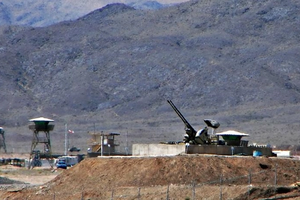
The head of Iran’s Atomic Energy Organization said Tuesday that the country's nuclear sites are protected against threats, just weeks after US President Donald Trump threatened to bomb Iran if it did not agree to a new nuclear deal.
“Good measures have been considered, and effective steps have been taken to fortify them," Mohammad Eslami said, speaking at an event marking the anniversary of the establishment of Iran's Revolutionary Guard (IRGC).

One of Iran's state television channels, Nasim TV, has apologized for a satirical program that mocked a Saudi Arabian official, saying the incident was a negligent mistake and that disciplinary action has been taken against those responsible.
The Tasnim news agency reported that a video circulating online showed actor Mohsen Afshani seemingly making fun of the Saudi foreign minister through what appeared to be digitally altered content.
The timing of the broadcast, just a week after the Saudi defense minister's trip to Iran, drew widespread criticism online and in some media outlets, raising questions about potential efforts to undermine the improving bilateral relations and the government's foreign policy objectives, including ongoing talks with the United States.
While Nasim TV did not name the program in its statement, it acknowledged that "some political policy lines regarding neighboring countries were inadvertently disregarded" in a recorded satirical show.
The network assured the public that those responsible for the lapse would face disciplinary measures.
The Financial Times, citing analysts close to the Saudi leadership, reported last week that Saudi Arabia’s defense minister used a high-level visit to Tehran to signal Riyadh’s opposition to military confrontation with Iran.
“Saudi is clearly sending a message to Tehran that it will not be a conduit in any fashion towards an attack on Iran,” said Ali Shihabi, a Saudi commentator close to the royal court. “The kingdom supports President [Donald] Trump’s efforts to find a diplomatic solution to the nuclear crisis, and doesn’t want a war.”
Prince Khalid bin Salman’s visit took place just days before Iran resumed nuclear talks with the United States. Bin Salman is the highest-ranking Saudi royal to visit Iran in decades and includes the kingdom’s ambassador to Yemen.
Saudi and Iran only resumed diplomatic ties in 2023 after a seven-year hiatus following an attack on the Saudi embassy in Tehran which drove a wedge between the two powers.
Iranian hardline cleric Ahmad Khatami, who previously denounced negotiations with the US as "humiliation," has now described such talks as a religious imperative.
Just weeks after vehemently rejecting any dialogue with Washington during a Friday prayer sermon in March, Khatami reversed his position, signaling a potential change in the hardline stance towards the ongoing talks.
Khatami's initial remarks characterized negotiations as an act of submission unacceptable to the Iranian people, contrasted sharply with his endorsement of talks.
"Accepting indirect negotiations with the US aligns with a Quranic verse stating that if the other side proposes talks, one should not refuse," he said.