US to reject Iranian oversight plan, push for centrifuge removal - Israel Hayom


The United States will oppose Iran’s proposal to allow Russian and Chinese oversight of its nuclear program and is expected to demand the removal of advanced centrifuges from Iranian territory, Israel Hayom reported citing an informed source ahead of a new round of talks due on Saturday.
American and International Atomic Energy Agency (IAEA) experts will participate in the technical discussions beginning Saturday.
“It is clear that the United States will not agree to Russian or Chinese oversight. In addition to IAEA inspectors, Washington is expected to demand supplementary monitors,” the Israeli outlet reported, citing an informed international official familiar with the details.
“The US is expected to demand the removal of advanced centrifuges, used for rapid enrichment, from Iranian territory.”

Debate is growing in Washington over talks with Iran, with hawkish Republicans urging against appeasing Iran's theocratic rulers but some observers saying the mercurial president might have a historic shot at clinching a deal with Tehran.
The debate has exposed unexpected fractures: US President Donald Trump’s own allies are split, while some longtime democratic critics of the president have cautiously praised his approach—highlighting the unpredictability of the current diplomatic moment.
Robert Malley, the former Biden administration Iran envoy who was sidelined for allegedly mishandling classified information, told The Free Beacon he is “optimistic” about Trump’s upcoming nuclear talks with Iran.
Meanwhile, traditional opponents of diplomacy with Iran are sounding alarms. Republican Senator Ted Cruz posted on X that “anyone urging Trump to enter into another Obama Iran deal is giving the President terrible advice,” calling for unified support behind the idea that Iran must never be allowed to obtain a nuclear weapon.
Other hawkish GOP lawmakers have echoed that sentiment. In recent days, a group of Republican members of Congress sent a letter to Trump, urging him to pursue a Libya-style full dismantlement of Iran’s nuclear program—an approach that would go far beyond the terms of the original JCPOA.
Trump's former United Nations ambassador Nikki Haley posted online that she had previously raised alarm bells over Tulsi Gabbard, the director of national intelligence: “There is no room for Iranian sympathizers in the national security team of the US.”
Confusion
But the rift may be rooted in Trump himself, says Greg Brew, an Iran analyst with the Eurasia Group.
“The fact that it is Trump who is sort of leading the charge to get a new deal with Iran when he himself departed the original JCPOA in 2018, called it the worst deal in history," Brew said, referring to an original 2015 nuclear deal with Iran.
"Making this even more confusing, there is a decent chance that he himself favors the return to a deal that would look very similar to the JCPOA,”
Speaking on Fox news earlier this month, Trump's envoy Steve Witkoff seemed to suggest that a nuclear deal would permit Tehran to enrich uranium. A day later he appeared to walk back his comments and hardened his stance.
"A deal with Iran will only be completed if it is a Trump deal," Witkoff's official account on X quoted him as saying, adding that Iran must eliminate its nuclear enrichment.
Brew added the Trump team's ambiguous messaging is throwing both parties off balance.
“You have allies of Trump who hate the idea of diplomacy with Iran, who strongly back a military solution, perhaps even regime change of the Islamic Republic," Brew added. "Trump himself has said on numerous occasions that he's not interested in regime change, that he wants Iran to be successful, which is sort of throwing these groups into confusion."
Transformed political climate
Alex Vatanka, founding director of the Iran Program at the Middle East Institute, told Iran International that the political landscape in 2025 is very different from when the JCPOA was first negotiated in 2015.
“The Republicans are in the majority and it's a Republican party that really doesn't want to say no to President Trump,” said Vatanka. “He probably has the best shot that I can think of any president in the last many years, if not decades.”
Vatanka noted that those with Trump’s ear right now are pushing for diplomacy, not confrontation.
“Right now, obviously with these ongoing talks, it's the folks who are arguing for diplomacy that seem to have the ear of President Donald J. Trump.”
As negotiations inch forward, Trump’s own political calculus—and how he chooses to navigate the diverse viewpoints on his home front—may determine whether US diplomacy succeeds or collapses under the weight of its own contradictions.
US President Donald Trump and Israeli Prime Minister of Benjamin Netanyahu spoke on Tuesday in a telephone call in which the two allies expressed no disagreement on ongoing US-Iran talks, White House Press Secretary Karoline Leavitt told reporters on Tuesday.
"They spoke particularly about Iran and the negotiations that are underway," she said. "The president has made it very clear repeatedly and I'll reiterate: there is no daylight between the United States of America and the State of Israel. He stands strongly behind our ally."
"He's made it quite clear when it comes to Iran that we want to see a deal and Iran has a choice to make."
Iran could build nuclear weapons within months, IAEA Director General Rafael Grossi said on Tuesday.
“Iran is not far from having a nuclear problem. They don’t have it, we know it... But the material for it already, it’s already there. To make a few warheads,” he told the Council on Foreign Relations.
He added Iran had previously tested elements of a nuclear device and “we don’t have full confidence that they have disappeared completely.”
Grossi said the IAEA lacks adequate visibility and called the current US-Iran talks “a moment of huge, huge, huge responsibility for everybody.”

I’ve grown the habit of checking the dollar exchange rate every few hours, even though I sold all that I had a few months ago—or perhaps because I sold all that I had a few months ago.
Late last year, when I did that, the dollar was 68,000 tomans. Two weeks ago, it hit an all-time high of 102,000. Then it started dropping sharply when Tehran and Washington began negotiating.
It’s now an almost masochistic exercise, calculating how much my partner and I could have gained had I waited a little bit longer.
Over the last six-seven years, we converted whatever we had and could save into dollars. It stood at around $20,000 in the fall of 2024.
We kept the cash at home, living in constant fear of a break-in. But we didn’t trust the banks either. People’s foreign currency deposits were once forcibly converted to rials during a currency collapse in the early 2010s. Public trust was shattered.
Our savings weren’t enough to buy a home in Tehran. Renting here, with inflation this brutal, is terrifying. Prices climb relentlessly. Our income doesn’t. Half of what we earn goes straight to rent.
Then the war drums began to beat louder. The Israeli-Iranian cold war heated up with missile attacks and airstrikes. War felt closer than ever. We went to bed each night bracing for the worst.
That’s when we made our decision: we’d buy a home outside Tehran—somewhere to safeguard our money, and ourselves, if war came. A property in the capital was out of reach anyway. A small 600 sq ft apartment in a modest neighborhood would cost about 5 billion tomans. We had less than two.
Even ChatGPT approved our thinking.
“If you're buying as a refuge, stay away from military centers and major cities, and prepare for wartime shortages,” it said.
We found an old 2000 sq ft house in a small town in Iran’s northern province of Gilan, far from military sites and with clean air. We sold our dollars overnight, sold the little jewelry that we had, and borrowed 600 million tomans to close the deal at 2.5 billion.
We couldn’t move. We’re both job-bound to Tehran. But now we had a place to escape to. A safe investment. A backup life.
Almost immediately, as if waiting for us to get rid of our assets, the dollar and gold surged. We couldn’t help calculating what we’d lost. It was dreadful. And all the more so because we had been advised against it by our family. “Why sell when the dollar is rising?” they said.
The stress and the anxiety boiled over into a fight. My partner kept saying “I told you so.” He hadn’t. Eventually, we decided and promised not to revisit the issue, but privately, we both still do. We check the rates. We run the numbers in our heads.
Since these US-Iran talks began, I’ve been torn. A deal with Donald Trump could bring much-needed cash to the government’s coffers. Would it ease the people’s hardship? Most likely not. It would only benefit Iran’s bloated IRGC-led oligarchy and its loyal forces inside and abroad.
Still—for now at least—the threat of war feels more distant. That offers a fragile peace of mind.
But Many are not even torn. In a recent poll on Telegram, seven in ten of over 5,000 participants said they’d rather the deal fell apart and the Islamic Republic was attacked. I can’t say this reflects society as a whole, but I know more than a few who oppose a deal because they believe it prolongs the theocratic rule in Iran.
Even the dip in the exchange rate hasn’t brought joy. Prices haven’t dropped. Inflation hasn’t eased. And the rule still holds: we earn in rials, we spend in dollars.
For me, personally, the falling dollar has brought a strange feeling of comfort. It makes the choice we made feel a little less like a loss.
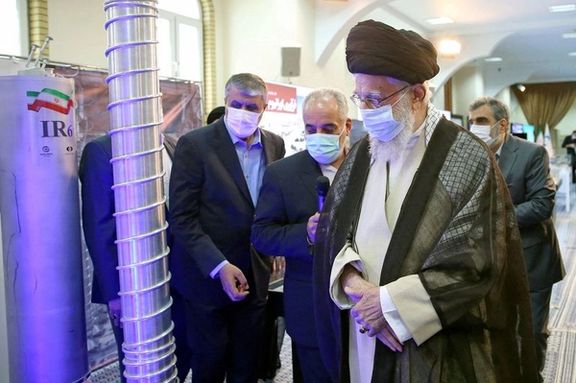
Iran’s government ruled out transferring enriched uranium out of the country in any deal with the United States and insisted sanctions relief remains Tehran’s top priority in the negotiations.
“The transfer of enriched uranium is among the issues that are a red line for the Islamic Republic of Iran,” government spokesman Fatemeh Mohajerani said on Tuesday.
She added that the talks aim to “effectively lift sanctions and improve economic conditions,” which she linked to both international cooperation and domestic market sentiment.