Gholamhossein Karbaschi, the former mayor of Tehran and a reformist politician, defended the composition of Iran's negotiating team for talks with the United States, led by Abbas Araghchi.
In an interview with the Khabar Online news website, Karbaschi addressed the objections of some officials and media outlets within Iran to negotiating with the US, saying, "The Islamic Republic's capacity is what it is; we can't import diplomats from abroad."
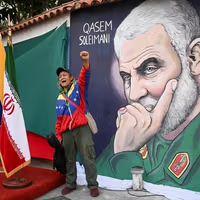
An Iranian lawmaker strongly opposed the upcoming talks between Iran and the United States, labeling the engagement as sitting with the killers of Revolutionary Guards commander Qassem Soleimani.
Mohammadreza Ahmadi voiced his vehement opposition, saying, "Sitting with the killers of IRGC commander Soleimani and thousands of martyrs has no meaning... We are sitting at a negotiating table with the Americans?! Be careful, we hope you come to your senses and do not continue this negotiation."
Soleimani was assassinated by a US drone strike in Iraq in 2020, where Trump was the president.
Russia said on Wednesday that military action against Iran by its adversaries would be illegal and counterproductive to achieving peace.
Foreign Ministry spokeswoman Maria Zakharova told reporters that bombing Iran would not lead to a peaceful resolution and expressed Moscow's hope that upcoming talks between the United States and Iran could help avert a crisis.
Zakharova added that the world was weary of what she described as endless threats against Iran, and that Russia supported a sensible approach to resolving the dispute over Tehran's nuclear program.
Separately, the Kremlin called for a focus on diplomatic engagement rather than actions that could escalate tensions surrounding Tehran's nuclear program.
Kremlin spokesman Dmitry Peskov said that Iranian authorities were taking preventative measures amid heightened rhetoric on the nuclear issue.

Iran’s president said Wednesday the country has never sought nuclear weapons, as officials marked National Nuclear Technology Day with a showcase of domestic achievements, days ahead of renewed talks with the United States.
“We do not want a nuclear bomb and never have,” President Masoud Pezeshkian said at a ceremony in Tehran. “We seek peace, security and dialogue — but dialogue rooted in dignity and independence. We will not retreat from our scientific and technological achievements.”
The president spoke at an exhibition of nuclear developments, where he inaugurated several new projects. He criticized Western powers for what he called leading the world into “war and destruction under the banner of civilization and peace,” and insisted Iran would not allow others to dictate its path.
Atomic Energy Organization head Mohammad Eslami said Iran was entering a new phase of nuclear development, including the production of medical radioisotopes and advancements in agriculture and power generation.
“Despite all threats and sabotage, our scientists are moving forward stronger than ever,” Eslami said.
In a separate statement, the Iranian parliament’s National Security and Foreign Policy Commission warned that “any threat to the peaceful nuclear industry will face a serious, decisive and destructive response.” The statement reiterated Iran’s right to nuclear technology under the Non-Proliferation Treaty.
The comments come as Iranian and US negotiators prepare to meet Saturday in Oman for indirect talks focused on Iran’s nuclear program and potential sanctions relief. Tehran has signaled openness to diplomacy but remains wary of US intentions.
Foreign Minister Abbas Araghchi has said the talks are “a new opportunity for diplomacy” and the sole focus will be confirming the peaceful nature of Iran’s program in exchange for lifting what he called “cruel sanctions.”
The upcoming talks have drawn attention amid rising regional tensions and diverging views in Washington and Tehran on the path forward.
Iran's nuclear program has advanced to a stage where it could potentially enrich sufficient uranium for several nuclear fission weapons within weeks.
Iran’s enriched uranium stockpile remains under monitoring and verification by the UN’s nuclear watchdog, but the agency has no longer daily access to the Natanz and Fordow enrichment facilities.
Addressing a National Nuclear Technology Day ceremony, Iran's president said again that the country is not pursuing nuclear weapons, while stressing the need for nuclear science and energy.
"We are not pursuing a nuclear bomb. In this country, who has authority above the Supreme Leader? He has officially issued a fatwa declaring the construction of a nuclear bomb forbidden."
The president also addressed repeated calls for monitoring, saying, "They constantly say that we must have verification. You have verified a hundred times, verify a thousand times as well; but we need nuclear science and nuclear energy."

Iran's nuclear program has advanced to a stage where it could potentially enrich sufficient uranium for several nuclear fission weapons within weeks.
Iran’s enriched uranium stockpile remains under monitoring and verification by the UN’s nuclear watchdog, but the agency has no longer daily access to the Natanz and Fordow enrichment facilities.
An Iranian analyst described the upcoming talks between Iran and the United States in Oman as highly sensitive and potentially transformative, suggesting their primary aim is to resolve decades of hostility between Tehran and Washington.
In a commentary, Ahmad Zeidabadi said the Muscat negotiations, involving Iranian Foreign Minister Abbas Araghchi and US envoy Steve Witkoff, differ significantly from previous engagements, which focused on technicalities or were seen as delaying tactics.
He said the success or failure of the talks have immense consequences.
Zeidabadi said that US President Donald Trump's primary objective has two levels: first, to end the long-standing animosity and foster mutual cooperation; and second, if normalization is rejected by Iran, to neutralize technological and military capabilities that Washington perceives as a threat.