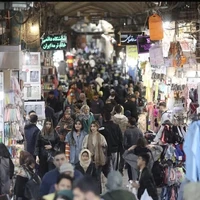
Mass protests break out in Iran in September 2022 over the killing of Mahsa Amini in police custody.
In his Eid al-Fitr sermon, Ali Khamenei once again voiced concern about the possible resurgence of anti-government protests in Iran, using his signature rhetoric to warn of a "new sedition."
But the fundamental question remains: who is the real seditionist? Is it the Iranian people protesting the country’s dire conditions—or is it Khamenei himself, who has held power for over three decades? Who is responsible for the current state of affairs that has him so worried? Who has ruled the country and made all major decisions over the past 36 years—ordinary citizens or Khamenei himself?
Khamenei labeling public protests as "sedition" and dismissing demonstrators as seditious is nothing new. This has always been his approach. He has never been willing to acknowledge that Iranian citizens are reacting to the country's deteriorating conditions, which are a direct result of his policies as supreme leader. He has consistently refused to recognize these protests as legitimate, branding them as riots in order to justify their suppression.
He views the citizens who took to the streets in dozens of cities during the 2017, 2019, and 2022 uprisings as being influenced by foreign enemies. But is this really plausible? Khamenei refuses to accept that these protests are domestic and popular in nature. He uses the label of unrest to delegitimize them.
If Khamenei is worried about new protests, he should understand that this fear stems from his own actions. The country’s current state—one that the majority of people reject—is the product of 36 years under his rule, and a decade before that under Khomeini.
Khamenei with top security and military officials. File photo
For 46 years, no one else has governed Iran. Even the monarchy, which the Islamic Republic continues to criticize and compare itself to, fares better in many metrics. In contrast, the Islamic Republic has dragged the country backward.
After 46 years in power, it is no longer acceptable for the Islamic Republic to measure itself against a government from half a century ago. And even when this comparison is made, in the minds of many Iranians, the Pahlavi era wins, while the Islamic Republic is clearly the loser.
While other nations have advanced in less time, Iran under the Islamic Republic has stagnated or regressed. Dubai and Qatar have achieved modern prosperity in under 46 years. China, now an economic superpower, began its development path after the Islamic Republic came to power—but unlike Iran, it made real progress. The Islamic Republic squandered these decades, pushed the country into ruin, and sacrificed three generations in the process—yet refuses to step aside. Meanwhile, those who object to these conditions are called seditious.
When Khamenei assumed power in 1989, the exchange rate was 1,200 rials to the US dollar. After 36 years of his leadership, it has surpassed one million—a depreciation of 87,000 percent. This isn't mere exaggeration; it’s verifiable with a basic calculation. And still, he labels public protests as sedition and threatens suppression—though such threats have long lost their force.
In just the past four years, the dollar has surged from around 200,000 rials to 1,040,000—more than a fivefold increase. So why wouldn’t people expect the currency to plunge further, possibly hitting one billion rials, if the current trajectory and war-driven policies continue?
Iran's government keeps printing money to make up for lack of revenues, fueling inflation.
Given this economic collapse—and the fact that widespread poverty and dissatisfaction are direct consequences of Khamenei’s rule—how can he possibly justify calling protesters seditious?
Even some of Khamenei’s own allies, like former deputy parliament speaker Mohammadreza Bahonar, have admitted that inflation has hovered at 40 percent for the past seven years. Inflation, in essence, is a legalized form of theft by the state—citizens go to sleep at night and wake up to find their savings eroded.
Even former president Hassan Rouhani, a figure deeply entrenched in Iran’s security apparatus, has openly stated that the people are unhappy.
When individuals who played key roles in cracking down on the 2017 and 2019 protests now speak of widespread dissatisfaction, how can Khamenei still claim these movements are foreign-led?
Many Islamic Republic officials have warned that the public will once again take to the streets—an outcome of the government’s own policies. If anything needs to change, it is the behavior of those in power, not the people.
Numerous insiders have acknowledged the failures of the Islamic Republic’s domestic and foreign policies, especially regarding the US and Israel. Khamenei and the Revolutionary Guard’s staunch anti-American and anti-Israeli stance has not only devastated the economy but also edged the country closer to a potentially catastrophic war.
Sanctions, largely driven by Tehran’s belligerent foreign policy, have primarily harmed ordinary Iranians—while enriching commanders of the Revolutionary Guard.
Mohammad Hossein Adeli, a former Central Bank governor, revealed that in just one year, efforts to circumvent sanctions—managed by the Revolutionary Guard—cost the country $50 billion.
Where did that money go? Beyond international middlemen, much of it ended up in the hands of IRGC commanders and oil smuggling networks. They call it “bypassing sanctions,” but in practice, it’s looting the nation while claiming sacrifice and heroism.
Naturally, the Guard will seek to protect this $50 billion racket—so it continues echoing anti-American policies. After all, it’s the people who pay the price, not the IRGC.
The reality is that through flawed domestic and foreign policies, the Islamic Republic has pushed Iran into a full-blown crisis. Public frustration and anger towards the ruling system is undeniable. The responsibility for this crisis rests squarely on Ali Khamenei and the government he leads.
Ultimately, public protests driven by economic collapse, corruption, and authoritarianism cannot be ignored—and they will inevitably erupt again. But the core question remains: in a country where even officials acknowledge the people's dissatisfaction, who is the real source of sedition—the people, or Ali Khamenei?
Outside the building of the General Directorate of Prisons of Semnan Province
A Swiss citizen Iran says died by suicide in prison was a 64-year-old tourist, a Swiss foreign ministry spokesman told Iran International, adding that Switzerland is seeking more details on his arrest and death from Tehran.
The foreign ministry added on Friday that the individual had been living in South Africa for the past 20 years and was traveling in Iran as a tourist.
The email response from the ministry said that the Swiss embassy in Iran was earlier denied access to the prisoner and now wants Tehran to provide full information about his arrest and death.
"Since Switzerland was informed of the arrest, the Swiss Embassy in Tehran has been in daily contact with the Iranian authorities to obtain more information about the circumstances of the arrest and to gain access to the detained Swiss citizen," the foreign ministry said.
"However, due to the accusations (espionage – national security), the requested consular access was not granted," it added. "Switzerland is demanding that the Iranian authorities provide detailed information."
The Swiss citizen who allegedly committed suicide in Semnan Prison on Thursday had been arrested while collecting soil samples in Iran’s central desert during an Israeli airstrike, media affiliated with Islamic Revolutionary Guard Corps reported.
Meanwhile, local media quoted unnamed Iranian official as saying that person was conducting espionage when he was arrested. The name of the Swiss citizen and the circumstances of his arrest and death remain unclear.
“This individual used prior intelligence training to take their own life during a specific opportunity,” Mashregh News, a publication affiliated with the Islamic Revolutionary Guard Corps (IRGC), reported late Thursday, citing an unnamed security official.
"Switzerland is demanding that the Iranian authorities provide detailed information on the reasons for his arrest and a full investigation into the circumstances of his death," the Swiss foreign ministry said.
The individual, detained by the IRGC Intelligence Organization, was accused of gathering information in a sensitive area during Israel's October air attack. The media report specifically said that this occurred during the Shahroud attack, which targeted an IRGC missile facility. Satellite imagery from Planet Labs later revealed significant damage to the site, known for building ballistic missiles and launching rockets as part of Iran’s space program.
After their arrest, the person was transferred to Semnan Prison, where they allegedly revealed information about their network and communication links, according to the outlet.
A local judiciary official confirmed the death on Thursday, saying that the Swiss national, facing espionage charges, had committed suicide in their cell.
Switzerland has also confirmed the death. "The FDFA confirms the death of a Swiss citizen in Iran," spokesperson Pierre-Alain Eltschinger told Iran International. "The Swiss Embassy in Tehran is in contact with the local authorities to clarify the circumstances of the death in an Iranian prison," he added.
According to Mizan, Iran's judiciary news website, the detainee asked their cellmate on Thursday morning to purchase food from the prison canteen. While alone in the suite, the detainee reportedly took their own life. "Prison officials immediately intervened to save the individual, but their efforts were unsuccessful," Mohammad Sadegh Akbari, a local judiciary official, was quoted as saying. “Suicide has been definitively confirmed.”
Iran has arrested dozens of dual nationals and foreigners in recent years, often on charges of espionage or security-related offenses. Some of these detainees have been released in exchange for deals involving Iranians held in foreign prisons.