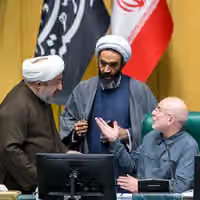
Pro-hijab vigilantes protesting outside the Iranian Parliament. March 2025
An unprecedented police crackdown on pro-hijab protesters in Iran suggests a shift in priorities, signaling that defiance of higher authorities even by supporters will no longer be tolerated.
On Friday evening, hundreds of male and female police officers raided a makeshift vigilante camp outside the Iranian parliament, dispersing around two dozen protesters—mostly women—who had been stationed there for over 45 days. They were protesting the delay in enforcing a controversial hijab law.
While no arrests were reported, religious vigilante groups claim that police used excessive force. They called on their supporters to rally outside the parliament on Saturday afternoon. A spokesman, Hossein Allahkaram, announced later that the rally would be postponed until after the Nowruz holidays.
In the past, security forces have even protected radical supporters during high-profile actions, such as the storming of the British embassy in 2011 and the Saudi embassy in 2016—both of which triggered major diplomatic crises.
A defiance of the Supreme Leader and his policy shift?
In mid-September, Iran's Supreme National Security Council (SNSC) suspended the implementation of the hijab legislation, which imposes harsh penalties—including heavy fines and prison sentences—on women who violate strict dress codes and businesses that fail to enforce them. The decision was reportedly driven by concerns over public backlash and the risk of triggering anti-government protests.
Since the decision could not have been made without the approval of Supreme Leader Ali Khamenei, who has avoided discussing the issue in his speeches for months, criticism of the delay could be viewed as defiance of what appears to be a strategic shift in Khamenei’s approach.
Vigilantes continue to refer to Khamenei’s April 2023 speech, in which he took a firm stance. Khamenei declared in the speech that disregarding hijab was “religiously and politically haram (forbidden).” In the same speech, he accused foreign intelligence agencies of encouraging Iranian women to defy the mandatory hijab. However, he has conspicuously avoided addressing the hijab issue in recent months, including during his December 17 address to an all-female audience.
Rather than blaming Khamenei, vigilantes hold Mohammad-Bagher Ghalibaf responsible for the delay in enforcing the legislation and argue that he should be accountable for Friday’s crackdown. Hours before the crackdown, they chanted against Ghalibaf during his speech at Friday prayers in Tehran.
The Friday crackdown could also be seen as a warning to ultra-hardliners that opposition to Khamenei’s potential policy shifts— possibly including allowing engagement in direct talks with the Trump administration—will not be tolerated.
“Consider the recent actions against [pro-] hijab protesters as marking a shift in Iran’s political landscape,” a former aide to ex-President Mahmoud Ahmadinejad, Abdolreza Davari, posted on X, suggesting that authorities are now seeking to mend their relationship with the hugely disillusioned middle classes.
Debate over freedom of assembly
The police action has sparked debate over the right to assembly in Iran. Some opposition figures have criticized the crackdown.
Ali-Asghar Shafeian, chief editor of the reformist Ensaf News, argued in a tweet that the police response was unnecessary and contradicted President Masoud Pezeshkian’s stance on freedom of expression.
Others, including prominent Islamic law expert Mohsen Borhani, pointed out that the vigilantes—who had no permit for their sit-in—have consistently rejected the right of other political groups to protest, despite Article 27 of the Iranian Constitution protecting peaceful assembly.
Mahmoud Nabavian, a senior Paydari member who played a key role in drafting the hijab law, recently argued that the preservation of the Islamic Republic must take precedence over enforcing the law, given the multiple domestic and international crises that it is facing—implicitly acknowledging the risk of unrest.