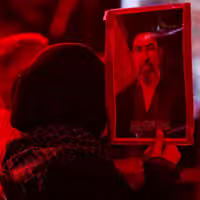
Pro-establishment protesters in Iran wearing shrouds with Khamenei's name printed on them
The protest by a guest on a program aired by Iran’s state television has ignited widespread debate over the Islamic Republic's emphasis on the veneration of death and its aversion to expressions of joy.
At the conclusion of each episode of the program The Black Box, guests are presented with a black box containing a folded white shroud tied with a black ribbon, along with a mock death notice featuring their photo. In this program, intended to be a light-hearted one-on-one talk show, guests are then asked to share their feelings about confronting their own mortality.
The shroud symbolizes the government’s Shia ideology, representing a wish for the recipient to achieve the honor of martyrdom or simply depart from an unworthy earthly life and go to paradise.
Around fifty episodes of the program have been aired over the past ten months with guests chosen from among recognized political, artistic, athletic, and academic personalities.
Many Iranians only heard the controversial program’s name a few days ago because Iran's ideologically driven state television has lost most its audience to satellite TV channels. Many Iranians turn to these both for news and entertainment.
The program drew widespread attention after a guest shared a video on social media. In his post, Hadi Amel, a popular television wrestling reporter, criticized the state broadcaster for the insensitivity of the gift he was presented with at the end of the show.
Amel revealed that he had protested immediately in the studio, demanding that the footage of the incident not be aired. Despite his request, he noted in his post, a re-run of the episode was broadcast last week. "It was unethical. They broke my heart," he said.
Amel’s post and a video clip of the controversial scene quickly went viral on Persian social media with thousands commenting.
In the aired program, Amel is visibly shocked upon opening the black box and discovering the gift symbolizing his "future." "I don’t like this. I don’t like talking about death," he says, placing the death notice face down on the table.
The presenter appears equally uncomfortable, turning to the production team and asking, "Is this what you wanted?" He then calls the gesture "bad taste."
“You wouldn’t kill so many people, commit such injustices, carry out executions, or engage in so much corruption if you truly understood the meaning of a shroud, a death notice, or the day of death,” a viewer said in an audio message sent to Iran International TV, addressing the Islamic Republic authorities. “You are the ones who should be gifted shrouds, as you are nearing your final day,” he added.
Shortly after, an excerpt from another episode surfaced on social media, showing the shocked reaction of another guest, Maryam Razzaghi-Azar, a prominent professor of pediatric endocrinology. Upon receiving the gift, she protested, stating that she did not want her children to see the shroud and death notice. She then insisted that the presenter tear it to pieces.
The intense public backlash compelled Peyman Jebelli, the head of the state broadcasting organization (IRIB), to address the controversy. Speaking to reporters, he acknowledged the criticism, agreeing that the gift was in poor taste. Jebelli also claimed to have reprimanded the producers responsible for the decision.
Despite the public outcry, pro-establishment figures and social media users argued that the criticism was unfounded because only two of the nearly fifty guests of the program were offended by the gift while some others, including ultra-hardliner lawmaker Hamid Rasaei, had even welcomed it.
Speaking to Iran International TV, prominent Washington-based Iranian sociologist Hossein Ghazian explained that the program’s controversy stems from its production and broadcast by a state-owned media outlet. He suggested that if a similar concept had been produced by, for example, a Belgian television channel, it might have been seen as creative. However, Iranians reacted negatively because the program is perceived as a reflection of the state’s ideology, he noted.
Ghazian argued that, within this ideology, life is viewed as a fleeting phenomenon unworthy of significant focus, while death is regarded as eternal. “In political terms, this implies that people should not expect much improvement in their living conditions from the government,” he added.
The IRIB has completely degenerated,” psychologist Azadeh Jazini wrote in an X post to fellow citizens. “This toxic system, which opposes life and happiness, has now stooped to presenting gifts that induce mental collapse. Stay away from this media outlet, not just for your own mental well-being but also to protect the mental health of your children.