Iran has engaged in direct talks with factions in Syria's new leadership following the ousting of its ally, Bashar al-Assad, a senior Iranian official said on Monday. The discussions aim to "prevent a hostile trajectory" in relations between the two nations, the official told Reuters.
The official said Iran's leadership, grappling with the loss of a key ally in Damascus and the impending return of Donald Trump to the White House in January, was open to engaging with Syria's new leaders.
"This engagement is key to stabilize ties and avoiding further regional tensions," he said.

In the aftermath of Bashar al-Assad's ouster in Syria, some Iranian politicians and commentators have pointed to his unpopularity and criticized the Islamic Republic for what they describe as the extensive resources wasted on keeping him in power.
Some of the more outspoken views about Assad, which could be seen as indirect criticism of Iran's Supreme Leader Ali Khamenei's policies, were conspicuously deleted after a few hours, possibly under pressure from authorities.
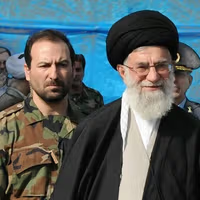
Khamenei has consistently praised Bashar al-Assad as a pivotal figure in the "Axis of Resistance" and has insisted on unwavering support for him against his opponents.
Conservative commentator Mohammad Mohajeri, tweeted Sunday, “In the last election, Bashar al-Assad had won 95 percent of the vote, but three years after that election, he fell from power without a single person from among ordinary people being willing to defend him." He later removed his post without an explanation.
Prominent commentator Sadegh Zibakalam, often labeled a reformist, reiterated his recent criticism of the Islamic Republic’s costly support for Bashar al-Assad in two tweets on Sunday.
Zibakalam, who has frequently condemned Iran's spending on arming and supporting groups like the Houthis and Hezbollah, as well as countries such as Venezuela, had also criticized the financial backing for Assad in a November 2023 interview.
In one of his tweets, Zibakalam who has also been very critical of Iran's costly nuclear program, said the Islamic Republic dedicated every possible assistance including the lives of its men to keep Assad in power but “never asked even once how this resistance leader treated his people.”
“Assad’s end was fortunate both for the Syrian people and Iranians. The people of Syria were saved from the suppressive rule of Baathists after half a century. The gain for the Iranians is that wastage of their country’s resources and throwing that into the bottomless well called Axis of Resistance to save a despotic and unpopular ruler ended,” he said in another post.
Zibakalam, who was imprisoned in May and later released for medical treatment, deleted his tweets after a few hours and made no further comments on Assad’s fall.
Parvaneh Salahshouri, a former reformist lawmaker and outspoken critic of the Islamic Republic’s policies, referred to Bashar al-Assad as a dictator in a brief post on X. “Assad’s destiny, the disgraceful fate of all dictators,” she wrote.
“The fate of over half a century of the Assad family dictatorship in Syria … must be a lesson for all authoritarian governments,” the former secretary general of the banned Freedom Movement of Iran Party, Mohammad Tavassoli, warned in an X post, adding that timely “return to the people” and giving them freedom and the power to exercise their wishes can “prevent such a costly process” as overthrowing the Assad family.
A similar view was expressed by Rahmatollah Bigdelli, a pro-Pezeshkian cleric and politician, who also in an X post said Assad’s fall should be a lesson for a government to surrender to the will of its people to stay immune to “internal and external threats”.
Assad’s reported $30 billion debt to Iran
In addition to deploying tens of thousands of fighters to support Bashar al-Assad’s forces against insurgents across Syria, the Islamic Republic provided his government with free oil and military equipment for years.
Iran's substantial support for Assad has contributed to sanctions being imposed on its prominent airline, Mahan Air, as well as the country's national carrier, Iran Air.
In May 2020, Heshmatollah Falahatpisheh, then-chairman of the parliamentary National Security Council and Foreign Policy Committee, said Iran had spent between $20 to $30 billion to support Assad and demanded that the debt be paid back.
“Syria … Iranians must rejoice now. Nobody has the right to spend the nation’s dollars to preserve the spider’s web,” Falahatpisheh tweeted Sunday.
Falahatpishes, too, removed his tweet Monday and in another tweet said he still considers the Assad family a "spider's web". "That's why I spent a decade of my life to recover Syria's debts to Iran," he wrote, but added that he distinguishes between the Assad family and the "true and rightful resistance movement."
Many of those who commented on his tweet accused him of cowardice for backing from his original position under pressure. "Look out of the window, the black van [of the security forces] has left the alleyway. It is too obvious that they called you to direct you to the right path,” one of the comments said.
Similar concerns were voiced by Bahram Parsaei, a member of parliament until 2020, who also claimed the Assad government owed $30 billion to Iran. “What will happen to this huge sum of money now?” he asked in an X post. He pointed out that according to Article 80 of the Iranian Constitution, any non-refundable foreign loans should have been approved by the Parliament.


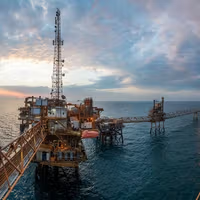
In the wake of the collapse of Bashar al-Assad’s government in Syria, an Iranian tanker carrying oil to Syria has reversed its course in the Red Sea apparently headed back toward the Persian Gulf.
Initially set to deliver approximately 750,000 barrels of Iranian crude to Syria, the Suezmax tanker LOTUS (IMO 9203784) is now returning to Iran, as reported by Tanker Trackers.
Iran has been providing Assad's government with free oil, as well as financial and military assistance throughout the country's civil war. According to Iranian politicians, the Assad government owed Iran between $30-50 billion.
This follows anticipated fuel shortages in Syria, likely to worsen with the fall of Iran's allied government and the takeover by insurgent groups, who stormed the Iranian embassy in Damascus on Sunday.
According to data received by Iran International from Kepler, a leading provider of technology-led insights into energy and shipping markets, Iran has been sending between 60,000 and 70,000 barrels of oil to Syria daily.
Anti-Assad rebels view Iran as a supporter of a regime that suppressed protests and targeted opponents with all available military means during the 13-year civil war. Assad's fall and the withdrawal of Iranian forces would disrupt Tehran's ability to use Syria as a strategic transit route for transferring weapons to the Lebanese Hezbollah and as a military base.
Syria served as a critical corridor for the Islamic Republic, linking Tehran to the Mediterranean in what was often referred to as Tehran's "Shiite Crescent." With Assad's fall, Iran's regional influence is expected to weaken further, particularly following significant Israeli blows against Hezbollah.
“This will probably embolden the Trump Administration to take a tough stance against Iran, in particular by constraining their oil exports. Inflicting economic pain on the regime would seem more likely to yield results now that the Iranians have seen their investment in Syria prove wasted,” wrote Forbes on Sunday.
Hayat Tahrir al-Sham, the main rebel group advancing in Syria, sent Iran a private diplomatic message this week, The New York Times reported citing three Iranian officials.
"The group promised that it would protect Shiite religious sites and Shiite minorities and asked Iran not to fight its forces," the report said.
Iran, in turn, asked the group to allow safe passage of its troops out of Syria and to protect the Shia shrines, according to two officials cited by the Times.
Iran's Foreign Minister Abbas Araghchi says the government of Bashar al-Assad was supposed to implement reforms and constitutional changes but "showed little flexibility and speed in this process."
"Everything was clear, and the analyses had predicted this event. Iranian and Syrian intelligence systems were fully aware of the movements in Idlib, and this information had been conveyed to the Syrian government. What was surprising, however, was the inability of the Syrian army and the unexpected speed of developments," Araghchi said in a televised interview on Sunday night.
"In a meeting we had with Bashar al-Assad, he himself was surprised by the army's performance. The Syrian army was affected by psychological and media operations rather than the real war," Araghchi added.
Asked about Iran's withdrawal of its forces from Syria, Araghchi said Tehran's "plan was not to engage with their internal opposition instead of the Syrian army."
"Our emphasis has always been on dialogue between the Syrian government and opposition groups," he noted.

Araghchi said that after Assad's fall, Tehran is now specifically concerned about Israelis taking advantage of the situation.
"We are monitoring the situation to ensure that the existing concerns do not come to fruition. These concerns include the possibility of a renewed internal and sectarian civil war between the tribes, the fragmentation of Syria, and, of course, the specific concern of the Islamic Republic, which is the potential exploitation by Israel, especially as movements have started since yesterday," he noted.
"It is important to issue a warning regarding these developments. Resistance groups in the region are closely monitoring and watching Israel's movements," he added.
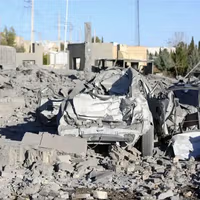
Israel conducted three airstrikes in the Syrian capital on Sunday against a security complex and a government research center which it has said in the past was used by Iran to develop missiles, Reuters reported citing two regional security sources.
The strikes caused extensive damage to the main customs headquarters and buildings adjoining the military intelligence offices within the security complex, which is located in the Kafr Sousa district of Damascus, the sources said.
The strikes had hit infrastructure used to store sensitive military data, equipment and guided missiles parts, one of the sources added.