A display of photographs honoring the victims of Iran’s state violence, featured at the "Memories Left Behind" exhibition, held from November 22 to 24, 2024, in Cologne, Germany.
Glasses left behind, a cherished jacket, a shirt bearing the last scent of dead man: the items on display moved many attendees of a unique exhibition on Iranian state repression to tears and tell a painful tale of Iran's suffering.
"Memories Left Behind" held over the weekend in Cologne, Germany paid tribute to the victims of 45 years of repression since the inception of the Islamic Republic in Iran.
The event coincided with the fifth anniversary of Iran's November 2019 protests, known as "Bloody November," in which security forces killed at least 1,500 protesters.
Organized by the Association of Victims' Families for Transitional Justice and the Association of Aban Families for Justice, the exhibition showcased personal belongings of victims, including handwritten letters, clothing and cherished keepsakes.
These items displayed served as a tribute to protesters, political prisoners, and victims of state repression beyond Iran's borders, spanning the mass executions of political prisoners in 1988 to the Woman, Life, Freedom uprising in 2022.
Soran Mansournia, whose brother Borhan was killed during the 2019 protests, reflected on the exhibition's meaning.
"We aimed to show the audience that the names and numbers seen in the news represent real people—human beings who fought for freedom and justice in Iran," said Mansournia, a co-founder Aban Families for Justice, whose name refers to the Persian month.
The brother of slain protestor Borhan Mansournia standing next to Borhan's shirt
Mahboubeh Ramezani, the mother of Pezhman Gholipour, who was also killed during the November 2019 protests, shared a message with attendees which was played for the audience.
"Every photo, every name, every item displayed here tells a story of courage. These are stories of integrity and honor, of those who gave their lives for freedom and justice. We will not forget the crimes of the Islamic Republic."
A composite photo of the hoodie worn by slain protester Pezhman Gholipour on display, alongside an image of his mother, Mahboubeh Ramezani, holding the bloodstained shirt he wore during the protests when he was shot and killed, with the shirt worn by slain protester Navid Behboudi also displayed.
Rahimeh Yousefzadeh, mother of Navid Behboudi, also killed during November 2019 protests remembered her son: “Navid, my passionate son, dreamed of justice and freedom, but the regime stole his dreams. We will not forget, and justice must be served.”
Fight against forgetting
The exhibition also commemorated the victims of the Woman, Life, Freedom uprising which began in September 2022 following the death of Mahsa Amini in morality police custody and was defined by months nationwide protests against theocratic rule.
Daughters of slain protestor, Minoo Majidi standing next to her dress
Among the items displayed was a dress belonging to Minoo Majidi, who was killed during the uprising on September 20, 2022 in Kermanshah, Western Iran.
"My mother wore this dress during her birthday celebration in England," her daughter, Mahsa Piraei, said. "It was the first and last time she wore it. One of the goals of the exhibition is to fight against forgetting. These souls were not just numbers; they were loved ones with families who adored them."
Slain teen protestor, Artin Rahmani's uncle standing next to Artin's jacket
Similarly, a jacket worn by 17-year-old protester Artin Rahmani killed during the same uprising on 16 November 2022 in Izeh, Southwestern Iran was on displayed.
"Artin joined the protests dressed in black the day after I warned him not to wear this jacket, as it was too identifiable during the previous day’s protests," his uncle, Foad Choobin recounted. "The next day at the protests, the Islamic Republic killed him with three bullets. We are here today to amplify Artin’s voice and the voices of others who were killed by the Islamic Republic."
Slain protestor Fereydoon Mahmoudi's brother standing next to Fereydoon's shoes
A pair of shoes belonging to Fereydoun Mahmoudi, who was killed on September 19, 2022 during the protests in the Kurdish city of Saqqez, Western Iran.
"When I saw the photos of our loved ones and Fereydoun’s shoes displayed, I choked up," his brother Farhad said.
"Those shoes, once worn at weddings and formal occasions, now serve as a memento far from his homeland. Fereydoun sacrificed everything for freedom, prioritizing the fight for his country’s liberty over his own ambitions."
Remembering PS752 Flight victims shot down by the IRGC
The exhibition also included items cherished by those who lost their lives in the downing of Ukraine International Airlines Flight PS752 by Iran’s Revolutionary Guards in January 2020.
A hat belonging to environmental activist Ghanimat Azhdari was among the artifacts. "This hat was part of her life," her sister, Azamat said. "Her memory and her fight lives on."
Azamat Azhdari standing next to her sister's hat and hair brush
1988 mass executions: a legacy of loss
The exhibition also featured a section paying tribute to the victims of the 1988 mass executions of political prisoners.
Khatereh Moini, whose brother Hebat Elah was executed during then, shared a heartbreaking memory as she stood next to her brother’s shirt.
"I wanted to smell his shirt, to see if I could still remember his scent," she said, pointing to the faded shirt returned to her after over 35 years.
Khatereh Moini standing next to her brother's shirt
"Twelve of my family members were killed by the Islamic Republic, including my brother and my sister’s husband, Kasri Akbari Kurdestani, in the summer of 1988," Moini said.
During this time, Khatereh Moini witnessed the heart-wrenching plight of families, including her own, as they searched for their loved ones in unmarked graves.
In the wake of the 1988 massacre of political prisoners, many victims’ bodies were neither identified nor returned to their families. Instead, they were buried in mass graves at Khavaran, a cemetery in southeastern Tehran, where thousands of victims remain.
Moini, one of the witnesses to this atrocity, recalled the painful experience of searching for her family members' final resting place.
"I remember my mother digging the graves, and it is something that will never leave me," she said, her voice breaking.
Ongoing tragedies and transnational repression
The exhibition also highlighted transnational repression and ongoing tragedies, such as the disappearance of former political prisoner Ebrahim Babaei while fleeing Iran in 2021.
Shima Babaei standing next to her father's glasses
Among the items displayed was a pair of glasses that belonged to Babaei. His daughter, Shima, spoke about the pain of his absence.
"Instead of embracing my father, I was handed his belongings. His glasses and other personal belongings are a testament to his memory and the crimes committed against him. Two years and eleven months have passed, and I still cling to hope."
A collective vow for justice
Organizer and activist Lawdan Bazargan said the exhibition aimed not just at preserving lost loved ones' memories but winning a better future for Iran.
"This is not just about remembering the past but amplifying the voices of victims and their families. We will not forget. The voices of our loved ones must be heard, and justice must prevail."
The exhibition drew dozens of attendees, many visibly moved by the stories and items on display.
Bazargan noted that the exhibition only scratches the surface of the crimes committed by Iranian authorities against their people.
"The sheer scale of these crimes shocks viewers. Our fight for justice will continue until it bears fruit."
The cost of for essential goods and services in Iran have risen by at least 40% over the past four to five months, the Iranian Labour News Agency (ILNA) said in a report, trapping Iranians in a worsening cost of living crisis.
The surge driven by inflation and the removal of government price controls has left families struggling to afford housing, food and utilities under President Masoud Pezeshkian’s administration.
A report published by the ILNA news agency, titled "From electricity to eggs: Everything has become more expensive" described the situation as akin to a "price liberalization bomb that has exploded across all sectors of the economy."
The report referred to sharp increases in electricity and energy bills, meat and eggs, housing, and even luxury goods such as gold and cars. This wave of inflation, ILNA said, has left no corner of the economy untouched.
Iran’s Statistical Center recently reported that urban rental prices rose by approximately 42% in the 12 months leading up to November 2024, compared to the same period the previous year. November alone saw rents climb 3% month-on-month and a whole 40% compared to November 2023.
"Workers across the country can no longer afford to manage their lives, start families, have children, or secure shelter," labor activist Hossein Habibi was cited as saying in an interview with ILNA.
"The crisis has penetrated their very core, and inflation has overwhelmed them."
The price increases extend far beyond housing. Electricity bills, a critical concern as winter approaches, have jumped significantly. At the same time, staple foods such as meat and eggs have become increasingly unaffordable for ordinary Iranians.
Faramarz Tofighi, another labor activist, confirmed that everyday living costs have risen by at least 40% since the Pezeshkian administration took office.
"Price liberalization is advancing at a frightening pace," Tofighi said, pointing to economic policies inherited from the previous government that he said are exacerbating inflation. "From the government and parliament’s statements, it appears that economic officials have raised their hands in surrender. They are openly telling the people that the situation is dire and nothing can be done," he added.
Tofighi emphasized the severity of the current crisis, saying, "This level of inflation is unprecedented in the entire history of Iran." He described the situation as a "collapse of working families into the black hole of livelihood crises."
An elderly man checking rice prices at a market in Iran
Government concedes economic missteps
Acknowledging the escalating challenges, President Pezeshkian delivered an assessment in a speech on November 22.
"We have significant imbalances in water, electricity, gas, and the environment—some of which are on the brink of disaster," he said.
Successive governments in the Islamic Republic have repeatedly struggled to address inflation and rising costs. Price-control policies, often implemented as quick fixes, have proven ineffective over the years and incapable of stemming the tide of economic instability.
The human cost of inflation
As inflation tears through Iran’s economy, families are bearing the brunt of the crisis.
The skyrocketing cost of basic necessities has forced many to cut back on essential expenditures, including food and healthcare. The inability to secure affordable housing is driving some into overcrowded or substandard accommodations, compounding the sense of despair.
Labor activists like Habibi and Tofighi warn that the government’s apparent inability to address inflation is eroding public confidence. The rising cost of living, coupled with stagnant wages and dwindling job opportunities, is pushing working-class Iranians to the brink of poverty.
Iran’s inflation crisis, long exacerbated by international sanctions and economic mismanagement, shows no signs of abating. With the cost of living rising sharply across sectors, the Pezeshkian administration now faces mounting pressure to find solutions.
President-elect Donald Trump's administration will focus more on Iran, a top potential security official said on Tuesday, and will aim to render the Islamic Republic less financially capable of aiding Russia and US adversaries in the Middle East.
"The change you're going to see is more focus on Iran," Mike Waltz, Trump's nominee to be US national security advisor, told CNBC in an interview.
"Maximum pressure, not only will it help stability in the Middle East, but it'll help stability in the Russia-Ukraine theater as well, as Iran provides ballistic missiles and literally thousands and thousands of drones that are going into that theater," he added.
The Republican congressman from Florida shares a strong pro-Israel and anti-Tehran stance with many of the incoming president's other top foreign policy picks.
In his last term, President Trump withdrew the United States from an international deal over Iran's disputed nuclear program and reimposed what his administration called a maximum pressure campaign against the Islamic Republic.
By ordering the assassination of a top Iranian military commander, Qassem Soleimani in Baghdad in 2020, Trump earned the lasting enmity of Iran's ruling military and clerical establishment which has repeatedly vowed revenge.
US investigators have alleged that the Islamic Revolutionary Guard Corps sought to enlist an Afghan national to assassinate Trump before the US election, in charges Iran denies.
The reimposition of harsh sanctions enforcement which had eased somewhat under President Joe Biden may herald a new era of confrontation between the United States in Iran as conflict between US ally Israel and armed Iranian fighters rages on.
Waltz said Iran was an obstacle to peace in the Middle East and that oil sales to China were a key lifeline that needs to be cut off.
"As long as they are flushed with cash, the Middle East is just never going to have peace. Iran doesn't want the Middle East to be in peace," he said.
"China buys 90% of Iran's illicit oil, in roughly 2017, 2018, they were exporting 4 million barrels per day. By the end of Trump's first administration, it was down to around 300,000 to 400,000," he added. "So I think we'll be having some conversations with China about their purchases."
Israel and Hezbollah have agreed to implement a US-brokered ceasefire deal that Prime Minister Benjamin Netanyahu says will allow Israel to focus on Iran.
Israel's security cabinet approved the ceasefire deal on Tuesday and the whole cabinet is due to review it later in the day. Lebanon and Hezbollah have also agreed to the proposal which is expected to be implemented on Wednesday.
"The ceasefire deal with Lebanon now means Israel will focus on Iran's threat", Netanyahu said in a speech following the approval of the truce deal.
Netanyahu said there were three reasons to pursue a ceasefire: to focus on Iran, to replenish depleted arms supplies and give the army a rest and finally to isolate Hamas, whose attack on Israelis on October 7, 2023, triggered a devastating war in Gaza and saw Hezbollah join conflict with Israel.
Hitting the 'head of octopus'
Netanyahu said that he is "determined to do whatever it takes to prevent Iran from obtaining nuclear weapons."
"That threat has always been my top priority and is even more so today, (is) when you hear Iran's leaders state over and over again their intention to obtain nuclear weapons," the Israeli prime minister said. "For me, removing that threat is the most important mission to ensure the existence and future of the State of Israel."
Israel’s defense minister said earlier this month the nuclear facilities of the Islamic Republic are now more vulnerable than ever, following Israel’s October 26 airstrikes which targeted Iran’s key air defense systems.
The Israeli air raids last month knocked out Iran's last three Russian-provided S-300 air defense missile systems, Fox News reported at the time citing US and Israeli officials. The surface-to-air S-300s were the last in the Islamic Republic's arsenal after one was destroyed in an attack in April which was also likely carried out by Israel.
"We destroyed major parts of Iran's air defense system and missile-manufacturing capabilities, and we demolished a significant component of their nuclear program," Netanyahu said in his Tuesday speech, calling Iran the "head of the octopus".
Iranian authorities have consistently called for Israel's destruction and consistently refuse call it by name but refers to it as the "Zionist entity".
The G7 and the European Union issued a formal rebuke of Iran in a joint statement on Tuesday, condemning its military actions in the Middle East, nuclear activities, and arms transfers to Russia and the Houthis in Yemen.
The statement also reflected growing concerns among Western countries their allies over Tehran’s regional and global activities.
“We reiterate our strong condemnation of Iran’s missile attacks against Israel, which pose a serious threat to regional stability,” the statement read.
The ministers also highlighted Iran’s support for armed groups such as Hamas, Hezbollah, and the Houthis, urging restraint to prevent further escalation.
“A wider conflict in the region is in nobody’s interest.”
The G7, or Group of Seven, is an informal bloc of seven advanced economies that collaborate on global economic and political issues. Its members include the United States, Canada, the United Kingdom, France, Germany, Italy, and Japan. The European Union also participates in G7 discussions as a non-enumerated member.
The group was established to address major economic challenges of the time, such as the oil crisis and global recession, and now is aligned geopolitically against challenges from Russia and China as well as smaller players like Iran and North Korea.
The statement comes against the backdrop of a turbulent year in Iranian-Israeli relations.
In April, Iran launched Operation True Promise, a coordinated strike involving missiles and drones targeting Israel. Tehran described the operation as retaliation for an Israeli airstrike on its embassy in Damascus, which killed two Iranian generals. Israel countered with airstrikes targeting Iranian facilities, escalating tensions further.
Hostilities reached a new peak in October when Iran fired 200 ballistic missiles at Israel. Israeli forces responded with attacks on Iranian military installations, including elements of its nuclear program. Israeli Prime Minister Benjamin Netanyahu later confirmed the strikes, signaling the intensifying cycle of retaliatory violence.
Mounting nuclear concerns
The G7 also addressed Iran’s nuclear activities, underscoring their opposition to Tehran developing or acquiring nuclear weapons.
“We reiterate our determination that Iran must never develop or acquire a nuclear weapon. We will continue to work together, and with other international partners, to address Iran’s nuclear escalation.”
“A diplomatic solution remains the best way to resolve this issue,” the statement added, emphasizing what they described as Iran’s obligations under United Nations Security Council Resolution 2231.
Iran responded defiantly, activating advanced centrifuges and enriching uranium closer to weapons-grade levels. By late October, the IAEA reported that Iran’s uranium stockpile had risen to 182.3 kilograms of 60% enriched uranium, a significant step toward nuclear capability.
“Iran must immediately cease all support to Russia’s aggression against Ukraine and halt such transfers of ballistic missiles, UAVs and related technology,” the G7 ministers said.
They also decried Iran’s arming of the Houthis, saying such transfers have enabled attacks on commercial shipping in the Red Sea and Gulf of Aden.
“These maritime attacks constitute an egregious violation of international law. They have killed innocent seafarers, continue to endanger the lives and safety of crews and have exposed ecosystems in the area and coastal States to serious and grave environmental risks,” read the statement.
The G7 applauded international naval operations, including EU and US-led missions, for mitigating risks in the region.
The G7 also urged Iran to end human rights violations and cease arbitrary detentions, particularly of dual and foreign nationals.
“We reiterate our deep concern over Iran’s human rights violations, especially against women, girls and minority groups. We call on Iran’s leadership to end all unjust and arbitrary detentions, including of dual and foreign citizens, and condemn the unacceptable harassment of its citizens.”
As diplomatic efforts to address Iran’s nuclear ambitions and regional interventions continue, the G7’s unified stance signals heightened pressure on Tehran.
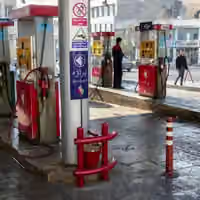
Iran’s parliament speaker has candidly warned of escalating energy shortages and called for immediate action to avert a worsening crisis as winter approaches.
Mohammad Bagher Ghalibaf’s remarks came during a review of the Energy Commission's report on seasonal power outages and fuel shortages for Iran's thermal power plants on Tuesday.
"Energy is one of the country’s significant opportunities but look at the current situation. This summer, we faced over 15,000 megawatts of consumption imbalance," Ghalibaf said, highlighting industrial production losses of 1.5% during the same period, according to the Parliament’s Research Center.
"This is detrimental to both producers and the government, as the government cannot collect taxes from their profits."
Iran’s natural gas production has slowed significantly, with a production growth rate in the past three years reaching just a third of the previous decade’s pace. Much of this slowdown stems from the aging South Pars gas field, which accounts for 75% of the country’s output but is experiencing natural declines. International sanctions have compounded the issue, preventing the acquisition of advanced production platforms.
During the winter of 2023, Ghalibaf noted, the country faced a 250-million-cubic-meter daily deficit in the gas sector, even with industry shutdowns and pressure drops.
This shortage has resulted in widespread power outages and industrial declines. Iran’s steel production, for instance, fell by 45% in the summer, while the petrochemical sector, heavily reliant on natural gas, has been operating at only 70% capacity.
Ghalibaf attributed part of the crisis to inefficiencies within the ministries of oil and energy, saying that their lack of coordination has exacerbated the problem.
“There is a conflict of interest between these two ministries. Both have grown so large that their coordination is no longer manageable by senior officials,” he said. He urged the government and parliament to collaborate with experts to resolve these institutional issues and address organized fuel smuggling, which siphons off 25 to 30 million liters of refined products daily.
Damavand power plant near Tehran
The energy shortages have had dire consequences for Iranian citizens. Widespread blackouts in residential areas have disrupted daily life, sparked public anger, and curtailed commercial activity. With 70% of the country’s energy consumption dependent on natural gas, no viable alternative exists to bridge the gap. Planned gas price increases, while potentially boosting revenue, are unlikely to significantly curb consumption given the low domestic gas prices.
Ghalibaf also touched on the international repercussions of Iran’s energy crisis. “There was a time when we could use oil as leverage against enemy threats,” he added, lamenting the loss of this strategic tool due to declining production and logistical issues.
With inflation exceeding 40% for five years, a halved national currency, and over 30 million citizens below the poverty line, the energy crisis adds yet another layer of strain to Iran’s already fragile economy.