Iranian officials have raised the stakes, suggesting another strike on Israel. The United States has issued a stern warning against such a move, while Israel stands ready with an intensified response if it occurs. Is Tehran bluffing—or playing Russian roulette?
Ongoing confrontation with Israel—and the U.S.—carries grave risks, seemingly at odds with the Islamic Republic’s enduring commitment to survival. Iran's first Supreme Leader, Ruhollah Khomeini, declared that “preserving the system” is “the most obligatory of obligations.” For him, clerical rule was essential; without it, he argued, religion itself would perish. In this view, power is paramount, taking precedence even over religious edicts, let alone public welfare.
Khomeini’s dictum has been the cornerstone of Iran’s theocracy for four decades. It has led his successor, Supreme Leader Ali Khamenei, to step back from the brink before, and it may very well compel him to back off again in the weeks to come. But the voices coming out of Tehran this week say otherwise.
On October 31, the three most senior commanders of Iran’s Revolutionary Guards (IRGC) promised an attack on Israel. Even Khamenei’s typically reserved chief of staff joined their chorus, calling for a response that would leave the Israelis regretting their air strike. Hours later, Axios and the New York Times ran stories of an impending Iranian attack. “Likely before the US election,” one source was quoted saying.
Khamenei himself in a speech on Saturday indicted that Israel and the United States will face a harsh response to Israel’s October 26 air strikes.
It may be bluster—or another “True Promise,” the IRGC's code name for its two massive missile attacks against Israel this year. Both actions are hard to rationalize, especially the latest one on October 1, given the genuine risks involved. Decision-makers in Tehran understand their adversary isn’t just Israel, but a U.S.-backed Israel. They’re acutely aware of Iran’s struggling economy and the mounting frustration among Iranians. An all-out war could be suicidal, threatening to dismantle the very system meant to stand above all else.
Could this be a simple yet catastrophic miscalculation? Or do they possess knowledge that fuels a sense of invincibility? Perhaps they’re driven by an external influence, feeling they have no viable—or favorable—choice.
Iran and Russia have drawn ever closer in the past few years. A war in the Middle East may not be what Moscow wants, but it won’t be all bad news if an Iranian attack drags the US into yet another quagmire and divert its attention from Ukraine. An Iranian attack on Israel before November 5 could benefit Donald Trump. Leaders in Tehran may be wary of that, but Russia’s president Vladimir Putin likely doesn’t mind.
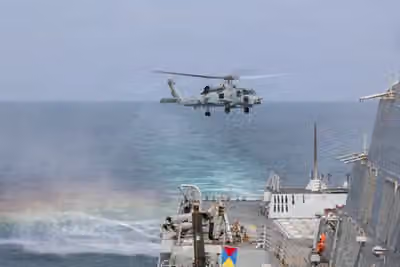
On Friday, the Pentagon ordered more bombers and warships to the Middle East, perhaps in anticipation of a new Iranian attack on Israel and a likely escalation.
In his Saturday speech, Khamenei cited “international logic” as a justification for an attack. Whether this implies aligning with shifting global power dynamics remains to be seen.
Iran’s belligerent messaging may be bluster. If it’s not—if it turns out to be yet another True Promise—then those calling the shots in Tehran may find themselves on a path they can’t back away from, one that serves Moscow’s interests more than their own.