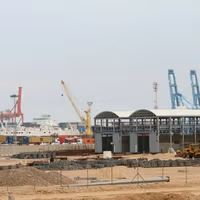
Israeli strikes target Parchin, Khojir military bases – Satellite images
According to analysis of satellite images cited by the Associated Press, the Israeli attack on Iran targeted a covert military base southeast of Tehran, which experts have previously associated with the country's nuclear weapons program, as well as another facility linked to its ballistic missile program.
Some of the damaged structures were located at Iran's Parchin military base, where the International Atomic Energy Agency (IAEA) has previously suspected Iran of conducting high-explosives tests that could potentially trigger a nuclear weapon. While Iran has consistently claimed that its nuclear program is for peaceful purposes, the IAEA and various Western intelligence agencies assert that Tehran maintained an active weapons program until 2003.
Additional damage was reported at the nearby Khojir military base, which analysts believe conceals an underground tunnel system and missile production facilities.
Israeli Defence Minister Yoav Gallant briefed US Secretary of Defence Lloyd Austin on Israel's Saturday strikes against Iran and discussed "strategic opportunities" arising from the operation, according to a statement by Gallant's office Sunday.
"Gallant discussed initial assessments regarding the success of the strikes against missile manufacturing facilities, surface-to-air missile arrays and Iranian aerial capabilities," Gallant's office said.
"Minister Gallant also discussed the strategic opportunities that have risen as a result of operational achievements, in both the northern and southern arenas," the statement added.
Iran’s reformist front has condemned Israel's attack, describing the operation as falling short of expectations after weeks of hype following Iran’s recent missile attack on Israel.
The group said that Iran now holds a strategic advantage, with regional support against the Israeli operation.
“Israel’s reckless attack on some of Iran’s military sites on Saturday night, while causing some damage and resulting in the martyrdom of several members of Iran’s army, was far below the level Israel had been promoting for weeks and did not serve as an effective response to Iran’s remarkable operation,” read a statement by the group.
Iran's Supreme Leader Ali Khamenei, 27 October, 2024
In his first response to the Israeli attack on Iran’s military installations, Supreme Leader Ali Khamenei refrained from an outright call for retaliation and delegated the decision to “authorities”.
Khamenei emphasized that Iran must make Israel understand “the power, determination, and innovation of the Iranian nation and its youth” while declaring that the decision on “how best to convey Iran's might and resolve to the Zionist regime” must be taken by the authorities in a manner that the best interests of the nation and the country are secured.
This may suggest that he has delegated the decision to the Supreme National Security Council, where many members are his appointees. It could also reflect Khamenei’s tendency to appear distanced from certain controversial policies that might carry political risks for him.
President Masoud Pezeshkian on Saturday saidin an X post that the Iranian nation would “stand fearlessly in defense of its soil and respond to any act of folly with prudence and intelligence” after the confirmation that several military installations in Tehran, Khuzestan, and Ilam provinces had come under Israeli attack in three separate waves overnight.
The Joint Staff of the Armed Forces in a statement Saturday claimed the military had intercepted a large number of Israeli missiles and succeeded in preventing Israeli aircraft from entering Iran's airspace but did not make any threat of immediate retaliation.
Speaker Mohammad-Bagher Ghalibaf, however, on Sunday said at a session of the Parliament that the Islamic Republic’s response to Israel's attack would be “definite and calculated,” while demanding that the United States compel Israel to accept a sustainable ceasefire in Gaza and Lebanon and prevent the conflict from spreading in West Asia.
Iran has been demanding a ceasefire, as its proxies, the Lebanese Hezbollah and Hamas face continued military pressure by Israel, losing leaders and cadres to constant attacks.
Foreign Minister Abbas Araghchi on Sunday also accused the United States of complicity in Israel’s Saturday attack by providing an air corridor to Israel in Iraq. US officials say Washington had no direct involvement in it.
Authorities have reported that four personnel from the regular army (Artesh) were killed and several others wounded in the attacks but have downplayed the extent of infrastructural damage caused by the Israeli strikes. Independent reports in Western media, however, indicate extensive Israeli targeting of air defense systems and missile production facilities.
Iran's Supreme Leader on Sunday also warned that the Israeli strikes must neither be exaggerated nor underestimated but insisted that Israel must be stopped from making “wrong calculations”.
The remarks were made in a speech to the families of “martyrs of security” at the meeting hall of his residence compound in central Tehran.
In his speeches after Israel’s attack on the Iranian embassy compound in Damascus in April and the targeted killing of the Hamas Leader Esmail Haniyeh in Tehran in July Khamenei vowed tough punishment of Israel.
His tone Sunday, however, was much more cautious and evasive regarding responding to Israel’s “Days of Reckoning” operation. Israeli warplanes reportedly penetrated Iranian airspace and operated freely, a fact that has probably not escaped Khamenei's attention.
Ultra-hardliners including lawmaker Hamid Rasaei have been demanding a quick and strong response to Israel and have already dubbed their proposed attack as “Operation True Promise 3”. The state broadcaster IRIB has also aired extreme demands for retaliation in its programs and interviews since the attack.
Iran's reform front in a statement Saturday condemned the Israeli attack. Still, it urged authorities to take an initiative to “prevent all-encompassing war from a position of dignity, wisdom, and expediency” and to support “ceasefire in Gaza and Lebanon and formation of an independent Palestinian state”.
Israel hit hard Iran's ability to defend itself and to produce missiles when its air force struck two nights ago, Prime Minister Benjamin Netanyahu said on Sunday.
"The air force attacked throughout Iran. We hit hard Iran's defence capabilities and its ability to produce missiles that are aimed at us," Netanyahu said in a speech.
"The attack in Iran was precise and powerful, and it achieved all its objectives," he said.
He emphasized that Israel’s war is not against the Iranian people, but with the Islamic Republic.
Iran’s Foreign Minister Abbas Araghchi said Sunday that the US involvement in Israel's operation is completely clear for Tehran, adding that the US provided a designated flight path for Israeli fighter jets.
“The least the US did was granting an air corridor to Israel’s air force,” he said.
Speaking about Iran’s diplomatic measures, he said, "Last night, I submitted a letter to the UN Secretary-General, officially recording this incursion on Iranian soil and requesting an urgent Security Council session.”