Grossi: Iran’s enriched uranium stockpiles continue to grow

Rafael Grossi, the Director General of the International Atomic Energy Agency (IAEA), has raised alarms over the continuous increase in Iran’s stockpile of uranium enriched to 20% and 60%.
Rafael Grossi, the Director General of the International Atomic Energy Agency (IAEA), has raised alarms over the continuous increase in Iran’s stockpile of uranium enriched to 20% and 60%.
Grossi also highlighted the agency's growing concerns over Tehran’s failure to provide critical information about its nuclear program, further escalating international fears of Iran's advancing nuclear capabilities.
"Iran’s stockpile of uranium enriched up to 20% and up to 60% continues to increase, and that Iran has expanded the number of cascades it is using to enrich UF6," said Grossi, in his latest statement on the Iranian nuclear issue.
The diplomatic landscape surrounding Iran’s nuclear program has been tense for years, but recent developments have escalated the situation. Iran halted its implementation of nuclear commitments under the Joint Comprehensive Plan of Action (JCPOA) more than three years ago, and its stockpile of enriched uranium continues to rise. With international inspectors barred from accessing key facilities, the IAEA now finds itself in the dark about Iran’s centrifuge inventory, uranium ore, and heavy water stocks.
"The Agency has lost continuity of knowledge in relation to the production and inventory of centrifuges, rotors and bellows, heavy water and uranium ore concentrate," Grossi explained, underscoring the gaps in oversight created by Tehran’s refusal to cooperate.
Iran's defiance has not been limited to the technical aspects of nuclear verification. Grossi pointed out that Iran has failed to resolve "outstanding safeguards issues," particularly regarding the discovery of uranium particles at undeclared sites, a discovery that contradicts Tehran’s claims of transparency.
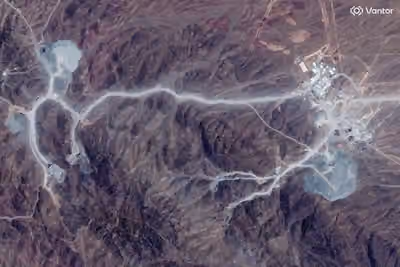
As the IAEA calls for renewed cooperation, Iran has instead accelerated its nuclear enrichment efforts. According to the latest reports, the installation of additional centrifuge cascades at the Natanz and Fordow nuclear facilities has intensified, bringing the nation closer to reaching the 90% purity required for a nuclear weapon.
This expansion comes on the heels of repeated IAEA requests for Iran to resume compliance with the JCPOA, an agreement Tehran abandoned following the US withdrawal under the Trump administration. Since then, efforts to reinstate or renegotiate the deal have stalled.
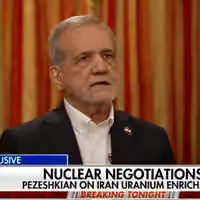
"I call upon Iran to implement the Joint Statement through serious engagement with the Agency’s concrete proposals," Grossi urged, signaling a desire to reestablish dialogue with the newly elected Iranian leadership.
"He (Pezeshkian) agreed to meet with me at an appropriate juncture," Grossi said, referring to an exchange after Pezeshkian's election in July.
"I encourage Iran to facilitate such a meeting in the not-too-distant future so that we can establish a constructive dialogue that leads swiftly to real results," he added.
In July, US Secretary of State Antony Blinken noted that Iran’s nuclear breakout time—the time needed to produce enough 90% enriched uranium for a nuclear weapon—has likely shrunk to "one or two weeks."
Reports indicate that Iran is ramping up efforts in its secretive nuclear weapons program, edging the country closer than ever to the development of a nuclear bomb, a threat that has persisted for over two decades.
Earlier this month, Abbas Araghchi, Iran's newly appointed Foreign Minister, stated that reviving the 2015 JCPOA nuclear agreement with the six major world powers is "untenable in its current form."