Jordan to allow Israeli use of airspace to thwart Iranian attack - report
Jordan will permit Israel to use its airspace to counter a potential Iranian retaliatory attack for the killing of a Hamas leader, citing security interests and its US alliance, according to Israel's Channel 12.
However, Jordan officially has denied allowing Israel to intercept missiles and drones in its airspace.
On Friday, Jordanian state-owned Al-Mamlaka TV cited an informed source who emphasized that Jordan "won't allow using its airspace under any circumstances and to any party," adding that the country will not permit a military response from any belligerent party at this time.
U.S. President Joe Biden and Jordan's King Abdullah attend a press conference, following their meeting, at the White House in Washington, U.S., February 12, 2024.
Iran’s UN representative has denied a Reuter’s report on Friday which said that Iran is planning to supply hundreds of missiles to Russia for its war in Ukraine.
"Legally, Iran has no restrictions or prohibitions on buying or selling conventional weapons. But morally, Iran will avoid transferring any weapons, including missiles, that may be used in the conflict with Ukraine until it ends," Iran’s UN representative said.
Two European sources told Reuters that dozens of Russian military personnel are being trained in Iran to use the Fath-360 close-range ballistic missile system, adding that they expected the imminent delivery of hundreds of the satellite-guided weapons to Russia for its war in Ukraine.
Some experts compare the Fath-360 truck-mounted missiles, that come in batches of six, to the US HIMARS rockets, although their overall range and accuracy is less.
Russian defense ministry representatives are believed to have signed a contract on Dec. 13, 2023 in Tehran with Iranian officials for the Fath-360 and another ballistic missile system built by Iran's government-owned Aerospace Industries Organization (AIO) called the Ababil, said the two intelligence officials, who requested anonymity in order to discuss sensitive matters.
The sources did not specify an exact timeline for the delivery of Fath-360 missiles but but said it would be soon.
The officials highlighted that Russian personnel have visited Iran to learn to operate the Fath-360 defense system. One of the sources said that "the only next possible" step after training would be actual delivery of the missiles to Russia.
The Fath-360 defense system launches missiles with a maximum range of 120 km (75 miles) and a warhead of 150 kg, while the Russian-manufactured Iskander-M ballistic missiles have a a range of 500km, but harder to operate. Iskander is also truck mounted but comes in one or two salvos.
A Russian Iskander ballistic missile often used against Ukrainian civilian targets
The supply of Fath-360s could allow Russia to use more of its own arsenal for targets beyond the front line, while employing Iranian warheads for closer-range targets, a military expert told Reuters.
A spokesperson for the US National Security Council told Reuters that US and its NATO allies and G7 partners "are prepared to deliver a swift and severe response if Iran were to move forward with such transfers."
It "would represent a dramatic escalation in Iran's support for Russia's war of aggression against Ukraine," the spokesman said. "The White House has repeatedly warned of the deepening security partnership between Russia and Iran since the outset of Russia's full-scale invasion of Ukraine."
A senior Iranian official, speaking on condition of anonymity, told Reuters that while Iran has not supplied Fath-360 missiles, they have sold other missiles and drones to Russia. The official emphasized, "How each country uses this equipment is entirely their decision," stressing that Iran did not sell weapons to Russia for use in the Ukraine war.
Iran's semi-official Tasnim news agency said in July 2023 the system had been successfully tested by the country's Islamic Revolution Guards Corps (IRGC) Ground Force.
Iran has supplied hundreds of Shahed drones to Russia since mid-2022, which have been extensively utilized for targeting civilian infrastructure and urban areas in Ukraine with NATO calling on Tehran to stop its military cooperation with Moscow.
The Shahed drones, however, carry a fraction of the explosives in comparison to the Fath-360 missiles and are easier to shoot down as they are slower than ballistic missiles.
The US, UK, and Canada imposed new sanctions on Iran’s drone industry in April this year, targeting Iranian drones, including their use by Russia in the war in Ukraine.
Data from Iran's customs organization, analyzed by Iran International, showed that several items listed under a US advisory guide were imported in the first two months of the current Iranian year, which began on March 20.
In July this year, NATO leaders accused Iran of "fueling Russia’s war of aggression against Ukraine by providing direct military support to Russia, such as munitions and uncrewed aerial vehicles (UAVs), which seriously impacts Euro-Atlantic security and undermines the global non-proliferation regime."
In the early hours of Friday morning, the town of Dahla in Deir Ezzor, eastern Syria, witnessed a sudden and bloody attack by Assad's forces and Iranian-backed militias against civilians.
Assad's forces and Iran-backed militias conducted a rocket attack on the town of Al-Dahla in eastern Deir ez-Zor around 2:30 AM on August 9th. The shelling resulted in a horrific massacre of the local population, killing 11 people, including five children. (See details of victims at the end of report)
The area of conflict is not far from US bases in Syria that have also been the target of frequent attacks by Iran-controlled armed groups.
This strike on the civilians occurred less than a day after an attack by "tribal" forces led by Ibrahim Al-Heflon areas east of the Euphrates River, specifically targeting positions of the Syrian Democratic Forces (SDF). SDF managed to drive them out of the eastern Euphrates areas within a few hours, forcing them to retreat beyond the river to the west of the Euphrates. The bombardment of civilians could have been a revenge attack by Syrian and Iranian-backed forces.
Details of the shelling and its aftermath
The recent shelling in Deir Ezzor underscores the ongoing violence and its indiscriminate impact on civilians, including women and children. The incident highlights the challenges faced by residents in regions experiencing heightened military conflict. Despite repeated calls to protect civilians in conflict zones, the shelling continues, putting the lives of those in Deir Ezzor and other parts of Syria at constant risk.
The tragedy extended to the funeral of the victims, where mourners in Dahla were subjected to further shelling by Damascus government forces and its Iran-backed allies This attack forced the community to hastily bury the victims under difficult conditions, amid fear and uncertainty.
This incident indicates that the targeting of civilians extends to entire communities, affecting their ability to carry out basic humanitarian and social duties such as burying the dead.
The Syrian Democratic Forces (SDF) reported that Damascus government forces and allies launched rockets at the towns of Dahla and Jadida Bakara after midnight on Friday, at around 2:30 AM. The shelling, which reportedly originated from regime bases in the village of Bou Lail on the western bank of the Euphrates River.
The ongoing escalation in Deir Ezzor reflects the tense situation in the region, where the Syrian regime and its allies are attempting to regain control over areas under SDF control and close to US forces.
Iran’s quest to enlist local tribes
Iran has long recognized the importance of local tribes in Syria as a means of expanding its influence. It recruited the Ibrahim Al-Hefl group through financial support and advanced military training. Through the Iranian Revolutionary Guard, Al-Hefl's elements were trained in unconventional warfare tactics and the use of advanced weapons in secret bases inside Syria and sometimes in Iran, making them an effective fighting force serving Tehran's regional goals.
This Iranian support for the Al-Hefl group is part of a broader strategy aimed at strengthening its regional influence and putting pressure on US forces in Syria. The coordinated attack carried out by the group against the Syrian Democratic Forces (SDF) in areas like Abu Hamam and Dhiban, using advanced tactics and weapons, reflects Iran's ability to carry out painful strikes and confirms its determination to use force to achieve its political and military goals in the region.
On August 7 and 8, 2023, northern Syria witnessed a dangerous escalation with a coordinated attack by an Iranian-backed tribal group on Syrian Democratic Forces (SDF) positions in areas like Abu Hamam in Al-Shaitat and Dhiban.
Victims of the bombardment by Syrian and Iran-backed forces:
Rahaf Ismail Al-Aboud, 12 years old; Nadia Kader Al-Mohammed, 18 years old; Hind Farhan Al-Aboud, 30 years old; Aya Ismail Al-Aboud, 8 years old; Nadine Thalej Al-Obaid, 22 years old; Yasser Yassin Al-Zu'ar, 37 years old; Maria Yassin Al-Zu'ar, 12 years old; Salwa Yasser Al-Zu'ar, 5 years old; Raghd Mohammed Al-Zughayr, 22 years old; Sham Bashar Al-Zughayr, 4 months old; Ilaf Bashar Al-Zughayr, 1.5 years old. Injuries were also reported among the children Ali Hassan Al-Daman, 12 years old; Malak Aboud Al-Hussein, 25 years old; Syria Al-Aboud, 50 years old; Fahd Ismail Al-Aboud, 15 years old; and Malak Ismail Al-Aboud, 6 years old.
Ali Shamkhani, advisor to the Supreme Leader Ali Khamenei, stated on X that Israel's actions, including the assassination of Hamas leader Ismail Haniyeh, aim to "derail [Gaza] truce talks."
He warned that legal and diplomatic measures are in place to punish a “regime that only understands force."
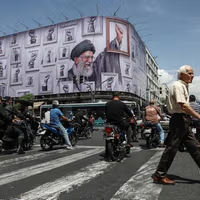
Iran’s Supreme Leader Ali Khamenei and Ali Shamkhani
References to a direct and large-scale attack on Israel have gradually diminished in Tehran's state-controlled media over the past few days.
On Saturday, the start of the week in Iran, news and political websites featured a few interviews and analytical pieces discussing the potential consequences of a major retaliatory strike.
However, there were no new reports of officials or clerics issuing fresh threats.
A Knesset member is warning the leaders of the Islamic Republic in Tehran against striking Israel, as a potential war looms after the assassination of Ismail Haniyeh in Tehran.
Amit Halevi shared his insider perspective as an Israeli official on the behind-the-scenes discussions surrounding escalating tensions in the Middle East during Iran International's 'Eye for Iran' podcast.
The Israeli lawmaker said Lebanon, where Iran's proxy Hezbollah is based, is crucial in the conflict as he hinted Israel's next move could play out there.
"Israel will not allow that Lebanon will stay a terror state," said Halevi.
The Middle East has been bracing for a possible strike by Iran and its proxies following Haniyeh’s assassination in Tehran, along with the killing of top Hezbollah military commander Fuad Shukr in an Israeli strike in Beirut hours earlier.
If the Islamic Republic decides to back down, despite it telegraphing revenge, and not retaliate on Israel's soil like it did on April 13, Lebanon may very well turn into a bigger proxy battle field for the two nations.
Israel has not confirmed or denied any involvement in the killing of Haniyeh, but Iran and its allies and proxies are blaming the Jewish state.
Iran managed to lobby Saudi Arabia to say on Wednesday that the assassination of the Hamas leader in Tehran was a “blatant violation” of Iran’s sovereignty.
Halevi said, while the Saudi kingdom, may have said that in public, a different picture emerges behind closed doors.
"MBS, the King of Saudi Arabia understands very well the meaning of a strong Iran," said Halevi.
The Israeli official, who is the chairman of the Israel-Bahrain Friendship Association, said neighboring Arab countries that are part of Abraham Accords, have the same fears as Israel, and secretly support their Jewish neighbor.
"Behind the scenes they know that this religious ideological infrastructure threatens them," he said.
Find out more about the appointment of Yahya Sinwar as the new head of Hamas, how Israel would respond to a potential attack from the Islamic Republic and how neighboring Arab countries would likely react by watching the full episode on You Tube, or listening on Apple,Spotify or Amazon.