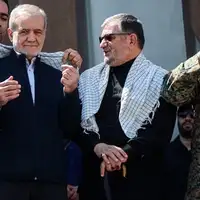
In a statement released on Saturday, the IRGC said the attack originated from outside the immediate area where Haniyeh was staying.
“This action was designed and implemented by the Zionist regime and supported by the criminal government of America,” the IRGC statement added.
After three days, this marks the first time the IRGC has publicly disclosed the exact cause of Ismail Haniyeh's death, who had traveled to Iran for the inauguration of President Masoud Pezehskian.
During this time, speculations abounded whether a long-range missile was fired from outside Iran's borders, or launched from an aircraft over Iranian airspace.
The IRGC-affiliated Fars News Agency had previously released a photo of the damaged residence, stating that Haniyeh was killed while staying on the fourth floor of a building in Zafaraniyeh in northern Tehran.
Iranian media, including the IRGC-affiliated Tasnim News Agency, previously reported, quoting Khaled Qaddoumi, Hamas' representative in Tehran, that Haniyeh's death was caused by a missile or rocket fired from outside the building toward the room where he was staying.
This contradicts reports by The New York Times and Telegraph, which claimed that the attack was carried out by planting a bomb in Haniyeh's room.
The Telegraph reported that Israel’s intelligence agency, Mossad, hired Iranian security agents to plant explosives in three separate rooms of a building where a Hamas leader was staying.
The original plan was to assassinate Ismail Haniyeh, the political head of the Palestinian militant group, in May during the funeral of former Iranian president Ebrahim Raisi, according to the report. However, the operation was aborted due to the many people inside the building and the high possibility of failure.
New York Times also, citing five Middle Eastern officials had stated that a bomb was hidden in the Islamic Revolutionary Guards Corps-run guesthouse in the Neshat compound in northern Tehran.
The newspaper detailed that the explosion, which occurred around 2 am local time, was triggered remotely and caused significant damage. It shook the building, shattered windows, and partially collapsed an exterior wall.
Regardless of the method employed, it is evident that even Iranian officials acknowledge a significant failure on Iran's part to protect Haniyeh, highlighting a profound lapse in security measures.
According to three Iranian officials speaking to The New York Times, this breach represents "a catastrophic failure of intelligence and security for Iran and a tremendous embarrassment for the Guards, who use the compound for retreats, secret meetings, and housing prominent guests like Mr. Haniyeh."