Trump calls for ‘obliteration’ of Iran if assassinated

Republican presidential candidate Donald Trump, in a social media post on Thursday, called for the annihilation of Iran if they ever assassinate him, following reports of such plots by Tehran.

Republican presidential candidate Donald Trump, in a social media post on Thursday, called for the annihilation of Iran if they ever assassinate him, following reports of such plots by Tehran.
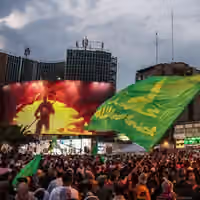
His statement was made alongside a video clip of Israeli Prime Minister Benjamin Netanyahu's speech to the US Congress on Wednesday, where Netanyahu emphasized Iran's threats.
On Truth Social, Trump wrote, “If they do ‘assassinate President Trump,’ which is always a possibility, I hope that America obliterates Iran, wipes it off the face of the Earth — If that does not happen, American Leaders will be considered ‘gutless’ cowards!”

US authorities were reportedly aware of an alleged Iranian plan to assassinate Trump before an attempt on his life occurred at a rally. On July 13, twenty-year-old Thomas Michael Crooks opened fire at a Trump rally in Butler, Pennsylvania, killing a former volunteer fire chief and injuring two others. Trump was slightly injured in his ear.
However, no direct link has been found between the reported Iranian plot and the attempted assassination.
In a recent interview with Iran International, Trump's former national security aide John Bolton said that naturally Trump would take the Iranian threat personally.
Trump withdrew from the Obama-era JCPAO nuclear deal with Iran in 2018 and imposed heavy sanctions, that have crippled Iran's weak economy.
Relations between the US and Iran became more strained since the 2020 US drone strike that killed Qasem Soleimani, the former commander of the Revolutionary Guards Quds Force, and Iran's top military intelligence operative in the Middle East.
Iranian officials, both political and military, have persistently issued threats against Trump and former members of his administration to avenge Soleimani's death, who orchestrated Iran's proxy operations throughout the region. For instance, in February 2023, Amirali Hajizadeh, the head of the Revolutionary Guards aerospace force, explicitly declared that the Islamic Republic intends to kill Trump.
In January 2022, Iran's former President Ebrahim Raisi vowed retaliation for Soleimani's killing unless former US President Donald Trump was brought to trial.
"If Trump and (former Secretary of State Mike) Pompeo are not tried in a fair court for the criminal act of assassinating General Soleimani, Muslims will take our martyr's revenge," Raisi said in a televised speech.
In 2022, the US Justice Department brought charges against a member of the IRGC for plotting to assassinate John Bolton, Trump's former national security adviser, likely in retaliation for Soleimani's death. Similar threats have been directed at other former Trump administration officials, including Mike Pompeo and Robert O'Brien, who continue to have security details due to ongoing risks.
Soleimani played a crucial role in Iran's external military and intelligence operations, often orchestrating hostilities against US forces in the region. Despite Iran's denials, the security concerns for those involved in the decision to kill Soleimani remain significant, necessitating ongoing protection measures.
Trump's post echoes his controversial rhetoric from 2019, when he threatened the "obliteration" of Iran if they attacked "anything American."
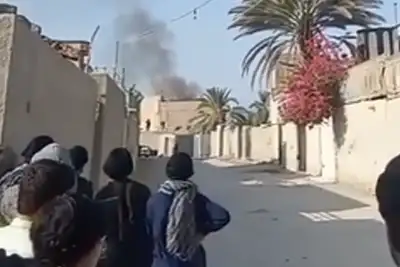

Sixty female political prisoners at Tehran’s Evin Prison staged an overnight sit-in on Wednesday to protest the recent death sentence of fellow inmate, Pakhshan Azizi.
The Instagram accounts of Nobel Laureate Narges Mohammadi, Iranian civil rights activist Golrokh Iraee, and German-Iranian rights activist Nahid Taghavi jointly announced that Evin's women unanimously demand the annulment of the Iranian-Kurdish political prisoner's death sentence.
The political prisoners at Ghezel Hesar Prison in Karaj also stated solidarity, condemning the "violation of the right to life of the Iranian people by the execution machine of the Islamic Republic."
They emphasized that resistance and protest against repression and executions would continue unabated. They urged international human rights organizations to address the new wave of executions.
Since the establishment of the Islamic Republic, Iran's Kurdish minority has experienced significant persecution. The rights organization Hengaw reports that during the first half of 2024, Iran executed at least 266 people as part of an ongoing execution spree. Of those executed, 72 were Kurds, Iran's largest minority.
Azizi is the second woman in the past month sentenced to death for "armed rebellion," following labor activist Sharifeh Mohammadi. The Hengaw Human Rights Organization which focuses on Iran's oppressed Kurdish minority, reported that Azizi was deprived of legal counsel and family visits for months, denying her a fair trial.
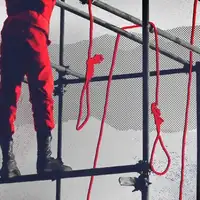
Hengaw published a letter from Azizi detailing torture and hanging during her detention. Authorities have also refused her family contact for the past two weeks.
The death sentence for labor activist Sharifeh Mohammadi, convicted on fabricated charges of armed rebellion, was announced a day before Masoud Pezeshkian's victory in the July 5 presidential runoff. The Campaign to Defend Mohammadi, initiated by her family on Instagram, argues the sentence is unjust based on her decade-old membership in a legal labor organization.
In early July, the Norway-based Iran Human Rights Organization (IHRNGO) warned of a probable surge in executions following the Iranian presidential election.
Mahmood Amiry-Moghaddam, the director of IHRNGO, noted that Iranian authorities historically decrease executions "to encourage participation in the elections," only to increase them afterward sharply. He urged both the international community and the Iranian public to brace for and appropriately respond to this potential wave of executions.
Amnesty International's annual report on the death penalty, released in May, highlighted Iran's rising execution rates, revealing that nearly 74% of all recorded executions worldwide last year occurred in Iran.
The report found that the Iranian government has intensified its use of the death penalty following the Mahsa movement to "instil fear among the people and tighten its grip on power."

Iran's Supreme Leader Ali Khamenei has criticized the United States for its handling of recent anti-Israeli demonstrations, despite his own security forces killing thousands over the past five years.
On Thursday, Khamenei accused the US government and police of trampling on students "right in front of the people, cameras, and the world's media."
In recent months, the US has witnessed a surge of protests against Israel, particularly in response to the ongoing conflict in Gaza. These demonstrations, often led by students, have been praised by Iranian officials as proof that their political ideology is taking root in Western countries.
"What they [the US] wanted to do in Iran has now happened to them,” Khamenei added, referring to his conspiracy theory that protests in Iran were an American plot.
Several rounds of widespread anti-regime protests shook Iran in 2017, 2019 and 2022. More than 2,000 protesters were killed by security forces and around 30,000 arrested. Iran has also hanged hanged dozens of dissidents and political prisoners in the past decade.
Khamenei took credit for protests in the United States, saying these are "blessings" brought on by Iran's Islamic revolution and its founder ayatollah Ruhollah Khomeini. The protests are "unprecedented phenomenon in contemporary history," he said.
Israeli Prime Minister Benjamin Netanyahu condemned the protesters as "Iran's useful idiots." In a speech to the US Congress on July 24, Netanyahu stated, "I have a message for these protesters: When the tyrants of Tehran who hang gays from cranes and murder women for not covering their hair are praising, promoting, and funding you, you have officially become Iran's useful idiots."
Thousands of people gathered in Washington DC on Wednesday, to protest against Israeli Prime Minister Benjamin Netanyahu. They attacked monuments and burned American flags chanting praise for Hamas and threats against Jews.
Netanyahu's comments come amid a backdrop of intense conflict in Gaza. Since the war began, following the Hamas attack on Israel, leftist and pro-Palestinian students mobilized across US campuses to oppose Israel’s actions. The Hamas invasion of October 7, which resulted in the deaths of 1,200 mostly civilians, triggered a harsh retaliation from Israel. According to Hamas, over 35,000 Palestinians have since been killed. However, Israel continues its campaign to eliminate Hamas and rescue the remaining 125 hostages in Gaza. Throughout the conflict, the US has defended Israel's right to self-defense.
Khamenei, who has spent 35 years of his authoritarian rule campaigning against Israel and the West, is leveraging these protests to bolster his anti-Western narrative. By showcasing anti-Israeli and anti-Western sentiment abroad, Khamenei aims to justify his government’s actions and ideology both at home and on the international stage.

Iran's absence of regulation is seeing children as young as toddlers exploited online as desperate families use unscrupulous measures to make ends meet amid the country's economic crisis.
Children, often as young as toddlers, are being used to create content for social media on platforms such as Instagram with some posts earning as much as $200 for better known 'influencers,' the equivalent of an average month's salary in Iran.
The desire for visibility, fame, and most importantly, income, is at the heart of the trend. Some parents generate revenue by documenting every aspect of their children’s lives since their birth.
Research done by Iran International on some of these pages shows that advertising rates can vary. A story to advertise a product might cost around $100, but if the child plays with a toy or wears the advertised diapers, the cost can rise to $200. Depending on the promotion method, prices can range between $10 to $1000.
"Child labor in the digital space, where children are engaged in income-generating activities while dressed neatly and fashionably, has been overlooked by many," wrote Nazila Ansaripour, a social affairs expert from Isfahan, in a report by Mehr News Agency on Sunday.
Until a few years ago, child labor involved things like selling flowers and gum at intersections or those working in underground workshops.
However, the emergence of social networks such as Instagram has led to the concept of virtual child labor. Children are placed in front of a camera by one or more family members to produce content for social media due to their beauty, charm, or skill.
The business of sacrificing childhood
This instrumental use of children, according to experts, can lead to disorders in their interactions with peers. When all of a parent's thoughts and behaviors focus on exploiting the child, it is expected that the child's needs will not be met, leading to potential anger towards their parents in adulthood.
"When a child grows up to become a CEO or engages in political activities, that photo or video is not deleted. This can lead to various social and psychological pressures on that person," Samaneh Savadi, a law expert from the UK's University of Sussex in Brighton, told Iran International.
Shadi Ramez, a psychiatrist, told Iran International it also impairs personal development. “A way to ensure healthy development in children is to give them the chance to define their identities without any conditions through trial and error. Unfortunately, child influencers lack this opportunity because they are pressured to maintain a persona created for them on social media, preventing them from experiencing trial and error.”
Government apathy or complicity?
Iran’s government, notorious for its heavy-handed internet censorship, is conspicuously silent on the issue of child exploitation on social media. While websites critical of the government are swiftly shut down and dissidents relentlessly pursued, platforms rife with child exploitation continue to flourish.
Although laws were approved in 2020 to protect child laborers in Iran, no practical steps have been taken to enforce them. Some observers believe that the government is fully aware of these practices but does nothing to stop them. Instead, they focus on censoring political dissent while such abusive practices continue unchecked.
While the country continues to spiral into poverty amid global sanctions, according to Iran's Parliament Research Center, 15% of the country's children are now engaged in labor activities.
At least 10% of these working children do not have the opportunity to attend school, depriving them of essential educational opportunities, the report revealed last year.
In 2017, out of nine million Iranian children, 499,000 were considered "active," signifying that nearly half a million children in the country were either engaged in labor or searching for work.
But the latest report suggests that the population of working children has now reached approximately 1.35 million, based on an estimated 15% involvement in child labor as the country's crisis escalates.

Commentators and analysts in Iran believe that negotiations with the Trump administration will be feasible if he wins the US elections, despite his tough stance against the Islamic Republic during his first term.
Former diplomat Nasrollah Tajik told reporters in Tehran that although former Iranian government's negotiations with the United States cannot be relied upon, Tehran can still pursue further discussions with Washington regarding its nuclear program and US sanctions.
Tajik however, noted that before any negotiations, the Iranian leadership should clarify its policy toward the United States. Meanwhile, he called on Iranian officials to sort out the technical problems with the UN nuclear watchdog IAEA as a first step for starting negotiations with Washington.
Former US President Donald Trump said recently that he was ready to “make a deal” with Iran on “everything” toward the end of his term, claiming that Tehran also “wanted” a deal because the country was in dire straits as a result of his tough sanctions.
Trump also said last week during the Republican National Convention that “Iran was broke. They had no money. I sanctioned the countries that wanted to buy oil from Iran. And I would’ve made a fair deal with Iran. I was gonna get along with Iran,” adding that “The deal was simple: Iran can’t have a nuclear missile. It cannot have that nuclear capability. Other than that, we talk about everything. They would’ve been very happy.”
Following the election of Masoud Pezeshkian and his pragmatic views about negotiations with the United States expectations grew in Iran about possible talks, albeit after the US election. Several Iranian politicians and commentators have said that Iran is willing to talk with the United States no matter who is elected President in Washington in November.
Trump's possible re-election worries the government in Tehran, that has been able to increase its oil exports during Joe Biden's presidency. Trump can re-invigorate the enforcement of US sanctions and possibly add new ones.
However, Abdolreza Farajirad, a professor of international relations in Tehran was more optimistic in an interview with Khabar Online website. "There are some hopes that the Democratic Party might win the 2024 US presidential election. If such optimism arises, the Iran-US negotiations might become more serious even before the upcoming US presidential election on November 5th. However, right now, I think the negotiation process is not moving quickly, and everyone is waiting to see what will happen in the future," he said.
However, Tajik, the former diplomat, highlighted that there won't be any talks during the next six months, and the subjects of the negotiations, though essential, are still not well defined. He noted the difficulty in agreeing on a single topic, suggesting that discussions could extend beyond the scope of the 2015 nuclear deal (JCPOA). Tajik emphasized that the most crucial factor is the political willingness from both sides to engage in negotiations.
He criticized the previous governments, specifically the Raisi administration's negotiations with the United States as weak and unreliable. Additionally, he pointed out that the revival of the JCPOA does not seem to be the focus of upcoming discussions.
Tajik added that if Trump wins the US election, there will be a better chance for an agreement. However, the negotiations are likely to be direct and may include issues beyond the nuclear topic, as suggested by Trump's statements.
Meanwhile, Iranian Foreign Policy Analyst Ali Bigdeli told Nameh News website in Tehran that there is a 90 percent likelihood for Trump's victory in the elections. He insisted that talks with the Republicans are as feasible as negotiations with IUS Democrats.
He went on to argue that traditionally the Republicans are focused on US domestic politics while the Democrats are more conscious of what goes on outside the United States. Nonetheless, If Iran shows some flexibility, negotiating with the Trump Administration can be as feasible as talks with the Biden Administration.

While Iran calls to ban Israel from the Olympic Games over the war in Gaza, 14 Iranian athletes will compete under the Olympic Committee's Refugee Team.
“Iran condemns the reception and protection of Israeli athletes at the Olympic Games in Paris, demanding their exclusion over Israel’s war against Hamas in Gaza. Announcing the reception and protection of the apartheid terrorist Zionist regime’s delegation means giving legitimacy to the child killers,” Iran’s foreign ministry stated in a post on X on Tuesday.
The foreign ministry statement said Israel does "not deserve to be present at the Paris Olympics because of the war against the innocent people of Gaza,” calling on organizers to ban Iran's archenemy.
On Thursday, Israel's foreign minister warned his French counterpart of a potential Iranian-backed plot to target Israeli athletes and tourists during the Paris Olympic Games.
"We currently have assessments regarding the potential threat posed by Iranian terrorist proxies and other terrorist organisations who aim to carry out attacks against members of the Israeli delegation and Israeli tourists during the Olympics," Israel Katz told Stephane Sejourne.
Katz did not detail any specific intelligence or threat against the Games.
On July 26, the flags of 206 countries will be paraded by athletes at the opening ceremony in the Stade de France, including Iran. The Refugee Team, bearing the flag of the International Olympic Committee, will be represented by 14 Iranians who have fled the country. The team has 37 athletes from 11 countries. They will represent sports such as taekwondo, canoe slalom, badminton and wrestling.
The numbers of athletes fleeing Iran have continued to spiral since the 2022 Women, Life, Freedom uprising and after the death of Mahsa Amini in police custody with athletes publicly taking the stage to oppose the government's oppression. Men and women from a range of sports have sought a life in exile, meaning competing under other flags.
Badminton player Dorsa Yavarifar, one of the youngest athletes on the Refugee Team, left Iran in 2018, just 15 at the time. Along with her mother, they left Tehran for Turkey using fake German passports.
She told Reuters she had been consistently rejected by the national badminton team without any given reason.
Shirin Shirzad, the former caretaker of Iran’s Women National Wrestling Team, told Iran International: “More than any other ministry in Iran, we witness mismanagement in the Sports Ministry, and that’s why many Iranian athletes whose big wish is to win medals in the Olympics or world competitions are leaving the country in clusters."
She said the federations lack experienced managers to help cultivate talent on the global stage. "An athlete sacrifices all his or her life to win a medal and when they see their efforts do not result in any advancement in personal life, they are forced to choose a better place to live," she added.

"I was really scared because I didn't know what was going to happen to me," said Yavarifar, who recently turned 21.
"I didn't know where I was going. My mum just said we were going to go to another country, but she never told me how or where," she noted. "It was all worth it. Now, that I think back about it—all that suffering is over, so I'm really happy now."

She is studying sports and exercise science at Middlesex University in London and trains three times a week at the Sankey Academy, an independent badminton club in Milton Keynes.
Saeedeh Fat’hi, an Iranian journalist, also told Iran International that sport is not a priority for Iranian officials who "want to misuse the achievements of the athletes to export the ideology of the Islamic Republic to other countries".
"When the Supreme Leader expresses gratitude to the woman who bore the flag of Iran wearing Hijab or the one who refused to shake hands with men in competitions, it shows how the Iranian government’s view of sports is,” she stressed.
Among the other Iranian athletes on the Refugee Team are Omid Ahmadi-Safa, a boxer who sought asylum in Germany and will compete in the 51 kg boxing category. Amir Rezanejad and Saeed Fazlouli, both refugees in Germany, along with Saman Soltani, a refugee in Austria, will represent Iranian rowing at the Paris Olympics.
Additionally, Mohammad Rashnonejad, a refugee in the Netherlands, and Mahboubeh Barbari Zharfi, a refugee in Germany, are the two Iranian judo athletes on the judo squad.
The Iranian national taekwondo team has four representatives in the Olympics, while the refugee taekwondo team includes three Iranians, making it likely they may come up against former team mates.
The wave of defections follows at least 30 Iranian athletes seeking asylum in recent years, escaping not only political repression in Iran but also specific challenges within the sports sector.
Athletes have cited issues such as corruption within sports federations, the enforced policy of not competing against Israeli athletes, and for women, the mandatory wearing of the hijab during competitions.
The Islamic Republic’s prohibition against its Olympic athletes competing against Israelis originates from its longstanding enmity toward the country since 1979.
Athletes are often pressured by government-controlled sports federation officials to intentionally lose matches or forfeit. Others, like judoka Leila Hosseini, have been told to cite injuries to avoid competing against Israeli opponents. For Hosseini, it cost her a gold medal in Tbilisi.
This year marks the third appearance of the refugee team in the Olympic Games, which began with a small team of 10 athletes in the 2016 Rio Olympics, growing to 29 in the 2020 Tokyo Olympics, and now reaching 37 athletes in the 2024 Paris Summer Olympics.
War-torn Syria and Afghanistan each have five athletes, sharing the second place after Iran. This means that each of these two countries, whose people are under the pressure of the Taliban and Bashar al-Assad, have about one-third of Iran's share in the Refugee Team. While Iran condemns the inclusion of Israeli athletes, it remains silent on the plight of its own refugees.