Saudi Arabia's king and crown prince congratulated Masoud Pezeshkian on his election as Iran's president, state news agency SPA reported on Saturday.
"I affirm my keenness on developing and deepening the relations between our countries and people and serve our mutual interests," SPA quoted Saudi Crown Prince Mohammed bin Salman as saying.
In March 2023, Iran and Saudi Arabia signed a landmark China-brokered deal to re-establish relations after years of regional rivalry. Since then, officials from both sides continued talks to bolster ties.

Zeinab Jalalian, one of the longest-serving female political prisoners in Iran, is in her 17th year of life imprisonment in the central city of Yazd, enduring severe health issues without proper medical care.
On Friday, the Human Rights Activist Network in Iran (HRANA) reported that Jalalian, despite suffering from multiple physical ailments, has been consistently denied the necessary medical attention and hospital transfers.
“Ms. Jalalian suffers from pterygium (an eye disease) as well as kidney and gastrointestinal diseases. Recently, due to pain in her right side, she was transferred to the prison infirmary. She was examined by the prison doctor, but no specialized treatment was provided. This political prisoner requires hospitalization and specialized care, yet the relevant authorities continue to prevent her transfer,” wrote HRANA.
Jalalian was arrested on February 26, 2008, while traveling on an intercity minibus in western Iran. Agents of the Ministry of Intelligence apprehended her at the entrance to the city, in front of dozens of passengers. During her detainment, Jalalian was subjected to severe physical and psychological torture, as reported by multiple rights groups.
In December 2008, she was sentenced to death by the Revolutionary Court in Kermanshah on charges of “enmity against God” (moharebeh) through “armed action against the Islamic Republic, membership of PJAK, possession and maintenance of military weapons and equipment, and propaganda activities in favor of anti-state groups” according to Kurdistan Human Rights Network (KHRN). Her sentence was commuted from execution to life imprisonment in October 2011.
In 2016, the UN Working Group on Arbitrary Detention determined that she was detained for the peaceful exercise of her rights to freedom of expression and association and denied her right to a fair trial. Amnesty International has repeatedly called on the Iranian authorities for her immediate release.
In January this year, Amnesty urged for her release again and stated that despite the findings of the UN Working Group on Arbitrary Detention, “Iranian authorities continued to subject Zeynab Jalalian to torture by deliberately denying her healthcare to coerce her into providing a videotaped ‘confession’ and ‘repenting’ for her past activities. Following at least two COVID-19 infections, Zeynab Jalalian has developed a lung condition and has trouble breathing – a condition that needs proper treatment.”
Jalalian has been transferred multiple times between various prisons, including Khoi, Qarchak, Varamin, Evin, Kerman, Kermanshah, and Yazd, without any leave. Her health has deteriorated significantly, with no respite from the prison authorities.
Numerous reports have highlighted the systemic neglect of medical treatment for political prisoners in Iran, resulting in the deaths of several inmates in the past.

Masoud Pezeshkian, the relatively moderate of the two finalists was declared the ninth president of Iran after securing 53.6 percent of the votes in the July 5 runoff against ultra hardliner Saeed Jalili with 44.3 percent.
Pezeshkian who considers himself an independent was backed by the Reform Front in the snap elections of June 28 that followed the death of hardliner President Ebrahim Raisi in a helicopter crash on May 19.
The pro-reform candidate secured over 7 million votes more than the first round and nearly 3 million votes more than his ultra-hardliner rival, according to official figures announced by the government.
The first round of the elections in which the turnout dropped to a record low of around 40 percent was widely boycotted by various political groups, activists, and disillusioned Iranians.
According to official figures, which many in the opposition are challenging, turnout in Friday’s runoff election increased by about ten percent to 49.8 percent. In Iran's tightly government-controlled electoral process, these figures cannot be independently verified.
The new president made many promises during his campaign, but as was the case with other candidates, detailed plans were lacking.
Pezeshkian advocates engagement in constructive talks with Western powers to revive the JCPOA nuclear deal and to lift the sanctions that he says have crippled the Iranian economy since the withdrawal of the United States from the agreement in 2018. He has not offered any concrete plans for such a move which requires the approval of Supreme Leader Ali Khamenei.
He has also insisted that Iran needs to accede to international conventions prescribed by the anti-money laundering Financial Action Task Force (FATF) to allow international banking ties. Iran has been on FATF’s blacklist since February 2020.
Former Foreign Minister Mohammad-Javad Zarif who campaigned for Pezeshkian relentlessly in the past few weeks is likely to be chosen for a senior position in his cabinet. The position of foreign minister is said to have been reserved for Zarif’s former deputy and nuclear negotiator Abbas Araghchi.
Pezeshkian said during campaign debates that lower-income and vulnerable Iranians would not pay taxes if he won the elections. He has also vowed free healthcare for the lower income and vulnerable families.
Ali Tayebnia, an economist and former minister of commerce in the government of Hassan Rouhani (2013-1017), is widely believed to be at the helm of Pezeshkian’s economic team. Tayebnia is believed to be a support of free market economy, as Iran suffers from overwhelming government control and ownership.
The 70-year-old heart surgeon, lawmaker and first deputy speaker of parliament (2016 – 2020), and veteran of the Iran-Iraq War (1980-88) has on various occasions admitted to helping impose the hijab on women in the early years of the Islamic Republic but has promised voters to put an end to the violent enforcement of the Islamic dress code by morality police enforcers.
Pezeshkian is known for his fiery speeches in the parliament against the government’s bloody crackdown on protesters in 2009.
In a tweet a day after Amini’s death, Pezeshkian strongly criticized the violence against her and said “arresting a girl for her hijab and handing her corpse to her family” was unacceptable in the Islamic Republic and shameful. He later said he had been barred by the Guardian Council from standing in the March 2024 parliamentary elections due to his protest to Amini’s killing.
He has also been critical of the house arrest of the leaders of the Green Movement who have been detained in their residences since 2011.
Pezeshkian had served as health minister under the reformist Mohammad Khatami from 2001 to 2005. Khatami who abstained from voting in the parliamentary elections of March in protest to the extensive disqualification of non-hardliners supported Pezeshkian and voted for him.
Pezeshkian’s additional votes in the runoff elections probably came from some of those who had boycotted the first round as well as some of the supporters of the Parliament Speaker Mohammad-Bagher Ghalibaf, who lost in the first round.
Pezeshkian’s approval to run by the ultra-hardline election watchdog, the Guardian Council, came as a surprise. He had previously registered for the presidency in 2013 but withdrew and registered again in 2020, only to be disqualified by the Guardian Council.
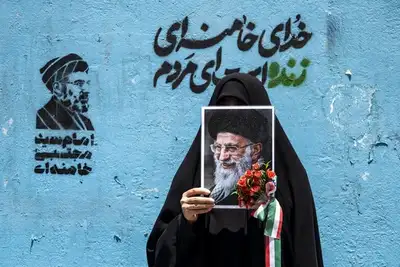
In a speech on Saturday morning, Interior Minister Ahmad Vahidi said that the second round of elections was conducted with "perfect security, health, serious competition, and participation of 30 million."
There were approximately 61.5 million eligible voters for the runoff presidential election.
Without addressing the widespread boycotts, he dismissed allegations that “elections in Iran are meaningless.”
He also thanked the other candidates for "energizing the elections."
Announcing the final election results, the government reported 10% increase in turnout compared with the first round on June 28.
Many Iranians opposed to the Islamic government began reacting on social by dismissing the high turnout number.
On Friday, dozens of videos were shared from Iran showing largely empty polling stations, while Supreme Leader Ali Khamenei remarked that the first round turnout was disappointing.