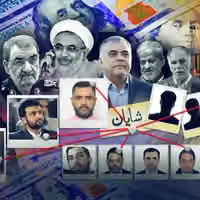
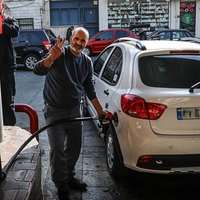
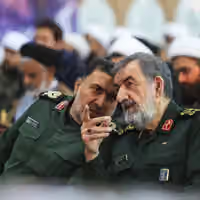
The three key groups are, in order of significance, the boycotters, the reformists, and the ultraconservative Paydari party members along with other like-minded hardliners.
At least 60 percent of eligible voters refused to go to the polls, leaving the race to one pro-reform candidate and five conservatives, two of whom withdrew before election day.
Until the final hours before the election, conservative figureheads and even top IRGC officers made extensive efforts to persuade either former nuclear negotiator Saeed Jalili or Parliament Speaker Mohammad Bagher Ghalibaf to withdraw, giving the other a better chance to win in the first round. Despite their efforts, the plan did not succeed.
Now, pro-reform Masoud Pezeshkian and Jalili are off to the runoff election for the final showdown on Friday. In the meantime, the three groups have to make tough decisions to shape the country's future.
The reformists need to put an end to their hesitations and stand firm in big numbers behind Pezeshkian to ensure a victory. At the same time, Paydari and other "revolutionary" hardliners will certainly do everything to support Jalili and enable him to form his ideal non-compromising, non-conformist hardheaded revolutionary government.
The boycotters need to reconsider their stance and decide whether to support a “moderate” who could perhaps marginally improve the country's situation and push back against power-hungry hardliners, or to leave it in the hands of ultraconservatives. The latter's economic and international policies are likely to negatively impact the country, potentially turning Iran into an "Islamic North Korea," as some critics have warned.
Hours after initial election results were out, Iranians started to voice their concerns. Siamak Ghassemi, an economic consultant in Tehran pointed out on multiple social media platforms that only 24 million out of the country's 61.5 million voters took part in the election which means a turnout of just under 40 percent based on unverifiable figures announced by the government.
He warned, "The message is clear. In one of the most competitive presidential elections, where both conservatives and reformists were represented, a 60-percent majority of Iranians chose to abstain. They do not care who occupies the President's Office or who will be in the runoff election. They do not care who will be the country's president." Ghassemi further cautioned the government, "Listen to the 60-percent majority!”
A deep economic crisis, partly triggered by US sanctions, worsening government repression, persistent news of corruption, and a host of other intractable issues have convinced many voters that it makes no difference who becomes president.
Meanwhile, a well-known reformist activist Sadeq Hosseini wrote: "Jalili would have been Iran's president now if we did not take part in the election even as much as we did. Just think of it that with this minimal participation we have stopped him so far."
While Ghalibaf left the race in silence with a temper tantrum after his defeat, another reformist figure, Nasser Torkan called on his voters to "lend their support to Pezeshkian in order to bring the country back on the right track of rationality to focus on the country's development and protect it from radicalism and backwardness."
Pessimists and boycotters, however, do not seem to be convinced that Pezeshkian is reformist enough. One of them said on a foreign-based satellite TV channel that preferring Pezeshkian to Jalili is like deciding whether to be taken to a detention center in a pink or a white Morality Police van.