• العربية
  • فارسی
Brand
  • Iran Insight
  • Politics
  • Economy
  • Analysis
  • Special Report
  • Opinion
  • Podcast
  • Iran Insight
  • Politics
  • Economy
  • Analysis
  • Special Report
  • Opinion
  • Podcast
  • Theme
  • Language
    • العربية
    • فارسی
  • Iran Insight
  • Politics
  • Economy
  • Analysis
  • Special Report
  • Opinion
  • Podcast
All rights reserved for Volant Media UK Limited
volant media logo

Calls for Boycott of Iran's Presidential Election Calling Candidates 'Known Criminals'

Jun 19, 2024, 11:56 GMT+1
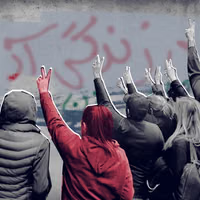
A graffiti in Iran urging citizens to boycott the elections

Masses of student, professional and civil activist groups have called for a boycott of the upcoming presidential election in Iran, slamming the candidates as "known criminals".

A joint statement issued by 12 student organizations criticised the presidential candidates, describing them as "a handful of known criminals against the Iranian people, returning to the scene for the presidency of a government at war with its people."

The signatories labeled the presidential election as a "farce," arguing that the candidates approved by the Guardian Council do not represent the Iranian people. They say that the candidates are "merely tools and mechanisms for appointing another perpetrator of crimes against humanity to the presidency."

The statement further asserted the lack of true choice in the candidates, selected ultimately by the Supreme Leader, Ali Khamanei. "Elections in the Islamic Republic are appointments from among the regime's agents who are committed to maintaining the policies of the Islamic dictatorship based on misogyny, imprisonment, torture, and execution," the groups said.

Six candidates will stand in the snap elections on June 28, after the sudden death of President Ebrahim Raisi in a freak helicopter crash. Only one is from the reformist camp, though even he has been accused with moving closer to Khamenei in a bid to win the seat.

Most Viewed

Ghalibaf defends Iran-US talks amid hardline backlash
1
INSIGHT

Ghalibaf defends Iran-US talks amid hardline backlash

2
INSIGHT

A nation in limbo: 100 days after the massacre, has the world moved on?

3
ANALYSIS

From instability to influence: Pakistan’s pivotal role in US-Iran diplomacy

4
ANALYSIS

100 days on: why Iran’s January protests spread across social classes

5

War-hit homeowners feel abandoned as Iran’s reconstruction aid fades

Banner
Banner

Spotlight

  • War-hit homeowners feel abandoned as Iran’s reconstruction aid fades

    War-hit homeowners feel abandoned as Iran’s reconstruction aid fades

  • 100 days on: the anatomy of Iran’s January crackdown
    INSIGHT

    100 days on: the anatomy of Iran’s January crackdown

  • Ghalibaf defends Iran-US talks amid hardline backlash
    INSIGHT

    Ghalibaf defends Iran-US talks amid hardline backlash

  • 100 days on: why Iran’s January protests spread across social classes
    ANALYSIS

    100 days on: why Iran’s January protests spread across social classes

  • From instability to influence: Pakistan’s pivotal role in US-Iran diplomacy
    ANALYSIS

    From instability to influence: Pakistan’s pivotal role in US-Iran diplomacy

  • A nation in limbo: 100 days after the massacre, has the world moved on?
    INSIGHT

    A nation in limbo: 100 days after the massacre, has the world moved on?

•
•
•

More Stories

Germany Warns of Growing Espionage, Cyber Threats from Iran

Jun 19, 2024, 11:33 GMT+1

German Interior Minister Nancy Faeser warned on Tuesday about the increasing espionage and cyber threats from foreign adversaries, particularly Russia, China, and Iran.

"The threat to our democracy from espionage, sabotage, disinformation, and cyberattacks has reached a new dimension," Faeser stated while presenting an annual report by Germany's domestic intelligence agency in Berlin.

The report also highlighted Iran's intelligence operations in Germany, focusing on surveilling Iranian opposition groups and individuals, especially after the 2022 anti-government protests which shook Iran's government.

The German government also expressed concern over China's cyberattacks, describing espionage aimed at stealing research, commercial, political, and technological information as major objectives of Beijing's operations in the country.

The Russian military intelligence service is also identified as a group that conducted attacks against German political targets, including the Social Democratic Party, in 2023.

In August 2023, the Federal Office for the Protection of the Constitution in Germany reported similar findings, highlighting the "attempts by Islamic Republic hackers to spy on regime opponents" in the country.

The government body named the group "Charming Kitten," affiliated with the Islamic Revolutionary Guard Corps (IRGC), stating that Iranian government hackers create fake identities to target Iranian individuals and organizations active against the regime.

It is the latest state to name Iran as a major domestic threat. Last year, British security services said it was one of the country's biggest foreign threats with multiple plots foiled including assassination and kidnap. Israeli intelligence also revealed last year it had foiled dozens of plots against Jews and Israelis globally, while just last month, Swedish and Israeli intelligence revealed Iran-backed Europe-wide plots continue against targets such as Iranian dissidents and Israeli embassies.

Iran, Taliban Discuss ‘Joint Actions’ Against Israel

Jun 19, 2024, 11:21 GMT+1

Iranian and Taliban officials have discussed potential "joint action" against Israel amid the war in Gaza and chances of a war between the Lebanese Hezbollah and Israel escalating.

During a Monday phone call, Ali Bagheri Kani and Amir Khan Muttaqi, the respective Foreign Ministers of Iran and the Taliban, underscored the imperative of unified Islamic efforts to exert pressure on Israel, particularly through the Organisation of Islamic Cooperation.

Iran's ambassador in Kabul recently declared that "martyrdom" forces from the Taliban would also be dispatched to Gaza, where Iran-backed Hamas is fighting Israel, if necessary. This is while Israeli forces control the borders of the strip.

Despite Iran seeking the Taliban's support in the event of further escalation, Aminullah Habibi, a senior international relations analyst, indicated to Afghan International that while Iran might sway some Afghans, the Taliban as a cohesive entity is unlikely to engage in a war against Israel.

However, Iran has been funding the Taliban to support its fight against the US, as disclosed by former US Defense Department adviser Carter Malkasian, who revealed that since 2012, Iran has given annually funding in the region of $100 million.

The relationship between Iran and the Taliban has been fraught with tension, primarily due to water rights and border security issues. The Helmand River, crucial for Iran’s eastern provinces, has been a major point of contention. Iran accuses Afghanistan of violating the 1973 Helmand River Treaty by restricting the river's flow, impacting agriculture and drinking water. In May last year, late Iranian President Ebrahim Raisi warned the Taliban about disregarding Iran's water rights, but the Taliban dismissed the threat mocking him, leading to heightened tensions and fatal border clashes.
The poorly demarcated Iran-Afghanistan border has also become a hotspot for smuggling, illegal crossings, and skirmishes. The Taliban's resurgence has exacerbated such issues, with frequent incidents of violence and mutual accusations.
Adding to these challenges is the influx of Afghan refugees into Iran following the Taliban's takeover has strained Iran's resources and infrastructure, heightening security concerns.

Since October 7, Iran's proxies in Syria, Yemen, Iraq and Lebanon have been attacking the Jewish state in allegiance with Hamas. On the deadliest single day for Jews since the Holocaust, over 3,000 Hamas forces invaded Israel killing 1,200 mostly civilians and taking another 251 hostage.

Since then, in allegiance with Hamas, Hezbollah has launched over 3,300 projectiles towards Israel with around 200,000 people displaced both on Lebanon's southern border and in Israel's north.

Israeli political and military chiefs have declared that measures are now in place should a war in Lebanon be authorized, as tensions between the two nations are the worst since the second Lebanon war.

Recent warnings from US officials cautioned Israel against a "limited" or "regional" war in Lebanon, highlighting the risk of uncontrollable escalation and potential Iranian intervention.

Iranian Death Row Scientist Reproaches Swedish PM Over Prisoner Swap

Jun 19, 2024, 10:26 GMT+1
•
Niloufar Goudarzi

Ahmadreza Jalali, an Iranian-Swedish scientist currently sentenced to death in Iran, has reproached the Swedish Prime Minister for abandoning him in the recent prisoner exchange with Tehran.

In the voice message from Iran’s notorious Evin prison shared with Iran International, Jalali condemned Ulf Kristersson for deserting him while he faces the imminent threat of execution. "You left me here, helpless. Why not me?" Jalali can be heard saying in the recording.

As part of a prisoner exchange agreement on Saturday, Sweden repatriated a former Iranian official convicted of war crimes in exchange for the release of two Swedish citizens, Johan Floderus and Saeed Azizi, who had been detained in Iran under allegations of 'spying for Israel'.

Jalali described the Swedish government’s decision to exclude him from this deal as "discriminatory" and challenged the Swedish PM to meet his son and family publicly and explain why he was left behind and what would be done for them in the event of his execution.

The release of Hamid Nouri, alongside leaving Jalali behind, has ignited widespread backlash and public protests. Following the news on Saturday, Iranians in Sweden, including Jalali's wife Vida Mehrannia, gathered outside the foreign ministry in Stockholm to express their indignation.

On Tuesday, Amnesty International criticized the Swedish government, urging them to "act swiftly to protect Ahmadreza Jalali’s rights, including his right to life." Jalali was sentenced to death in October 2017 on charges of “corruption on earth” after a trial before Branch 15 of the Revolutionary Court in Tehran, which was marred by reliance on torture-tainted confessions.

Amnesty International also condemned the release of Hamid Nouri, describing it as a “stunning blow to survivors and relatives of victims” of the 1988 prison massacre in Iran, Nouri sentenced to life imprisonment by a Swedish court in 2022 for crimes against humanity related to his involvement in the mass executions of prisoners in the 1980s in Iran.

His arrest in Sweden was in accordance with the principle of universal justice, and his trial and subsequent conviction were considered significant steps for international justice. However, his release has been widely condemned.

Political activist Lawdan Bazargan criticized the Swedish government's actions as "dangerous" with "far-reaching consequences", reinforcing Iran's policy of diplomatic hostage taking which has seen unknown numbers of dual nationals imprisoned in Iran.

Last year, five American-Iranians were released in return for the freeing up of $6 billion of frozen Iranian funds in Iran, which was also slammed by rights organizations for supporting Iran's blatant hostage taking agenda.

Nobel Laureate Narges Mohammadi Sentenced to Additional Year in Prison

Jun 19, 2024, 09:56 GMT+1

Human rights activist and Nobel Peace Prize laureate Narges Mohammadi has been handed another year in prison on charges of "propaganda against the system" as she continues to fight the government from behind bars.

On Tuesday, Mohammadi's lawyer, Mostafa Nili, revealed on the social network X that her conviction stemmed from her remarks shared from Evin Prison about sexual harassment of journalist Dina Ghalibaf, her open letter advocating the boycott of parliamentary elections, and her correspondence with the parliaments of Sweden and Norway.

Mohammadi's court session, held on June 8, was conducted in secret and without her presence in spite of her public appeal on May 18 for an open trial.

In a December message to the Norwegian Parliament, Mohammadi urged the world to support the "Women, Life, Freedom" movement and cease being mere spectators.

In March, she branded the Islamic Republic's parliamentary and Assembly of Experts elections a sham, calling on Iranians to boycott what she described as the "staged elections of the despotic religious regime".

On October 6, Mohammadi was awarded the Nobel Peace Prize, becoming the second Iranian to receive the honor after Shirin Ebadi in 2003.

Amnesty Joins Afghan and Iranian Women Against Gender Apartheid

Jun 19, 2024, 08:56 GMT+1
•
Niloufar Goudarzi

Rights group Amnesty International has joined an Afghan and Iranian women's gender apartheid campaign amid continued nationwide oppression in the two Islamic regimes.

The group says it aims to strengthen efforts against “institutionalized regimes of systematic oppression and domination imposed on the grounds of gender.”

Agnès Callamard, Amnesty International’s Secretary General, said on Tuesday.“Generations upon generations of women and girls, the world over, have been subjected to institutionalized and systematic violence, domination and oppression. Incalculable numbers have been killed, with many more denied dignity, freedom, and equality in their daily lives."

The concept of gender apartheid emerged from Afghan women's human rights defenders and allies in response to the Taliban's suppression of women's rights in the 1990s.

The impact of the Iranian movement joining the campaign was especially pronounced after Iranian women protested against compulsory hijab laws which have seen brutal crackdowns by morality police, including the deaths of women including Mahsa Amini. Her death in September 2022 led to months-long nationwide demonstrations during which time, over 550 protesters were killed, including many minors.

Now, Afghan and Iranian activists have joined forces to elevate gender apartheid to a recognized crime comparable to racial apartheid.

Women such as Iranian-American dissident activist Masih Alinejad, have played a pivotal role in amplifying and broadening the campaign's reach.She has been the subject of multiple assassination attempts abroad by the regime as it continues to target dissidents both at home and on foreign soil.

“The hijab became a tool in the hands of the Islamic Republic to control the whole society through women. The mullahs are writing their ideologies on our bodies,” Alinejad told American philosopher Sam Harris in his podcast episode titled Gender Apartheid and the Future of Iran.

In 2021, the US Department of Justice pressed conspiracy charges against Iranian agents for their foiled attempt to abduct Alinejad in New York and transport her to Iran. Subsequently, in 2023, additional charges were filed by the Justice Department regarding a murder-for-hire plot orchestrated by the Iranian regime targeting her.

In 2023, TIME named Alinejad one of the Women of the Year, and she was elected President of the World Liberty Congress.

"In the 21st century, gender apartheid remains absent from international legal frameworks," remarked Alinejad at the Copenhagen Democracy Summit last month. "Women from Afghanistan and Iran implore world leaders to expand the definition of apartheid to encompass gender discrimination."

According to the 2023 Global Gender Gap Report by the Global Economic Forum, Iran ranks 143rd among 146 countries regarding gender equality.

"The bottom of both regional and global rankings feature Pakistan, Iran, and Afghanistan," noted the report.