In the early hours of Saturday, five Iranians convicted of drug-related offenses were hanged at Urmia Central Prison, northwest of Iran, as authorities have significantly accelerated executions.
•
Hengaw Human Rights Organization, a Kurdish rights group, says the executed prisoners were identified as Parvin Mousavi, 50; Mansour Naseri, 45; Parviz Ghasemi, 35; Yousef Saeidi Chehreh, 32; and Ramin Lavandi, 27.
The prisoners had been jailed for four to five years, separately accused of involvement in drug trafficking.
Parvin Mousavi, who developed cancer while imprisoned, was the ninth woman executed in Iranian prisons since the start of the year amid a rising wave of execution.
The execution day was marked by protests from fellow prisoners during Mousavi’s transfer to solitary confinement, leading to altercations with prison guards.
Sareh Sedighi Hamedani, a former fellow inmate, spoke to Voice of America, asserting Mousavi’s innocence and questioning the fairness of the trial that saw a co-defendant acquitted despite a criminal record.
Amnesty International has highlighted a significant uptick in executions related to drug offenses in its latest report, stating that over half of the 853 death sentences issued in Iran in 2023 were for drug-related crimes. This marks a return to stringent anti-drug measures, a contrast to the relatively lower rates of execution for such offenses recorded between 2018 and 2020.
The organization's report titled "Don't Let Them Kill Us" calls for urgent international intervention to halt the surge in executions, which it describes as transforming Iranian prisons into grounds for mass executions. The report also warns against the disproportionately impact of such policies on impoverished and marginalized communities, urging a reconsideration of the approach to drug-related offenses.
In his November 2023 address to the United Nations General Assembly, UN Secretary-General Antonio Guterres highlighted the “alarming” rise in executions in Iran. The concern was widely shared both within and outside Iran, prompting calls for the Iranian government to halt the "state killings," and sparking numerous global protests.
In February, Iran’s Supreme Leader Ali Khamenei responded to the global condemnation by minimizing it as "some noise," and categorizing the executed individuals as "criminals." He further exploited the Gaza war between Israel and Hamas to criticize Western reactions. "Those in the West who protest the execution of a criminal turn a blind eye to the killing of 30,000 people in Gaza," he stated.
Biden administration officials held indirect talks with representatives of the Iranian government in Oman this week, to discuss regional issues, Axios reported on Friday.
According to the report, talks focused on how to reduce the likelihood of more military clashes in the region. Since the Hamas attack on Israel in October, Iranian backed proxies have launched nearly 200 attacks against US forces in the region.
Israel in turn has attacked a multitude of Iranian targets, including a strike on its diplomatic compound in Damascus on April 1. In that attack two Revolutionary Guard generals and five other officers were killed. Iran retaliated on April 13 by launching more than 300 drones and missiles at Israel, most of which were intercepted by Israeli air defense and allies air forces.
Two sources told Axios that President Joe Biden’s top Middle East adviser, Brett McGurk, and Abram Paley the acting US envoy for Iran arrived in Oman on Tuesday and held talks with unidentified Iranian envoys. In addition to discussing regional tensions, the two sides also discussed Iran’s escalating nuclear program, according to the report. In recent weeks Iranian officials have threatened to opt for producing atomic weapons.
They had held similar talks with Iranian officials in January. At the time, tensions were rising between Israel and Iran and Tehran-backed Yemeni Houthi forces were attacking international commercial shipping in the Red Sea.
The Biden administration has amended federal regulations to exempt internet communications services from Iran sanctions, allowing Iranians to access certain American software, hardware and services.
The existing ‘sanctions waiver’ was granted by the US Treasury in September 2022, as thousands across Iran took to the streets following the death in custody of the 22-year old Mahsa Amini, who had been detained for improper hijab.
On Friday, that waiver was codified and entered federal regulations, according to a notice published on the Federal Register. The new rule incorporates “a general license relating to the export, reexport, and provision of certain services, software, and hardware incident to communications over the internet,” the official summary of the document reads.
This would be good news for many Iranians, activists, in particular, who for many years have been stuck between a rock and a hard place –with US sanctions often aggravating the agony of internet users struggling to find a way around the regime’s censorship.
“This should give compliance teams at big tech companies more assurances to finally open up services such as Google Cloud Platform for hosting circumvention tools for Iran,” Mahsa Alimardani, an Internet researcher at Oxford University, posted on X.
Tech giants such as Google and Amazon are known to have been restricting the use of their cloud services and platforms for hosting tools that could help users in Iran to circumvent the government's draconian Internet censorship.
Advocates of free Internet, as well as technologists who want to provide circumvention tools to Iranian users, have criticized ‘blind’ US sanctions that they say harm ordinary people more than they deny technology to the sanctioned government. They now hope that the ‘waiver’ being codified into federal regulations would pave the way for the tech companies to provide services to Iranians that they until now refused.
“This codification is a reminder to technology companies that they bear the responsibility to ensure their platforms remain accessible to Iranian civil society in the face of the Islamic Republic’s digital repression,” freedom of expression campaigners Article 19 said in a statementpublished on their website.
US administrations –at least since the 2009 protests in Iran– have consistently underlined the importance of keeping ordinary Iranians ‘connected’ to the outside world. In recent years, the US Treasury has issued several licenses to exempt certain internet communications services from its Iran sanctions.
It remains to be seen whether the latest move –and the codification of the exemptions– is enough to convince tech companies to offer their service to Iranians inside Iran.
In 2022, amid the most widespread protests in the 45-year history of the Islamic Republic, Tesla CEO, Elon Musk, was asked if he’d make Starlink internet services available to the people of Iran. In response, he said his company would apply for an exemption from the US treasury –which in turn exempted some satellite internet equipment from sanctions.
In December 2022, the Wall Street Journal reported that Starlink equipment was being smuggled into Iran. Roughly the same time, Google announced that it was working to create secure internet access for Iranians inside of Iran.
Former President Hassan Rouhani’s chief of staff claims that the IRGC concealed the truth about the downing of Flight PS752 from Rouhani for three days, while authorities attributed the crash to technical issues.
According to Mahmoud Vaezi, Rouhani insisted on immediately issuing a statement to admit the truth when he found out. “I want to say Rouhani persevered when he found out,” Vaezi said in an interview an excerpt of which was published by the reformist Etemad newspaper this week.
The IRGC shot down the Ukrainian airliner shortly after it took off from Imam Khomeini International Airport near the capital Tehran on January 8, 2020. All 176 people onboard the plane were killed in the incident.
Vaezi claims Rouhani became aware of the possibility of the IRGC's responsibility after some US media outlets, officials, and Canadian Prime Minister Justin Trudeau, whose country lost 63 citizens in the crash, asserted that the plane had been downed.
The full-length interview, which must have been conducted at least two months ago, was published in Etemad Yearbook in March, which was not accessible abroad. The excerpt which sheds light on some of the events never spoken of in such detail before is solely related to the downing of the Ukrainian flight.
Vaezi claims these events took place before the IRGC admitted it had shot down the plane and that the authorities who were hiding the facts from Rouhani and his government insisted that Foreign Minister Mohammad-Javad Zarif should do an interview, presumably to reiterate what he had been told, but he refused unless he was made aware of the facts.
The downing of the plane by two surface-to-air defense missiles, came a few hours after Iran fired more than a dozen missiles at two Iraqi bases hosting US and coalition troops. The attack was in retaliation for a US drone strike that had killed the commander of the IRGC’s extraterritorial Qods force, Qasem Soleimani, and nine others in Baghdad just five days earlier.
Iran’s Armed Forces admitted they had shot down the Ukrainian airliner on January 11 but claimed the air defense had mistaken the plane for a hostile target heading toward a sensitive IRGC base. Amir-Ali Hajizadeh, the chief of IRGC air operations responsible for airspace security, attributed the downing of the airliner to “human error” of the air defense. The IRGC also alleged that the “risky behavior” of the United States had caused the incident.
Despite expecting retaliation from the US, the IRGC which is responsible for air defense of the capital did not close the civilian airspace in the early morning hours of January 8.
Many Iranians including some victims’ families have always maintained that the IRGC used the airliner as a “human shield” to prevent possible US retaliation for its missile attacks.
Apparently referring to remarks made by IRGC officials, Dr Mohsen Asadi-Lari, a former high-ranking health ministry official who lost both his children in the tragic downing of the plane, said in an interview in 2022 that officials had admitted the downing of the plane was meant to evade war with the US.
"They say a difficult war would happen the next day if the plane was not downed. The US would have attacked, and ten million lives would be in danger," he said.
The Iranian government to this day has not allowed an independent investigation and insists that the incident resulted from human error by a missile operator.
While hardliner factions in Iran's new parliament are vying for the Speakership, an aide to former President Mahmoud Ahmadinejad claims this competition is not the main event in Iran's political landscape.
Ghalibaf withdrew from the presidential race twice, in 2017 and 2021, in favor of Raisi. In 2017, he stepped aside to give Raisi the upper hand among conservatives, although Raisi ultimately lost to Hassan Rouhani. In 2021, Ghalibaf did not enter the race, knowing, like everyone else in Iran, that Raisi, as Khamenei's chosen candidate, was going to win.
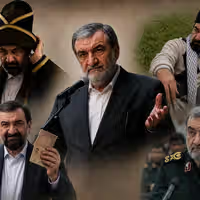
Meanwhile, as reported by the Rouydad24 website in Tehran, several conservative "gangs" have been making incriminating disclosures against each other over the past week. The group named Masaf (Battle), led by regime propagandist Ali Akbar Raefipour, has been more prominent in the corridors of power in Iran than any other group.
According to Rouydad24, until mid-2021, Masaf was known primarily as a cultural group that focused on discussions about the re-emergence of the Shiites' hidden Imam from occultation, as well as debates about Bahaism and Judaism. These discussions were not significant enough to be considered political. However, after the presidential election, Masaf has become known as a political propaganda group due to its serious confrontations with Majles Speaker Ghalibaf.
Masaf controversial politician Raefipour
Subsequently several social media influencers and conservative media outlets started a fierce campaign against Masaf, which is now fighting other conservative factions rather than fighting Israel and the West as it has been always claiming, the website wrote.
In the March 1parliamentary election, a coalition known as the Coalition Council of Revolutionary Forces (Persian acronym SHANA) led by Ghalibaf and his predecessor Gholam Ali Haddad Adel, and another group called the Popular Coalition of Revolutionary Forces (Persian acronym AMNA) led by Roads and Urban Planning Minister Mehrdad Bazrpash and ultraconservative figure Hamid Rasai were the main players. The latter coalition that previously supported Ahmadinejad, chose to Support the Raisi Administration in this election.
Masaf formed a third group named Iran Morning Front with a list that shared more than 70 percent of its candidates with AMNA. Masaf shared only one candidate with SHANA, so it was clearly an ally of the pro-Raisi coalition. While Masaf claims 50 of the candidates it introduced have won the election, other groups say that many of those 50 candidates were also on the other two groups' lists.
After the election, several disclosures were made about Masaf's financial record. Their rivals said that tens of billions of rials were deposited from unidentified sources into the accounts of Raefipour's inner circles including some of his family members. One of these happened to be Raefipour's three-years-old son!
Counteraccusations were made against Ghalibaf and his family. In the meantime, while Ghalibaf's supporters claim that Khamenei backs him as the next Speaker of the Majles, Rasai wrote in his newspaper that Iranians want a new Speaker. Apart from that, the Raisi administration has introduced a new vice president for parliamentary affairs, showing its interest in playing an active role in the election to determine the new Speaker.
In another development, shedding light on the fierce competition among various conservative groups who claim to have won the election, the incumbent MP from Marvadasht Jalil Rashidi Koochi says the disclosures and mudslinging that is going on among various conservative groups is a war of words for power.
However, he criticized all conservative groups for their ruthless attacks on each other. Koochi likened the latest election in Iran to a competition within a single group, as all candidates came from the same camp while their political rivals were barred from running. He also accused the conservatives of using illegitimate access to intelligence to attack their opponents.
Iranian authorities arrested over 260 people, including three Europeans, at what authorities called a "Satanist" gathering near Tehran on Friday, the semi-official Tasnim News Agency reported.
The report stated that 146 men and 115 women were arrested, and authorities seized alcohol, banned under the Islamic Republic’s laws, along with psychedelic drugs.
Those detained had “signs and symbols of satanism on their clothes, head, face, and hair,” according to Tasnim which is linked to the Islamic Revolutionary Guards (IRGC).
The media outlet also published photographs showing masks, model skulls, and T-shirts depicting skulls. The report did not specify the nationality of the Europeans, and there is no independent confirmation of the nature of the gathering raided by the police.
The raid comes amid a nationwide crackdownby Iranian authorities on women accused of violating the strict Islamic dress code.
Across Iran, there have been increasing reports of young people being detained for participating in "mixed parties" and refusing to wear hijabs.
As the regime’s “morality police” intensify their operations, many detainees are being whipped with lashes as punishment.