Iran's Economy Under Raisi Can Only Produce Corruption, Say Observers

In recent days, politicians and academics in Iran have continued to highlight inefficiency, mismanagement, and negligence in President Ebrahim Raisi's government.
In recent days, politicians and academics in Iran have continued to highlight inefficiency, mismanagement, and negligence in President Ebrahim Raisi's government.
Some politicians, such as pro-Ahmadinejad lawmaker Ahmad Alirezabeigi who cannot believe the scale of chaos in the Raisi administration, are adamant that there are infiltrators in the administration who sabotage government's initiatives.
Others see the root of the problem in the government itself. Iranian academic Taghi Azad Armaki, a professor of sociology at the University of Tehran has been quoted by Iran International television as saying: "A government that came to power based on an ideological discourse, has no understanding of problems in the society."
Armaki also highlighted recurring news of corruption schemes. "When we ask government officials about embezzlements, they say this is done by the enemies. When we ask why the Iranian rial is falling, they promise to boost it but they do not know how."
Elsewhere in social media, Armaki said, "We are facing a weak government that is standing against a powerful nation. A large part of the government's weakness is the outcome of the inefficiency of its bureaucracy. The nation no longer trusts the government. No one in the government pays any attention to what Raisi says, although the people generally do not care what Raisi or his men in the government say."
Iran’s short-term economic outlook is bleak, according to some insiders and critics in Iran who, by and large, are allowed to comment publicly. Inflation, which stands at around 50 percent is expected to rise as the national currency has depreciated further since January.
Among regime figures, former Vice President Es'haq Jahangiri said last week that "We can hear the sound of the people's bones breaking," he remarked, emphasizing the severity of shortages. "The government must heed the people's voices and address their grievances," he added.
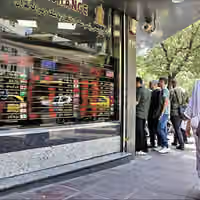
Sodayf Badri, a lawmaker from Ardabil told Etemad website that "There is chaos in the forex market. The Central Bank tells businesses that that it does not have any foreign currency to allocate to the importing of raw material.”
Meanwhile, ‘reformist’ politician Mahmoud Mirlohi told Khabar Online website: "Raisi has failed to stand by his promise to fight financial corruption in the government." He further charged that Raisi cannot name even two economic experts in his government.
Mirlohi highlighted the heavily politicized nature of Iran's economy, stressing that its problems are intrinsically linked to the unresolved foreign policy issues surrounding its nuclear program and the nuclear deal with world powers. He emphasized the interconnectedness of global events and Iran's economic situation, stating that "developments worldwide inevitably impact Iran's economy."
Over the past three years, many observers have criticized the weaknesses in Raisi's economic team and called for a cabinet reshuffle to address the issue. However, Raisi largely disregarded these concerns and repeatedly asserted that the country's economy was on a path to growth.
Mirlohi pointed out that “Raisi lacks both an economic plan and a coherent economic theory. Despite claiming to have a 7000-page economic plan during his 2021 presidential campaign, no one has seen even seven pages.”
Regarding Raisi's pledge to build four million houses in four years, Mirlohi expressed skepticism, stating that it is highly improbable for the administration to achieve even one million houses within the specified timeframe. He emphasized that based on Raisi's track record over the past three years, Iran's economy will continue to rely on government control, oil revenues, and concessions. Mirlohi highlighted the inherent issues with such an economy, asserting that it breeds corruption and impedes genuine progress.