Canada Sanctions Iranian Officials Over Women’s Repression

The Canadian government announced on Friday that it would be imposing new sanctions on two Iranian individuals accused of participating in the repression of women.

The Canadian government announced on Friday that it would be imposing new sanctions on two Iranian individuals accused of participating in the repression of women.
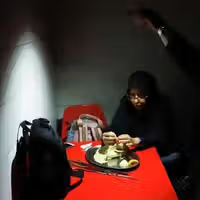
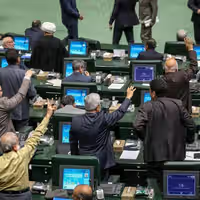
Foreign Affairs Minister Melanie Joly made the announcement on the International Women's Day, targeting Masoud Dorosti, the chief executive of Tehran's metro system, and Zohreh Elahian, a conservative parliamentarian.
Dorosti is responsible for enforcing Iran's mandatory hijab law on public transit, and Elahian, a vocal supporter of measures including the death penalty for protesters, have been accused of leveraging their positions to enforce increasingly repressive measures against women and girls in Iran.
“These two individuals have used their positions of influence to call for or carry out increasingly repressive measures against women and girls in Iran,” Joly’s office said.
The move marks Canada's latest effort to respond to the death of 22-year-old Mahsa Amini in 2022, who died in police custody after allegedly being arrested for incorrectly wearing her hijab and the subsequent bloody repression of protests in Iran.
So far, Canada has sanctioned 155 individuals and 87 entities connected to human rights abuses in Iran. Those on the sanctions list are barred from entering Canada and conducting business with Canadians.
The Iranian regime continues its policies of punishing women for removal of hijab. Aziz Jafari, former commander of the Islamic Revolutionary Guard Corps, announced this week that the government will undertake new measures against hijabless women.
Addressing hijab enforcer agents on Friday, he said, "I regret not being able to accompany you on the field due to physical limitations. The removal of hijab is a major cultural problem for us that can strike at the root of the revolution."

Peruvian officials say an Iranian man arrested for planning to kill an Israeli citizen is a member of IRGC's Quds Force, signaling Tehran's terror activities in the Western hemisphere.
Ever since Hamas’ rampage of Israel on 7 October and the ensuing Israeli onslaught on Gaza, Iran has intensified its indirect campaign against American and Israeli interests, utilizing armed groups that it funds, equips, and trains across the Middle East.
But to attempt an assassination in Peru, in South America, suggests a different level of brazenness on Iran’s part and an almost complete absence of US deterrence.
Majid Azizi was arrested earlier this week for allegedly plotting with a Peruvian national to attack an Israeli citizen at the Asia-Pacific Economic Cooperation (APEC), scheduled to be held later this year in Peru. A third individual is reportedly on the run, according to a police statement.
"We had to act quickly because today [Majid Azizi] was set to return to Iran after forming a terrorist cell to wipe out an Israeli national" who was going to participate in the APEC event, Peru's police chief Oscar Arriola said.
Azizi, 56, holds Peruvian citizenship by marriage and has had regular trips to the country for many years, the last of which was in ‘early March’, allegedly to set up the assassination plan and leave. He is now under investigation for “terrorism against the state,” according to Peru’s ministry of interior.
Peruvian authorities have identified the Israeli citizen who was to be targeted but have not revealed their identity for security reasons.
This is the second time in the last decade that Iran has attempted an attack on Israelis in Peru. In 2014, a Hezbollah operative called Mohammed Amadar was arrested in Lima on suspicion of plotting against Israeli and Jewish targets. Later, the police found explosives and detonators in the Lebanese residence.
This time, however, the alleged plotter is not Lebanese but Iranian. And the authorities in Peru say he is a member of IRGC’s Quds Force. If true, the arrest could mark a significant moment as there’s no proxy ‘cover’ to help deny culpability for the regime in Tehran.
The revelation may not be significant enough to sway those who oppose the designation of IRGC as a terrorist organization in many European and other democratic countries. It may weaken their opposition, however, especially if more information emerges and the Quds Force connection is proven beyond doubt.
The Quds Force, the overseas arm of Iran’s Revolutionary Guards, is widely believed to be behind most attacks against the United States and its allies across the Middle East, from Hezbollah in Lebanon to the Houthis in Yemen and an array of armed groups in Iraq and Syria –all visibly emboldened in the past few years, and since October 7th, in particular.
Critics of President Joe Biden lay this issue squarely at his door. Biden and his team, they say, have eroded deterrence by their unwillingness to confront Iran and impose “costs” on the regime for all the ‘malign activities’ in the region that they admit comes out of Tehran.
“It is indisputable that Tehran controls its proxies, and those proxies have killed Americans,” Senator Roger Wicker (R-MISS) said in a Senate Armed Service Committee hearing Friday. “Iran's objective is and has always been to evict the United States from the Middle East so it can achieve regional hegemony.”
The hearing, titled Posture of US Central Command and US Africa Command in Review of the Defense Authorization Request for Fiscal Year 2025 and the Future Years, saw many senators denouncing the Biden administration for its Iran policy.
“President Biden ordered minor counter strikes on Iran's proxies in Syria, Iraq, and Yemen,” Wicker continued. “This approach has failed and will fail because it assumes that we can deter terrorist groups without causing pain to their chief sponsor, Iran.”
A key witness at the hearing was General Michael Kurilla, Commander of the US Central Command, who refrained from any criticism of the administration while offering a clear picture of the situation with Iran.
“Iran is undeterred in support to the Houthi,” he said, “they are undeterred in their support to Hezbollah, their support to Hamas, the support into the West Bank. They are deterred right now in Iraq and Syria and their support to the Iranian aligned militia groups, but not in terms of attacks, but not necessarily in terms of their funding and equipping.”

Iran has strongly condemned a recent report by a UN fact-finding mission which had said that the regime’s crackdown on 2022 protests amounted to crimes against humanity.
“The unfounded allegations in this report are based on false and biased information and thus lack legal standing,” claimed Iran’s Foreign Ministry Spokesman Nasser Kanaani on Saturday.
He accused the United States, Israel and some Western countries of “preparing” the mission’s report, adding that they try “to continue the project of Iranophobia and Iran’s defamation.”
The UN’s human rights mechanisms have turned into a plaything to fulfill the nefarious and illegal goals of these countries, Kanaani claimed.
The Fact-Finding Mission (FFM) was established by the United Nations’ Human Rights Council in November 2022, two months after the Woman, Life, Freedom protests swept Iran in response to the death in morality-police custody of 22-year-old Mahsa Amini.
The mission published its first report on Friday after 18 months of investigations with help from experts, witnesses and victims. The FFM concluded that the Iranian regime is responsible for the “physical violence” that led to the death of Amini.
“Credible figures suggest that as many as 551 protesters were killed by the security forces, among them at least 49 women and 68 children. Most deaths were caused by firearms, including assault rifles,” the report said, adding, “The Mission found cases of women and girls subjected to rape and other forms of sexual and gender-based violence, including gang rape, rape with an object, electrocution of genitalia, forced nudity and groping.”

On the occasion of the International Women's Day, protests were held in several cities including in Germany, the UK, and Sweden in solidarity with Iranian women.
The demonstrations in London and Stockholm were held outside parliaments, with the protesters demanding that these counties hold Iran accountable for its human rights violations.
Designating Iran’s Revolutionary Guards as a terrorist organization was the key demand in the gatherings. The IRGC is the main force for the crackdown on dissent by the Islamic Republic.
The demonstrators said that the IRGC has not only suppressed women during the 2022 uprising – ignited by the death in custody of Mahsa Amini, but also put them under pressure, imprisoned them, and killed them over the past four decades for pursuing their basic rights.
In Gothenburg, another Swedish city, Iranians gathered to support women in Iran and to call for the overthrow of the Islamic Republic.
The protesters carried pictures of political prisoners such as Nasrin Sotoudeh and Narges Mohammadi, as well as pictures of some of those killed in the uprising.
In London, a group of Iranian women staged a silent protest in front of the parliament, wearing red dresses similar to the characters of the TV series "The Handmaid's Tale". The Handmaid's Tale is a series set in a dystopian New England, in which an authoritarian, totalitarian, religious and anti-women government as overthrown the United States government and victimizes its citizens, especially women.
The protesters outside the British Parliament told Iran International that Iranian women are the real victims of a religious and oppressive government as they grapple with the consequences of a gender apartheid, highlighting the similarities between the series and the real lives of women in Iran.

A recent report by an Iranian rights group contends that authorities treated the Woman, Life, Freedom protests of 2022-2023 as an "armed conflict," categorizing the demonstrators as combatants.
Consequently, they deployed military units specialized in combating armed groups, alongside security forces armed with military-grade weapons, authorized to use lethal force, torture, and terrorize civilians to suppress the uprising, stated Omid Shams, a lawyer and director at Justice for Iran, in an interview with Iran International.
Shams also noted that authorities deployed tanks and armored vehicles in several provinces. His organization identified at least twenty military units from the Revolutionary Guards (IRGC), the IRGC’s Basij militia force, and the police, along with 526 individuals directly involved in severe crimes against protesters.
The report highlights recurring suppression tactics, including the deliberate and indiscriminate firing on protesters, bystanders, and those documenting the attacks, reminiscent of previous protests such as those in 2019.

The protests erupted when Iran’s ‘hijab police’ arrested Mahsa Amini, a 22-year-old woman in the street for improper attire and hours later she was transferred to hospital with severe head injuries and died three days later. Months of protests that followed represented the most serious challenge to the Islamic Republic since its inception in 1979. Iranian authorities had used brutal force against protesters in the past also, the worst being in November 2019, when they killed at least 1,500 people in the streets.
Justice for Iran, a London-based non-governmental organization (NGO), focuses on human rights abuses in Iran. It maintains a database of political prisoners in Iran (The Atlas of Iranian Prisons) and organized the Iran Atrocities tribunal in London to mark the first anniversary of the November 2019 protests.
The organization's new 250-page report, titled "Waging War on Civilians: Exposing Iran's Repressive Units and Crimes Against Humanity," offers a comprehensive overview of the command structure responsible for the protester massacre, the forces involved, and the weaponry used.
During the Woman, Life, Freedom protests, which began in mid-September following Amini’s death, security forces reportedly targeted passing cars, public transport, residential and commercial buildings, medical centers, and hospitals, instilling fear among citizens.
Many protesters were systematically targeted in the face, resulting in numerous cases of blindness. Iran Human Rights (IHR) reported in September 2023 that women comprised 9 percent of slain protesters and 28% of those who suffered eye injuries.
Justice for Iran employed various methodologies, including open-source intelligence, expert interviews, and an in-depth analysis of visual evidence from its archive database of 35,000 videos, to assess the government's actions during the 2022-23 protests and identify serious human rights violations.
Based on its findings, the report argues that authorities treated the protests as an armed conflict, labeling protesters as combatants and deploying military units and security forces authorized to use lethal force, torture, and terrorize civilians.
In April 2022, Iran's Supreme Leader, Ali Khamenei, called for a robust response to criticism and attacks against the Islamic Republic, advocating for the use of "hybrid warfare" to counter various forms of aggression.
Justice for Iran has shared its findings with relevant international rights organizations, including the United Nations Fact Finding Mission on Iran, established in December 2022 after the brutal crackdown on protesters. The mission is set to release a preliminary report on March 8 and a comprehensive report on March 18.

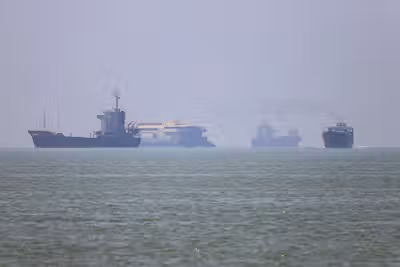
Amid Iran-backed Houthi attacks on vessels in the Red Sea, the head of the US military's Central Command says Tehran is escaping accountability for its nefarious activities across the Middle East.
“Iran is not paying a cost,” CENTCOM Commander Gen. Erik Kurilla told the Senate Armed Services Committee on Thursday.
Repeated retaliatory strikes by US and UK forces – meant to limit the capacities of the Houthis to target ships – have so far failed to deter the militant group from hitting one of the world's busiest trade lanes.
This week alone, a Houthi missile attack killed three civilian seafarers on a merchant ship, marking the first deaths caused by the group's attacks on merchant vessels.
The Iranian regime-backed group started attacking ships in the Red Sea in November in what they say is a campaign in solidarity with Palestinians during the war in Gaza.
CENTCOM needs POTUS approval to sink Iranian ships
Republican Senator Sullivan questioned Gen. Kurilla on why the US hasn't escalated its response to these attacks by targeting Iranian spy ships, which provide intelligence used to harm American sailors.
The CENTCOM Chief maintained he is not authorized to take action against Iranian naval vessels – without permission from POTUS to do so.
In response to largely Democratic lawmakers raising the alarm of a confrontation with Iran and the risk of “escalation”, parallels were drawn several times to Operation Praying Mantis.
That military operation on April 18, 1988, saw the US retaliate for the Iranian mining of the Persian Gulf during the Iran-Iraq War.
Republican lawmakers insisted that the US was able to destroy Iran’s naval capacity with that operation, without risking a wider war.
While Democratic Senator Jack Reed expressed optimism regarding a temporary pause in Iran-backed attacks against US forces in Iraq and Syria, Gen. Kurilla maintained several times that Iran continues to be undeterred in its support to the Houthis, Hezbollah, Hamas, and factions in the West Bank.
Despite these concerns, forceful words on Iran were notably absent from President Joe Biden’s State of the Union speech on Thursday night.
For numerous analysts, this mirrors the absence of a coherent US policy aimed at deterring Tehran from its malicious activities throughout the Middle East.
Former CENTCOM Chiefs critical of US approach
But, Republicans aren’t the only critics of the current strategy to contain Iran’s proxy attacks.
Several high-ranking former senior armed forces officials have gone on record with their criticism for the lack of accountability the regime in Tehran faces.
Retired Vice Adm. John Miller, who oversaw all US naval activities in the Middle East until 2022, told POLITICO that his country is “not taking this seriously” and “not deterring anybody right now”.
Ret. Gen. Frank McKenzie, who commanded US forces in the Middle East during both the Trump and Biden administrations, also told the same news outlet recently, that Iran perceives the absence of a robust US military reaction to the recent Houthi attacks as encouragement to persist in its aggressive actions.
“We’ve given them no reason not to continue [attacking],” he said of the Houthis.
In an interview with Breaking Defense, Gen. Joseph Votel voiced his view that problems started when the US administration under President Barack Obama decided to “pivot” to Asia and reduced its involvement in the Middle East region.
The former US Central Command chief said that the administration focused only on brokering an agreement on the Iranian nuclear program, which neglected the growing threat of its proxy groups in the region.
Meanwhile, the leader of Yemen’s Houthi militia seemingly bragged about his group’s missile striking capabilities in a televised speech on Thursday.
“In [Wednesday’s] strike, there was amazement at the precision of the attack and the power of damage,” Abdul Malik Al-Houthi said.
“Discovering ships and hitting them with such precision using ballistic missiles for the first time is an achievement in every sense of the word”, he said.